
Fractional CFO Tech Stack: The Layers That Matter
A practical fractional CFO tech stack, layer by layer: ledger, banking, close, forecasting, reporting, AI, and the investor-facing layer for client raises.
November 13, 2026 · 13 min read

A fractional CFO tech stack is a short chain of tools, built in order: the client’s ledger first, then banking and billing, close and reconciliation, the forecast model, reporting, and finally the layer that faces investors. Get the order right and you can serve more clients with fewer unbilled hours. Get it wrong and you spend every close fighting your own software. If your clients are raising pre-seed or seed money, the stack also needs a place where their pitch deck is shared and read, and that is the layer most guides skip. BabyLoveRaise fills it with a hosted raise room that shows which investors opened a deck and which slides they read.
BabyLoveRaiseAdd an Investor Layer to Your StackGive each client a hosted raise room to share pitch decks and see which investors open them and which slides hold attention.VisitTL;DR
- Build in sequence: stabilize the ledger, then add banking, close, forecasting and reporting. Sequencing matters more than brand selection.
- Under roughly $20 million in revenue, QuickBooks Online or Xero usually carries the accounting core. NetSuite or Sage Intacct enter with multi-entity or inventory complexity.
- Standardize before you automate: one chart of accounts template, one close checklist, one set of KPI definitions across every client.
- Keep client-owned systems (ledger, bank, payroll, credentials) separate from your own reusable method, so you can leave cleanly.
- For clients in a raise, add an investor layer: one deck link per client, with first-read alerts and per-slide engagement.
Table of Contents
- Who this stack is for, and what it must do
- The layers, in the order to build them
- Match the stack to the stage
- The layer that gets skipped: investor-facing materials
- Account ownership and data portability
- Using AI without exposing client data
- What the stack costs, and what clients pay you
- A one-page setup checklist
- Perspective
- Run the investor layer with the raise room
- FAQ
- Sources
Who this stack is for, and what it must do
This guide is written for fractional CFOs, boutique advisory firms, accelerators and the founders who hire them. A fractional CFO runs finance for several companies at once, usually part-time. That means the stack is not just a set of tools for one company. It is a production line repeated across a book of clients.
That changes how you judge a tool. One practitioner’s framing is that the total across a book of clients matters more than any single tool, because every app you stitch together adds unbilled admin hours. The question is not which ledger has the prettiest reports. It is how many hours per client per month the close takes, since that number largely decides how many clients one advisor can handle.
The same source prices a traditional multi-tool setup at $275 to $980 per client per month plus 4 to 8 unbilled hours, against a consolidated platform at $1,000 flat. Treat those as the vendor’s own figures for its comparison, and run your own numbers. The useful part is the method: count tool cost and your hours together.
The layers, in the order to build them
Guides disagree on whether there are five layers or six, but they agree on the order. One 2026 guide describes five layers: accounting and bookkeeping, data and integration, forecasting and modeling, reporting and dashboards, and practice management. Its view is that the first two are non-negotiable, the third is where the value lives, and the last two are where overspending happens.
Here is a plain version, with what each layer does and where it goes wrong.
| Layer | Job | Common tools named in 2026 guides | Where it goes wrong |
|---|---|---|---|
| 1. Ledger | System of record for booked activity | QuickBooks Online, Xero, NetSuite, Puzzle | Messy chart of accounts inherited from the client |
| 2. Banking, billing, payroll | Live cash, invoicing, people costs | Mercury, Ramp, Brex, Gusto, Rippling, Deel, Stripe | Feeds that do not reconcile to the ledger |
| 3. Close and reconciliation | Turns raw activity into final numbers | Ledger plus a close checklist | No owner for the calendar or review standard |
| 4. Model and forecast | Runway, scenarios, budget vs. actual | Mosaic, Causal, Runway, Fathom, Jirav | A model nobody updates after the first month |
| 5. Reporting and board pack | Monthly pack, KPIs, dashboards | Power BI, Tableau, Spotlight Reporting | Different definitions in every client’s pack |
| 6. Investor layer | Shares the raise materials and shows who read them | A raise room | Decks sent as PDFs with no signal back |
Tool names in rows 1, 2, 4 and 5 come from a July 2026 survey of fractional CFO software, which also lists SmartVault and ShareFile for client portals and Harvest for time tracking.
Layer 1: the ledger
The ledger is the most consequential choice. As one author puts it, get it right and the rest of the stack becomes easier; get it wrong and you fight your tools at every close. Everything else feeds into it or pulls from it.
A practical rule on size: for companies under $20 million in revenue, QuickBooks Online or Xero can handle core accounting. Above that, or once inventory, project accounting or multi-entity consolidation appears, look at NetSuite or Sage Intacct. Another finance firm gives the same advice: start with QuickBooks Online or Xero and migrate when multi-entity consolidation, sophisticated revenue recognition or dimensional reporting is needed.
Most pre-seed and seed companies never reach that threshold during a raise. Their ledger is a lightweight one, and the work is keeping it clean.
If you are weighing platforms as a client grows, a comparison of online bookkeeping options can help you frame what changes when reporting needs expand.
Layer 2: bank feeds, billing and payroll
The ledger records what has been booked. Bank data shows what cash is there now. Layerz makes this distinction, and notes that Stripe often sits beside the ledger for subscription billing. Its practical advice: when the close runs more than a few days behind, pull cash from the bank layer, not the ledger.
For startups, the common picks are a business bank account built for startups, a spend card with approvals, and a payroll provider. A September 2026 guide lists QuickBooks Online or Xero, Bill.com or Ramp, and Gusto or Rippling as typical US startup choices, moving from ledger and payables toward forecasting and reporting.
One trap for SaaS clients: subscription revenue arrives through a processor, and the fees can distort margins in reports. If you need to build cash and operating reports from banking and billing data, it helps to understand how card processing costs break down before you set up the revenue mapping.
Layer 3: close and reconciliation
The close is not a tool, it is a calendar. Layerz notes that the bookkeeper or outside accountant normally operates this layer, while the fractional CFO owns the close calendar, the definition of final numbers and the review standard. Write those three things down for each client. When they live only in your head, a missed close becomes a missed forecast.
Layer 4: the model
This is where your judgment shows. A solid default for startups is a three-statement model, meaning income statement, balance sheet and cash flow, with scenario analysis. Benton Financial recommends exactly that for decisions, fundraising and long-range planning.
For a raise, build three scenarios: the plan, a slower-hiring case and a case where the round closes later than hoped. Investors ask about runway before anything else, and the client should be able to answer from one number.
Layer 5: reporting and the board pack
The fastest way to waste time here is letting each client’s pack define terms differently. Standardization is the real lever: aim for sameness in onboarding, definitions, cadence and exceptions. Gross margin, runway, burn and ARR should mean the same thing in every pack. Keep a written list of what triggers an alert, so your judgment goes to exceptions, not routine.
The same source frames it by job: rent the ledger but standardize hard, own the reporting format but rent the engine, own the forecast logic but rent the software.
Match the stack to the stage
Do not hand a pre-seed company the stack of a Series B business. One stage-based roadmap suggests that pre-seed needs a lightweight ledger, payroll, banking and an expense tool. Seed adds recurring invoicing, contract tracking and simple FP&A (financial planning and analysis, meaning budgets and forecasts). Series A adds mature payables, recurring revenue recognition, basic BI and close management. Series B and later adds multi-entity readiness, a data warehouse, advanced FP&A and audit alignment.

A workable rule: add a layer only when its absence costs the client a decision. If nobody will read a dashboard this quarter, do not build one this quarter.
The layer that gets skipped: investor-facing materials
Every guide that ranks for this keyword stops at the board pack. But for a pre-seed or seed client, the document that decides the next twelve months is the pitch deck, and it usually travels as an email attachment or a shared drive link. You send it and hear nothing. Silence could mean the investor never opened it, or read every slide and passed. Those are different situations that need different next moves, and email cannot tell them apart.
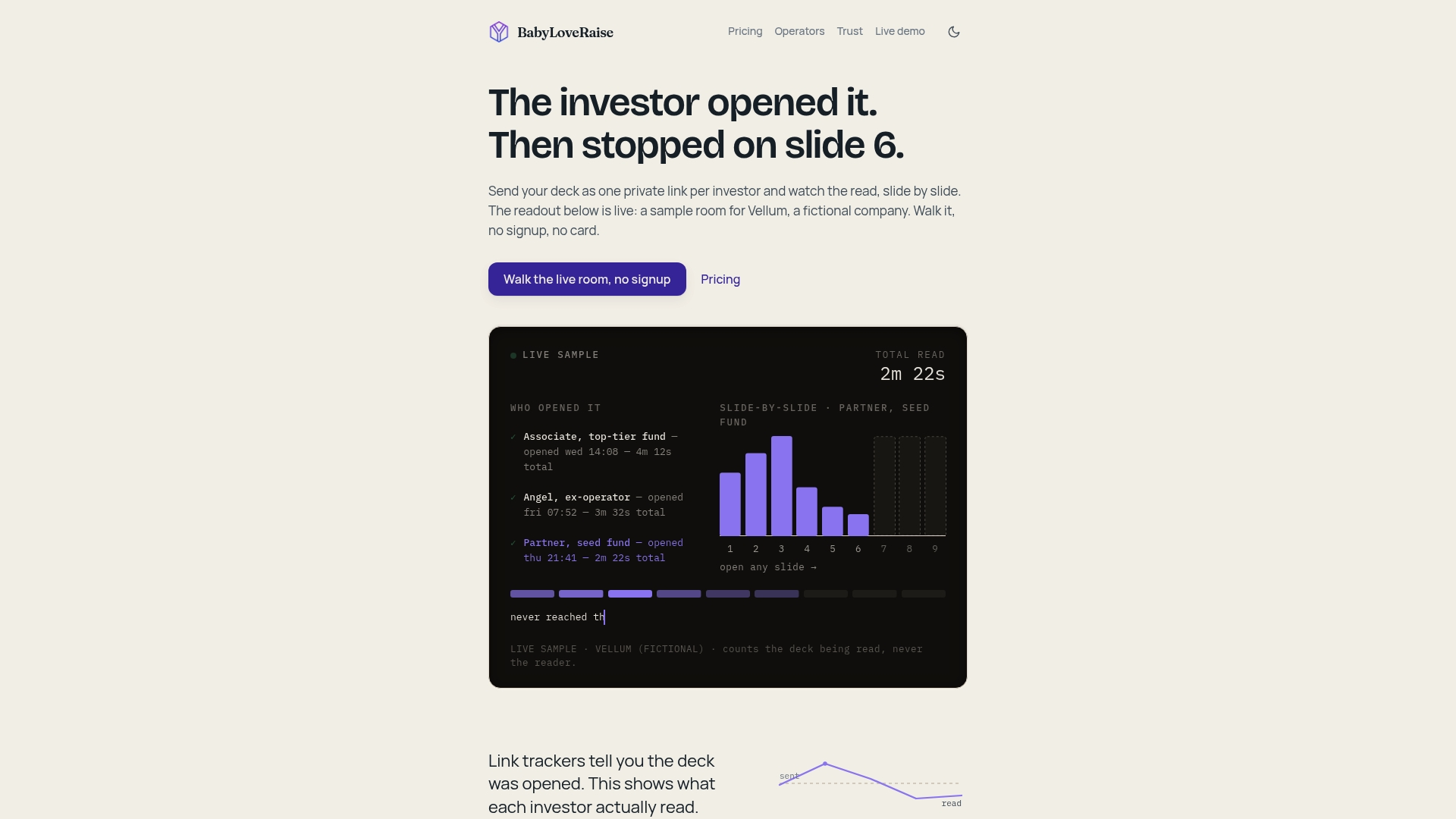
That is the gap a raise room closes. In ours, the founder or advisor sends one room link instead of a file. The room notifies you when the deck is first read and records per-slide engagement: who opened it, who reached the last slide, and which slides held attention versus getting skimmed. An owner dashboard then separates “never opened it” from “read everything and passed”, so follow-ups go to actual readers and deck revisions target the slides where attention dropped.
For a fractional CFO, this fits the same logic as the rest of the stack: it produces data you can act on. The model tells you how long the runway is. The room tells you which investors are actually reading, which is the input to the weekly pipeline review. If you keep an investor tracker alongside it, our guide to a founder’s investor CRM spreadsheet shows a three-tab layout and weekly review, and the guide on fundraising document analytics and the 48-hour follow-up covers what to do with the signal.
Two more details matter for advisors. Share links come in three registers: first send, forwardable and private. Downloads can carry a measured watermark. If you want to control who sees what, see how to set up pitch deck access control. And when the raise closes, the room converts to a free permanent archive instead of a paywall.

Account ownership and data portability
This is the part that protects you when a client leaves, or when you do. The cleanest model separates what the client owns from what you own. Layerz draws the line this way: client-owned infrastructure includes the ledger, bank accounts, billing, payroll, credentials and actuals. Your reusable method includes mappings, conventions, prompts and board-pack structure.
In practice, set it up like this:
- Have the client create and own every account, then invite you as a user with the narrowest role that works.
- Require multi-factor authentication on every login, yours and theirs.
- Keep an access log: who has which tool, with which permission, since when.
- Confirm you can export the data before you commit. A buyer checklist for cloud accounting lists role-based permissions, audit logs, encryption, backup and recovery, retention policies and export.
- Test integrations in a real workflow. The same checklist stresses checking for duplicates, reversals, settlement timing and fee detail, because a connection that exists on paper can still reconcile badly.
Using AI without exposing client data
AI is useful in the reporting layer, and it depends on the layers underneath. One reporting guide says AI needs a clean chart of accounts, reconciled bank, card, payroll and billing data, defined KPIs, standard templates and explicit permissions. Use it for repeatable tasks, and review its output before anything goes to a client or an investor.
On governance, one guide advises minimizing the data you put in, checking retention and subprocessors, piloting with low-risk data, requiring human approval and documenting approved tools. A consumer chatbot is not automatically suitable for client records. Approve narrow use cases first, and write down which classes of data are off limits.
What the stack costs, and what clients pay you
Tool cost is small next to your own fee. One 2026 guide puts fractional CFO engagements at $3,000 to $12,000 per month, with hourly work at $175 to $450. It also recommends quoting onboarding separately, with model build, KPI definitions, access setup and the first close cycle as onboarding deliverables. That is a useful habit: the stack setup is real work, and it should show up as a line item.
For a raise, add the cost of the investor layer. Our raise room is $149 per month or $399 per quarter. For firms running several client raises, the Operator seat is $399 per month per seat or $3,990 per year per seat, with white-label rooms under your firm’s brand. Because a raise has a start and an end, pricing it per raise rather than per seat forever matches how your engagements actually run. For the wider cost picture of sharing documents with investors, see what founders and CFOs pay for a data room.
A one-page setup checklist
Use this when you onboard a new client:
- Ledger audit. Clean the chart of accounts and apply your template.
- Ownership. Client owns every account; you hold scoped access with MFA.
- Feeds. Connect bank, card, payroll and billing; reconcile one month by hand to test them.
- Close calendar. Name who closes, who reviews and what counts as final.
- Definitions. Fix burn, runway, gross margin and ARR in writing.
- Model. Three-statement, three scenarios, one runway number.
- Pack. Same format, same delivery day as every other client.
- Investor layer. If a raise is on, set up one room link, choose the share register for each recipient, and review engagement weekly.
Perspective
Most stack advice treats finance as a closed loop: books in, reports out. A raise breaks that loop, because the most important document is read by strangers who never tell you what they thought.
We built BabyLoveRaise around that silence. A solo founder has no cofounder to ask whether slide seven made sense, and an advisor running five raises cannot read five inboxes for signals. Per-slide engagement stands in for that missing second reader, and the first-read alert tells you when to act instead of when to worry.
We also believe a raise should be priced like a raise. A fractional CFO’s work has a beginning and an end for each client, so the room is priced per raise, and the Operator tier gives firms branded rooms across client raises without the cost of a full virtual data room. When the raise closes, the room becomes a free permanent archive, so nobody is held hostage by their own history.
If your stack already tells you how much cash a client has, let it also tell you who has read the deck.
Paul
Run the investor layer with the raise room
If a client is raising, the raise room is $149 per month or $399 per quarter. It gives you one link per deck, a notification on first read, and per-slide engagement you can bring into the weekly review. If you want hands-on help with the narrative first, we also offer an editorial pass on the deck. Advisory firms running several raises can look at the Operator seat, at $399 per month per seat or $3,990 per year per seat.
FAQ
What tools should a fractional CFO start with?
Start with the client’s ledger, usually QuickBooks Online or Xero for companies under about $20 million in revenue. Then connect banking, payroll and billing, set up a close checklist, and only then add forecasting and reporting tools. Sequence matters more than which brand you pick.
How much does a fractional CFO cost?
Published 2026 guides vary. One puts engagements at $3,000 to $12,000 per month, another at $1,500 to $3,500 for a light retainer of about ten hours. Fees depend on the condition of the books, the complexity of the business, how often you report and the project load. Quote onboarding separately.
Does a fractional CFO need different tools for a startup that is fundraising?
The core stack is the same, but the model needs scenarios and a clear runway number, and the client needs a way to share the deck and see who read it. A raise room covers that last step, with first-read alerts and per-slide engagement.
Can I use AI on client financial data?
Yes, for repeatable reporting tasks, once the data is clean and reconciled and permissions are defined. Minimize the data you share, check retention and subprocessors, and review every output before it goes to a client. Document which tools are approved and which data is off limits.
Sources
- How Fractional CFOs Build a Finance Tech Stack
- The Fractional CFO Tech Stack (2026 Guide)
- The Fractional CFO Tech Stack, Layer by Layer
- The Fractional CFO Tech Stack: Build for Margin, Not Tools
- The Fractional CFO Accounting Software Stack
- Building a Finance Function from Zero
- Fractional CFO Tech Stack: Tools to Scale in 2026
- The Fractional CFO Tech Stack: What to Own, What to Rent
- Building Your Startup Finance Stack
- How AI Automates Financial Reporting for Fractional CFOs
- Client Data in AI Tools
- Cloud Accounting Software: Practical Buyer Checklist
- Fractional CFO Services: Cost, Hourly Rates 2026
- Card Processing Costs for B2B SaaS
- Online Bookkeeping Options for Freelancers