
Investor Meeting Prep for Founders: Track Deck Reads, Earn Next Steps
Prepare a focused 20 minute investor pitch, research each fund, and use per slide deck engagement to shape follow up and agree on a clear next step.
October 12, 2026 · 15 min read

To make an investor meeting succeed, prepare a 20-minute pitch that earns attention, a one-page investor dossier tailored to that investor, and a clear follow-up plan informed by who actually reads your deck. The meeting itself should run short on slides and long on dialogue: a brief opener, a focused pitch, then a real conversation that ends with an agreed next step.
TL;DR:
- Research each investor’s portfolio, recent funding, and partner interests, then prepare a one page dossier with fit, useful introductions, and potential conflicts.
- Aim for a 20 minute deck: open with what changed, your one sentence description, traction, and ask, then keep detailed metrics in an appendix.
- Prepare runway, monthly burn, revenue or ARR growth, and cohort based margin, CAC, LTV, and churn; state assumptions when metrics remain immature.
- Use 3 to 5 minutes for context, 15 to 20 for the pitch, and protect question time; agree on a specific next step before leaving.
- Send requested materials within 24 to 48 hours, share a meaningful update after 7 to 10 days, and prioritize investors who read the deck through.
BabyLoveRaiseKnow Who Read Your Pitch DeckBabyLoveRaise tracks first reads and per-slide engagement, helping founders focus follow-ups on investors who have actually read their deck.Explore BabyLoveRaise
Table of Contents
- How to research an investor and tailor your pitch
- Tighten your deck: a slide-by-slide checklist for a 20-minute pitch
- Which numbers investors will ask for and how to present them
- The investor question bank and concise answer framework
- Meeting agenda template and pacing tactics to create two-way dialogue
- High-conversion follow-up workflow founders should run after the meeting
- Practical example: using per-slide engagement to focus follow-up and revise your deck
- Pre-meeting technical setup and testing of presentation tools
- Strategies to anticipate and handle difficult questions or objections
- Ways to tailor your prep based on investor type
- Why rehearsing the pitch and the Q&A matters
- Setting clear meeting objectives and desired outcomes
- Author Paul’s perspective: priorities to carry into the first and second meetings
- How BabyLoveRaise helps you track engagement and run targeted follow-up
- FAQ
- Sources
How to research an investor and tailor your pitch
Generic pitches get generic answers. Before a meeting, pull together what the investor actually cares about so you can speak to their portfolio instead of your own assumptions.
Start with public signals, then narrow to specifics:
- Check portfolio pages and Crunchbase for stage fit, sector focus, and typical check size.
- Read partner bios and recent posts to find language they use and theses they hold.
- Scan recent news for what they’ve funded in the last two quarters, since priorities shift fast.
Once you have the signals, build a one-page dossier: three reasons this investor specifically might care about your company, any partners who could make useful introductions, and flags worth avoiding, such as a portfolio company that competes with you. Our reverse due diligence guide walks through how to vet investor fit the same way they vet founders.
Pro Tip: Mirror the investor’s own portfolio language in your deck. If they describe their thesis as “infrastructure for the AI stack,” use that phrase, not your own synonym for it.
Tighten your deck: a slide-by-slide checklist for a 20-minute pitch
Sequoia Capital’s guidance for founders recommends opening with three slides that do the heavy lifting before you get into the details, aiming to cover the full deck in about 20 minutes so there’s real time left for discussion.
- What’s changed: the update since your last contact or since the fund’s last look at your category.
- What you do, in one sentence: no jargon, no two-sentence hedge.
- Fast facts: founding date, current traction, and the ask, all on one slide.
After the opener, move into a “why invest” slide backed by your strongest numbers, followed by a milestone and catalyst timeline that shows what the raise unlocks over the next 6 to 18 months. MarketClimber’s guidance on investment-grade presentations recommends exactly this kind of modular structure, with dense data pushed into an appendix rather than the core narrative.
Keep the appendix stocked with backup slides: cohort tables, competitive landscape detail, and anything an engaged investor might ask to see. Our pitch deck strategy guide covers slide order and visual design choices that keep the core narrative tight while the appendix does the heavy lifting.
Which numbers investors will ask for and how to present them
Investors will ask for specific metrics, and vague answers cost you credibility fast. Have these ready in a single, clean format:
- Runway and monthly burn rate, stated in months and dollars.
- Trailing twelve-month revenue or ARR, with growth rate.
- Gross margin, CAC, LTV, and churn, each with the cohort it’s based on.
MarketClimber’s guidance on investor presentations recommends budgeting one to two minutes per slide and keeping detailed metrics in an appendix rather than cluttering the core pitch. When a metric is still immature, present it as a range with the underlying assumption stated plainly rather than forcing a false precision. Tie your KPIs to a one-slide performance summary that shows where each number needs to land over the next 12 to 18 months to hit your next milestone.
The investor question bank and concise answer framework
Investors ask a predictable set of questions, so rehearsing answers matters more than rehearsing the pitch itself.
- Team: why you, why this problem, why now.
- Defensibility: what stops a competitor from copying you in six months.
- Unit economics: your CAC, LTV, and the trend line, not just a snapshot.
- Customer acquisition: which channel actually works and why it scales.
- Competition: who else is solving this and what makes your wedge different.
- Exit path: who would buy this company and why.
Use a short framework for each answer: a 15 to 30 second lead that states your claim plainly, one data point that backs it, and a signpost to the appendix if they want more. When a question is genuinely tough, treat it as an invitation rather than a trap: ask the investor what they’ve seen work in similar situations. It shifts the dynamic from interrogation to collaboration.
Pro Tip: Write your six toughest answers on an index card and read them aloud once before every meeting. It catches the awkward phrasing you won’t notice in your head.
Meeting agenda template and pacing tactics to create two-way dialogue
A pitch that runs the full hour leaves no room for the conversation that actually moves a deal forward. Structure the meeting so the investor talks as much as you do.
- Open with 3 to 5 minutes of context and a quick agenda for how you’ll spend the time.
- Ask a short check-in question right after the opener, such as what they’d like to focus on, to catch any bias toward a specific slide or concern early.
- Spend 15 to 20 minutes on the pitch itself, then open the floor.
- If you’re running long, cut appendix material rather than the discussion time.
- When you sense real interest, ask directly for the next meeting before the call ends.
Sequoia’s founder guidance notes that a short pitch that earns attention in the first five minutes, then pauses for questions, produces more meaningful follow-up than a long scripted presentation ever does.
High-conversion follow-up workflow founders should run after the meeting
What you send after the meeting often matters more than what you said during it.
- Within 24 to 48 hours, send a thank-you note with a short, tailored explainer and anything they specifically asked for.
- At 7 to 10 days, send a more substantive follow-up: an updated metric, a customer win, or a relevant press mention.
- Prioritize by engagement, not by gut feeling: investors who read to the last slide get a warmer, faster follow-up than those who never opened the deck at all.
- Keep subject lines specific (“Update: [Metric] since Tuesday”) rather than generic (“Following up”).
- Ask for a partner introduction once you’ve established genuine interest, not in the first message.
A fundraising coach writing for Forbes recommends pairing the deck with a text-heavy explainer document, since it gives an interested partner something easy to forward to colleagues who weren’t in the room. Our investor follow-up strategy guide has templates for both touchpoints.
Practical example: using per-slide engagement to focus follow-up and revise your deck
Two silences look identical from a founder’s side: an investor who never opened your deck, and one who read every slide and quietly passed. Treating them the same wastes your best follow-up energy on cold contacts while warm ones go untouched.
- A room that shows never opened versus opened and read to the end tells you who gets the fast, warm follow-up and who gets a re-engagement nudge instead.
- Per-slide dwell time shows exactly where attention dropped, so you revise that slide instead of guessing which one is weak.
- Pricing per raise, rather than per seat indefinitely, fits a process that has a clear start and end rather than an ongoing subscription need.
Pro Tip: When a slide shows a consistent drop-off across multiple investors, that’s a narrative problem, not a one-off reader issue. Fix the slide before the next batch of meetings.
Pre-meeting technical setup and testing of presentation tools
A strong pitch can fall flat if your screen share freezes or your slides render wrong on someone else’s monitor. Treat the technical setup as part of your prep, not an afterthought.
Test your video platform at least a day ahead, not minutes before. Confirm your camera, microphone, and screen-share permissions all work on the exact device you’ll use for the call, since a laptop that worked fine yesterday can suddenly ask for a permissions reset. If the meeting is in person, bring your deck on two formats, a laptop and a printed backup, in case the room’s projector doesn’t cooperate with your file type.
Check how your deck renders outside your own software. A deck built in one tool can shift fonts, break animations, or crop images when opened in another, so export a PDF version and preview it exactly as the investor will see it. If you’re sharing a link instead of a file, confirm the link opens cleanly on both desktop and mobile, since investors often skim decks from a phone between other calls.
Close any tabs, notifications, and messaging apps that might pop up mid-screen-share. It sounds minor, but an unexpected notification during your “fast facts” slide undercuts the polish you spent weeks building. Finally, have a single-page backup plan ready, a condensed version of your three-slide opener, in case technical issues eat into your allotted time and you need to compress fast.
Strategies to anticipate and handle difficult questions or objections
The questions that rattle founders are rarely random. They tend to cluster around the same handful of weak points: a thin team, an unclear moat, or a customer acquisition number that doesn’t hold up under scrutiny.
List your three or four most uncomfortable truths before the meeting, not after someone asks about them. If your churn is high, your team lacks a technical cofounder, or your market is crowded, write the honest version of that answer in advance rather than hoping it won’t come up. An answer that acknowledges the gap and names a concrete plan to close it lands better than deflection ever does.
When you don’t know an answer, say so directly and commit to a follow-up with the number or detail. Guessing in the room is far more damaging than admitting you’ll check and report back within a day. Investors are evaluating how you handle uncertainty as much as the content of the answer itself.
Watch for objections disguised as questions, like “how do you think about competition from [adjacent player]?” These are often testing whether you’ve thought past your own narrative. Treat them as a chance to show range: name the competitor honestly, then explain the specific wedge that keeps you differentiated. A question that goes nowhere also tells you something: if an investor keeps circling the same concern, that’s likely their real objection, not a side note.
Ways to tailor your prep based on investor type
An angel investor, a venture fund partner, and a corporate venture arm are evaluating different things, even when they ask similar-sounding questions.
Angels often write smaller checks and decide faster, sometimes in a single conversation, so your prep should emphasize the founder story and your own judgment under pressure more than a polished operating plan. They’re frequently investing in you as much as the business, so a dossier entry on their own background and why your category interests them personally pays off.
Venture fund partners move through a more structured process: a partner meeting is often one step toward an investment committee decision, so your job is to give them ammunition to advocate for you internally. That’s where the “why invest” slide and a catalyst timeline matter most, since the partner will likely reuse your framing in their own pitch to colleagues.
Corporate investors bring a third set of priorities: strategic fit with their parent company often matters as much as financial return. Research what business unit is sponsoring the conversation and prepare a specific answer for how a partnership, pilot, or distribution deal could work alongside the investment. NVCA’s guidance on investor selection notes that the right investor adds value beyond capital through introductions, operational insight, and credibility, so your dossier should name what kind of help you actually want from each type, not just the check size.
Why rehearsing the pitch and the Q&A matters
A deck you’ve read ten times in private sounds different the first time you say it out loud to another person. Rehearsal catches the awkward transitions, the slide that needs an extra sentence of context, and the number you keep fumbling.
Practice the opening three slides until they’re close to memorized, since that’s the stretch where you’re earning the attention that carries the rest of the meeting. The middle of the pitch can flex more naturally, but the open and the ask should feel rehearsed enough that nerves don’t derail them.
Run a mock Q&A with someone who will push back, not just nod along. A cofounder, an advisor, or another founder in your network asking your six toughest questions out loud surfaces gaps that silent rehearsal never will. Time yourself doing it, since the goal is a confident 15 to 30 second answer, not a rambling two-minute one.
Rehearsing the handoff between pitch and discussion matters just as much as the slides themselves. Practice the exact sentence you’ll use to transition, such as inviting questions after the opener, so it feels natural rather than abrupt when the moment arrives in the real meeting.
Setting clear meeting objectives and desired outcomes
Walking into an investor meeting without a defined goal makes it hard to know whether the meeting succeeded. Before you schedule the call, decide what a good outcome actually looks like: a second meeting, an introduction to a specific partner, a commitment to review your data room, or simply useful feedback on your narrative.
Write that objective down and share a version of it with the investor early in the conversation. A simple line like “today, we’d love to get your read on our go-to-market and figure out if there’s a fit for a deeper conversation” sets expectations and gives both sides a clear marker for what comes next.
Different meetings call for different objectives. A first meeting with a new fund might aim only for a second conversation, while a second meeting with someone already engaged might aim for a term sheet discussion or a specific diligence request. Matching your ask to the stage of the relationship keeps the conversation realistic instead of overreaching.
End every meeting by restating the agreed next step out loud, whether that’s a follow-up email, a specific document, or a date for the next call. A next step that both sides said out loud is far more likely to actually happen than one left implied.

Author Paul’s perspective: priorities to carry into the first and second meetings
The mistake most founders make is optimizing slide polish over conversation quality. An investor remembers how you handled their hardest question far longer than they remember your transition animations.
Let engagement data, not instinct, decide who gets your best follow-up energy and which slide needs a rewrite. Our guides on pitch deck analytics and deck versus memo strategy go deeper into both.
— Paul
How BabyLoveRaise helps you track engagement and run targeted follow-up
We built our service around the problem this guide addresses: knowing who actually engaged with your deck so your follow-up goes to the right people first.
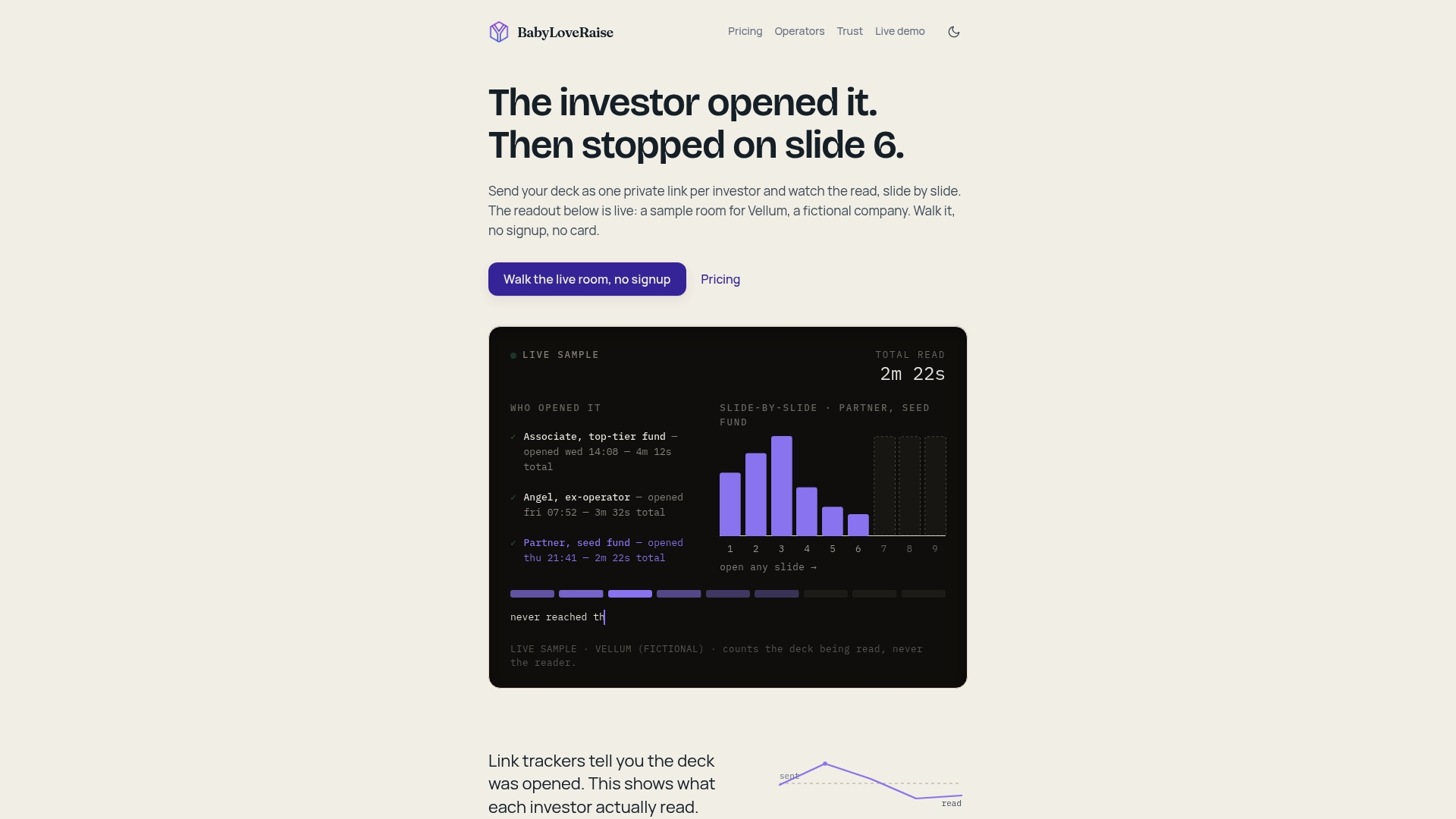
- We send a single link instead of a PDF, and notify you when someone opens it.
- We track per-slide dwell time so you can see which slides held attention and which ones lost it.
- We report on the document, not the person, so engagement data concerns the raise itself.
- Our editorial pass offers a hands-on deck review, and an operator tier lets advisors run branded rooms across client raises.
Visit our pricing page to see the raise room and editorial pass options, or check our trust page for details on how we handle your data.
FAQ
What does an investor want to see?
Investors want a clear, one-sentence explanation of what you do, evidence of traction, and a credible path to the milestone your current raise funds. They also want to see that you understand your own numbers well enough to defend them under questioning.
What is the 7 5 3 1 rule in investing?
This term is not a standardized fundraising or venture capital framework, and definitions of it vary widely depending on the source. Rather than relying on an unverified rule, focus your prep on the metrics and milestone timeline investors actually ask about during meetings.
What is the 10% investor rule?
Like the 7-5-3-1 rule, this is not a recognized standard in startup fundraising, and no primary source defines it consistently. Founders are better served focusing on investor-specific dilution and ownership questions directly with their legal or financial advisors.
What is an investor presentation?
An investor presentation, or pitch deck, is the slide set founders use to explain their business, traction, and funding ask to potential investors. Sequoia’s guidance for founders recommends structuring it around a short opener, a clear “why invest” case, and roughly 20 minutes of total presentation time to leave room for discussion.
How long should an investor meeting last?
Most first investor meetings run about 30 minutes, with the pitch itself ideally taking up about 20 minutes so the remaining time goes to questions and discussion. Sequoia’s founder-facing guidance frames this pacing as a way to maximize genuine dialogue rather than a one-way presentation.
Sources
- How to present to investors — Sequoia Capital
- Inside Zeck — NVCA
- Investment grade investor presentations — MarketClimber
- A fundraising coach’s step-by-step guide to meeting with investors — Forbes