
Investor Outreach Benchmarks: Reply and Meeting Rates
Realistic reply, meeting and conversion rates for pre-seed and seed outreach, cold versus warm, and how to read your own funnel to find where it leaks.
November 14, 2026 · 12 min read

Published benchmarks put cold investor email at roughly 2% to 8% replies, personalized cold email at roughly 8% to 20%, and warm introductions at 40% or more. Published figures disagree because they count different things, so use them as goalposts for your own funnel, not as promises. The most useful number is the one you cannot see in a reply rate: how many investors opened your deck and how far they read. That is where we start the work with founders.
This guide gives you the ranges, what each stage of the funnel measures, how to tell which stage is leaking, and what to do about it. It is written for pre-seed and seed founders, for founders about to raise, and for the advisers, accelerators and studios who run raises for others.
BabyLoveRaiseSee Which Investors Read Your DeckBabyLoveRaise tracks first reads and per-slide engagement, helping you distinguish unopened decks from investors who read and passed.VisitTL;DR
- Cold email replies run about 3% to 8% for generic templates and 8% to 20% for personalized, thesis-aware messages. Warm introductions reach 40% to 70% replies (AngelsPartners, 2026).
- Replies turn into first meetings about 20% to 40% of the time, and first meetings turn into second meetings at roughly 35% at pre-seed and 37% at seed (Metal data desk).
- Small, targeted sends beat big blasts: in one dataset of cold emails, founders sending 25 or fewer got 9.3% replies, and those sending over 100 got 1.2% (VC Boom).
- Compare your funnel stage by stage. A low reply rate points to targeting or subject lines; a low second-meeting rate points to the pitch or the deck.
- Reply rates cannot tell “never opened” from “read it and passed”. Deck-level read data can.
Table of Contents
- What investor outreach benchmarks actually measure
- The benchmark funnel for pre-seed and seed
- Cold versus warm: the gap is large
- How many investors should you contact?
- Reading your own numbers: where is the funnel leaking?
- The step reply rates cannot see
- How BabyLoveRaise gives you the missing numbers
- What we think about benchmarks
- FAQ
- Sources
What investor outreach benchmarks actually measure
A benchmark is a ratio between two steps of a funnel. Most published ones follow the same chain:
- Open rate: share of emails opened. Typical cold email open rates are reported at 20% to 45%, and 60% to 85% for warm introductions (AngelsPartners). Open rates are the least reliable figure, because mail privacy features inflate them.
- Reply rate: share of investors who answer at all. A reply can be a yes, a pass, or a request for the deck.
- Reply-to-meeting rate: share of replies that become a first call.
- First-to-second meeting rate: share of first calls that advance.
- Meeting-to-term-sheet or check rate: the end of the funnel.
The reason numbers look contradictory is that sources define the denominator differently. One counts any reply, another counts only interested replies. One counts emails sent, another counts investors contacted. A 2018 field experiment in which researchers sent about 80,000 pitch emails to venture capitalists and angels found a cold-email response rate of roughly 6%, as summarized in a later academic paper. Other sources report 2.5% or 15%. Both can be right for their own sample and method.
Before you compare yourself with any figure, check three things: the stage it covers (pre-seed and seed behave differently from Series A), the year, and whether it counts replies or interested replies.
The benchmark funnel for pre-seed and seed
The table collects ranges from published data. Treat each row as a range that people have reported, not as a target you are failing if you miss.
| Funnel step | Reported range | Notes |
|---|---|---|
| Cold email, generic template, reply rate | 3% to 8% | Bottom of the range for blasts (AngelsPartners) |
| Cold email, personalized, reply rate | 8% to 20% | Higher with thesis-aware targeting and a follow-up |
| Cold email with a day-4 follow-up | 12% to 18% | Targeted list of active investors (Round Funded) |
| Warm introduction, reply rate | 40% to 70% | Strength of the introducer matters |
| Intro request, investor response | About 25% median | Lower at seed than at pre-seed (Metal data desk) |
| Reply to first meeting | 20% to 40% | Wider spreads in some datasets |
| First to second meeting, pre-seed | About 35% | Drawn from thousands of investor calls (Metal) |
| First to second meeting, seed | About 37% | Overall range 27% to 55% |
| Meeting to check, pre-seed | About 5% to 10% | First contact to check closer to 1% to 2% (Funding Framework) |
One worked example shows how the chain compounds. A published back-of-envelope model starts with 150 outreaches, assumes a 30% reply rate, 65% of replies becoming meetings, 35% of those moving to a second meeting and 20% of those reaching a term sheet, and ends at about two term sheets (ProRaise). Notice how sensitive it is. Cut the reply rate to 10% and the same 150 emails produce well under one term sheet. That is why fixing the early step matters, and why a spray-and-pray list rarely works.
Cold versus warm: the gap is large
Warm introductions are the strongest lever in every dataset. Reported reply rates are 40% to 70% for warm paths against 3% to 8% for generic cold email (AngelsPartners). The gap persists further down the funnel. One analysis of seed rounds puts meeting conversion at 5% to 10% for cold email, 25% to 40% for second-degree warm introductions, and 60% to 80% for introductions from portfolio founders (Unbuilt Lab). Another reports close rates from meeting to check of about 0.5% to 1.5% for meetings that began cold, against 5% to 15% for those that began warm (Round Funded).

That does not mean cold outreach is pointless. A survey of 885 institutional VCs found that more than 30% of deals come through partners’ professional networks and about 20% are referred by other investors, with roughly 8% arriving through portfolio-company referrals, as summarized here. The remainder still arrives through other channels, and the large research experiment above shows that well-built cold pitches get read. The practical takeaway is to run both: ask for warm introductions to your top targets first, and send a tightly personalized cold note to the rest. We go deeper on that split in our guide to warm intros versus cold email.
Email versus LinkedIn
LinkedIn messages tend to land in a similar or slightly higher band than cold email. One 2026 report puts LinkedIn replies at 10% to 25%, higher when you share a connection (AngelsPartners). Another dataset suggests meeting conversion from cold LinkedIn messages of 10% to 20%, against 5% to 10% for cold email (Unbuilt Lab). Use LinkedIn when you have a mutual connection or a recent post to reference, and email when you have a specific reason tied to the investor’s thesis.
How many investors should you contact?
No one number fits every raise, but the pattern is consistent. Many first-time founders close a pre-seed after roughly 30 to 50 investor meetings drawn from 60 to 100 contacts (Funding Framework, October 2026). Volume alone does not explain success. Cold-email data show reply rates falling as batch size grows: founders who sent 25 or fewer emails saw 9.3% replies, and those who sent more than 100 saw 1.2% (VC Boom). The same dataset found verified addresses got 2.7% replies against 1.7% for catch-all addresses, so list hygiene counts.
A workable plan for a seed raise:
- Build a ranked list of 60 to 100 investors who have written checks at your stage, sector and check size.
- Send the first 15 to 25 to your best-fit targets, preferably through warm paths.
- Read the funnel after that first batch before you send the rest. Adjust the message and the deck, then continue.
The timing of each batch matters too; see our notes on the best day and hour to send investor emails.
Reading your own numbers: where is the funnel leaking?
A benchmark is useful only when it points to a fix. Here is how to read each gap, with the minimum sample before you trust it. One source suggests looking at a dataset of at least 15 meetings before judging conversion against benchmarks (Metal). For email replies, wait until you have sent at least 25 to 30 messages to a comparable group of investors.
Low replies
If replies sit at the bottom of the range, the problem is usually the list or the first two lines. Segment investors by thesis, name a specific portfolio company or recent announcement, and state your traction in one sentence. Reports consistently tie stronger results to thesis-aware segmentation, personalization and warm paths (AngelsPartners). One 2026 analysis found outreach that stated facts plainly got a 30% response and an 18% meeting-booking rate, against 7% and 1% for unsettled stories (CherryPitch Q2 2026). A follow-up helps as well; our investor follow-up guide covers cadence, and our outreach email templates give you a starting structure.
Replies but few meetings
Investors are interested enough to answer, but the ask or the timing fails. Make the request small and specific, offer two time slots, and attach one deck rather than a package of links. If the replies are mostly polite passes, your list is out of thesis.
Meetings but no second meetings
This is the most diagnostic break. Investors take a first meeting out of curiosity or because of the introducer, and take a second only if something landed. Around 30 first meetings with no second meetings is the point where you should stop and fix the pitch before spending more of your list (Funding Framework). Compare yourself with the roughly 35% to 37% benchmark at pre-seed and seed. Our guides on pitch deck strategy and investor meeting prep cover what to change.
Second meetings but no checks
Expect this to be the steepest drop. Pre-seed meeting-to-check conversion is reported around 5% to 10%. If you are well below it after 15 or more late-stage meetings, the issue is usually diligence material, terms, or round momentum, not outreach.
The step reply rates cannot see
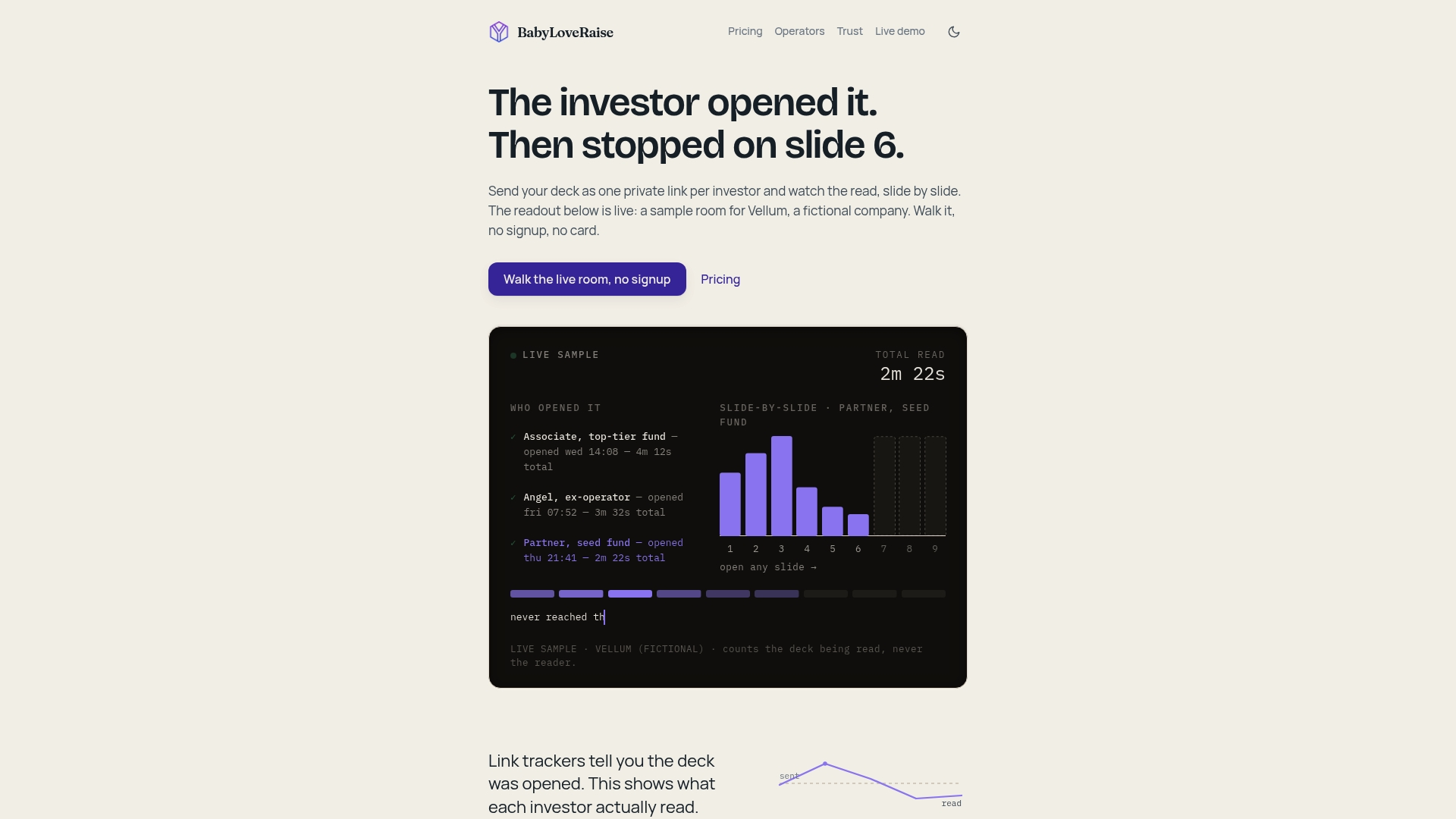
Every benchmark above starts after an investor replies or takes a meeting. Before that, there is a stage almost no founder measures: what the investor did with the deck. Silence after you send a PDF can mean three very different things. The investor never opened it. They opened it and skimmed two slides. Or they read all of it and passed without telling you. A reply rate lumps all three together.
That changes what you do next:
- Never opened: the problem is the subject line, the sender, the timing or the list. Resend or try another path. The deck is not the issue.
- Opened, left early: the deck lost them. Look at which slide they stopped on and revise it.
- Read to the last slide, no reply: the investor is interested enough to finish. This is the best moment for a short, specific follow-up.
Without this data, founders send the same follow-up to all three groups, or rewrite a deck that was never opened. With it, your follow-ups go to the people who actually read, and your revisions target the slides where attention fell. Our piece on pitch deck analytics explains which signals matter and which are noise.
How BabyLoveRaise gives you the missing numbers
BabyLoveRaise hosts your pitch deck in a raise room. Instead of attaching a PDF or a Drive link, you send one room link. The room notifies you on first read and records per-slide engagement: who opened the deck, who read to the last slide, and which slides held attention versus got skimmed. The owner dashboard turns “never opened it” and “read everything and passed” into two different states, so you know whom to follow up with and what to revise.
Share links come in three registers: first send, forwardable and private. Downloads can carry a watermark. When the raise closes, the room converts to a free permanent archive.
The raise room is $399 per quarter or $149 per month, priced per raise rather than per seat forever. Advisory firms and fractional CFOs running several client raises can use Operator seats at $399 per month per seat or $3,990 per year per seat, with firm-branded rooms. If you want hands-on help with the deck itself, we also offer an editorial pass. See plans and pricing or the Operator plans.
Pair the room with outreach that is already working: a tracked link in each email, a stage-by-stage tally in a simple sheet, and a review after every batch of 15 to 25 sends. If you manage several decks, our guide to pitch deck version control keeps each investor on the right version.
What we think about benchmarks
Founders ask us for the “right” reply rate as if one number could grade a raise. It cannot. Benchmarks come from different samples, different years and different definitions, and the honest use of them is as goalposts: they tell you which stage to look at, not whether you are good.
A solo founder has no cofounder watching an investor read the deck, so the deck has to speak for itself and you have to know how it was received. That is why we built the room around the raise itself: first-read moments, per-slide attention, and a list of who finished the deck. A reply rate tells you who answered. Read data tells you who is paying attention.
We price per raise because a raise has an end. When it closes, the room becomes a free permanent archive. And the tracking reports on the document, never on the person: you see what was read, not who someone is.
Paul
FAQ
What is a good reply rate for investor outreach?
For personalized cold email, reported ranges are 8% to 20%, and for generic templates 3% to 8%. Warm introductions reach 40% to 70% (AngelsPartners). Judge yourself against the segment that matches how you actually reached the investor, and only after at least 25 to 30 sends.
How many investors do I need to contact to close a pre-seed?
Many first-time founders report 30 to 50 meetings drawn from 60 to 100 contacts before closing (Funding Framework). Expect variation by sector, traction and network. Send in batches and read the funnel after each one rather than emailing the whole list at once.
Are warm introductions really that much better than cold email?
In every dataset we found, yes. Reported reply rates for warm paths are several times those for cold email, and meetings that begin warm convert to checks at a higher rate (Round Funded). Cold still works when the message is specific and the list is small and well matched.
What is a good first-to-second meeting rate?
About 35% at pre-seed and 37% at seed, with an overall range from 27% to 55% (Metal). If you have held 15 or more first meetings and fall well below that, review the pitch and the deck before you contact more investors.
How do I know if investors are reading my deck?
Send one hosted link instead of an attachment. A raise room notifies you on first read and shows per-slide engagement, so you can tell investors who never opened the deck from those who read it through. See the raise room pricing.
Sources
- 2026 Investor Outreach Benchmark Report for Founders
- 1st to 2nd Meeting Conversion
- Intro Response
- Warm Intro vs Cold Email for VCs
- Cold email vs warm intros: cold numbers
- How Many Investor Meetings It Takes to Close a Pre-Seed
- The investor funnel math
- How to Prepare for a Seed Round in 2026
- The Q2 Report: What Predicts a Meeting
- How to get a warm intro to any investor
- Discrimination in the Venture Capital Industry (Columbia)