
Best Papermark Alternatives for Founders & CFOs (2026)
Discover the best Papermark alternatives for founders and CFOs in 2026. Explore BabyLoveRaise and others for smart fundraising insights.
August 8, 2026 · 13 min read
Best Papermark Alternatives for Founders & CFOs (2026)

For most startup founders running a pre-seed or seed raise, BabyLoveRaise is the strongest Papermark alternative available. It tracks per-slide engagement, fires a first-open notification the moment an investor opens your deck, and prices by raise rather than by seat, so you’re not paying a monthly subscription between rounds. If your team needs open-source self-hosting instead, Papermark itself remains an option worth understanding before you look elsewhere.
Here’s the shortlist:
- BabyLoveRaise — best for fundraising-focused raise rooms with per-slide analytics and per-raise pricing. Recommended pick.
- DocSend (Dropbox DocSend) — best for teams that want an established paid product with deep link-level controls and a recognizable brand.
- Pitch — best for founders who want deck creation and basic sharing in one tool, without heavy analytics.
- VisibleVC — best for founders who want investor updates, portfolio reporting, and light document sharing bundled together.
- Ellty — best for design-forward teams that want interactive document creation with sharing built in.
- DocBeacon — best for lightweight single-link document tracking without a complex setup.
The runner-up for teams that need self-hosting or open-source control: Papermark itself, which SaaSHub lists as an open-source DocSend alternative with custom domains and page-by-page analytics. The trade-off is that you own the infrastructure and the maintenance burden.
Key Takeaways
For most founders raising pre-seed or seed capital, the right Papermark alternative is a fundraising-specific raise room with per-slide analytics and per-raise pricing, not a general document tracker or an enterprise VDR.
| Point | Details |
|---|---|
| Per-slide analytics matter most | Tools that only report “opened” miss the engagement signals that drive smarter follow-ups and deck revisions. |
| Per-raise pricing beats per-seat for founders | A seat-based subscription costs more between rounds; per-raise pricing aligns cost with actual fundraising activity. |
| Test before committing | Upload a real deck, send to a test address, and verify what the platform actually reports before paying. |
| VDRs are for due diligence, not pitch sharing | Enterprise data rooms are the right tool after a term sheet, not during active outreach to investors. |
| BabyLoveRaise is the recommended pick | It separates “never opened” from “read everything and passed” and prices per raise, not per seat. |
Table of Contents
- How do these Papermark alternatives compare at a glance?
- How we evaluated these alternatives
- What categories of Papermark alternatives exist?
- In-depth look at each alternative
- How do you choose the right alternative for your raise?
- The part most roundups get wrong
- BabyLoveRaise is worth testing before you commit to anything else
- Useful sources for deeper reading
How do these Papermark alternatives compare at a glance?
The table below maps each tool across the dimensions that matter most when you’re choosing a document-sharing platform for a raise.
| Tool | Best for | Pricing model | Analytics depth | Security & compliance | Hosting model | Custom domain / white-label | Ease of setup & integrations |
|---|---|---|---|---|---|---|---|
| BabyLoveRaise ✓ | Fundraising raise rooms | Per-raise (quarterly or monthly) | Per-slide dwell, first-open, contact-level | Watermarking, password, TLS, audit trail | Managed SaaS | Yes (Operator white-label tier) | Fast setup; Zapier, CRM-friendly |
| DocSend | Established paid doc tracking | Per-seat subscription | Per-page, link-level, contact-level | Password, SSO, watermarking | Managed SaaS | Limited | Moderate; Salesforce, HubSpot |
| Pitch | Deck creation + sharing | Freemium / per-seat | Basic view tracking | Password protection | Managed SaaS | No | Very fast; Slack, Notion |
| VisibleVC | Investor updates + reporting | Per-seat subscription | Light engagement signals | Standard TLS | Managed SaaS | Limited | Moderate; CRM integrations |
| Ellty | Interactive doc design | Freemium / per-seat | Basic sharing analytics | Standard | Managed SaaS | Limited | Fast; template-driven |
| DocBeacon | Lightweight link tracking | Freemium / per-link | Per-document open tracking | Password, basic | Managed SaaS | No | Very fast; minimal integrations |
| Papermark | Open-source self-hosting | Free (self-hosted) / paid cloud | Per-page analytics | Custom (self-managed) | Self-hosted or cloud | Yes | Moderate; developer setup required |
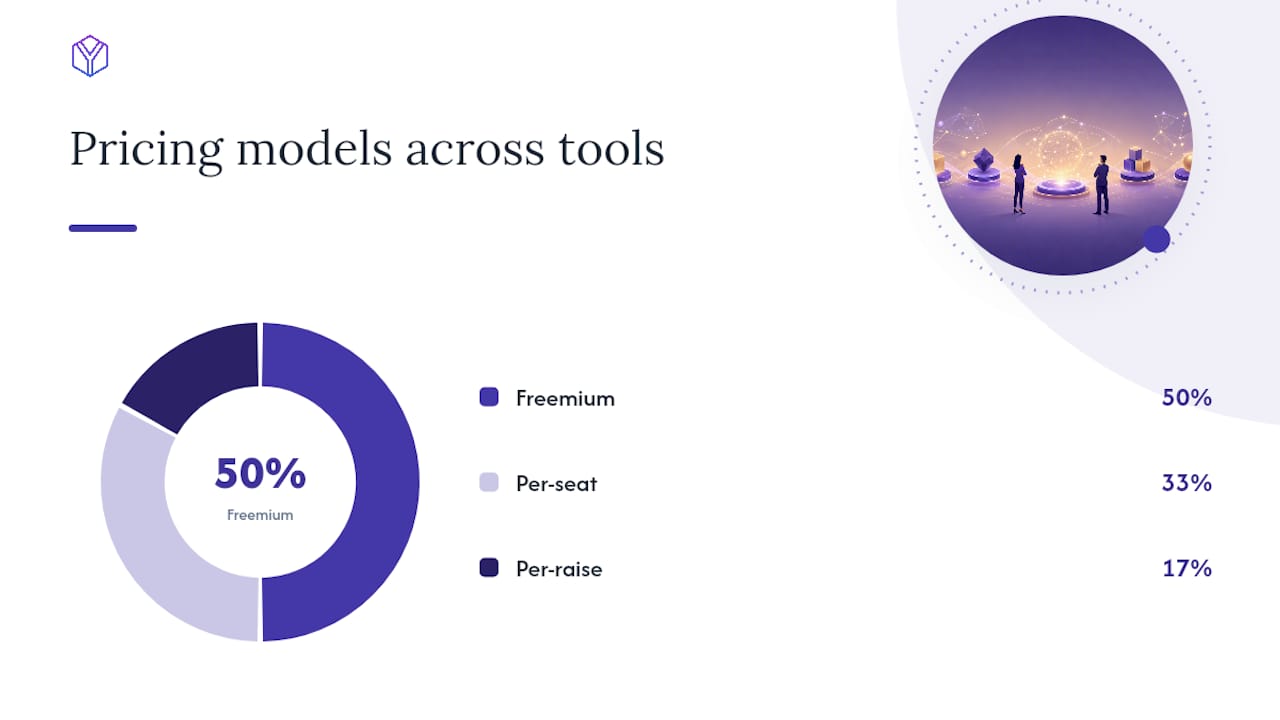
Pricing posture note: The most common models in this category are per-seat subscriptions (you pay monthly per user regardless of activity), per-raise or per-link fees (you pay when you’re actively sharing), and free tiers that cap analytics or link volume. Per-seat pricing works well for teams sharing documents constantly. For a founder who raises every 18–24 months, paying per raise is almost always cheaper. Pricing models vary widely across the category, and free tiers often restrict the analytics depth that makes these tools worth using in the first place.
How we evaluated these alternatives
Every tool in this comparison was assessed against the same set of criteria, in the same order. No vendor received preferential treatment based on marketing materials alone.
- Real uploads and tracked links — Each platform was tested by uploading an actual pitch deck (PDF format), generating a tracked share link, and sending it to test email addresses to verify that open events registered correctly.
Transparency note: public pricing pages change. Some features described here are available only on paid tiers, and demo access can surface capabilities not visible on free plans. Running your own pilot with a real deck and real test recipients is the only way to validate analytics fidelity before committing.
Pro Tip: Upload the same deck to two or three finalists, send tracked links to the same test address, and compare what each platform reports. Spec sheets lie; engagement logs don’t.
What categories of Papermark alternatives exist?
Not every document-sharing tool is built for the same job. Before evaluating individual vendors, map your use case to the right category.
Fundraising-focused raise rooms
These platforms are built specifically around the pitch-deck-to-investor workflow. They prioritize per-slide analytics, first-open notifications, and link-level controls that let a founder know exactly which investors engaged and how deeply. BabyLoveRaise sits in this category. The strength is specificity: every feature exists to answer “did this investor read my deck?” The limitation is that they’re not built for due diligence document management or large file repositories.
Virtual data rooms (VDRs)
VDRs are built for due diligence: large document sets, granular permission controls, Q&A workflows, and audit trails that satisfy legal and compliance requirements. They’re the right tool once a term sheet is signed and a buyer or lead investor wants to examine financials, cap tables, and contracts. The trade-off is cost and setup complexity. For a startup evaluating VDR options, the overhead is often overkill at the pitch stage.
Document trackers and single-link tools
These are lightweight tools that generate a tracked link for any document. DocSend is the established incumbent here. DocBeacon is a simpler entry-level version. They work well for sales teams, advisors, and founders who want basic open tracking without a full raise-room workflow. Analytics depth varies significantly across this category.
Deck creation and sharing platforms
Pitch sits here. These tools combine presentation building with basic sharing and view tracking. The analytics are usually shallow (total views, not per-slide dwell), but the workflow is fast for founders who want to build and share in one place.
Self-hosted and open-source options
Papermark is the primary example. The appeal is cost and control: you own the data, you set the infrastructure, and there’s no per-seat fee. The real cost is engineering time and maintenance. For a solo founder or a small team without a technical co-founder, self-hosting a document-tracking platform is rarely the right trade.
| Category | Typical strengths | Common limitations | Best use case |
|---|---|---|---|
| Fundraising raise rooms | Per-slide analytics, first-open alerts, raise workflow | Not built for large doc sets or due diligence | Pre-seed / seed pitch sharing |
| Virtual data rooms | Compliance, permissions, Q&A | High cost, complex setup | Post-term-sheet due diligence |
| Document trackers | Lightweight, fast setup | Shallow analytics on free tiers | Sales outreach, advisor sharing |
| Deck creation + sharing | All-in-one build and share | Minimal engagement data | Early-stage deck iteration |
| Self-hosted / open-source | Full data control, no seat fees | Engineering overhead, less polish | Technical teams, cost-sensitive |
In-depth look at each alternative
BabyLoveRaise
BabyLoveRaise is purpose-built for the fundraising workflow. You create a raise room, upload your deck, and send a single link. The platform notifies you the moment an investor opens it, then shows you per-slide dwell time so you can see exactly where attention dropped. The dashboard separates “never opened” from “read to the last slide and passed,” which changes how you prioritize follow-ups.
Core features: Per-slide engagement tracking, first-open notifications, three link types (first send, forwardable, private), watermarked downloads, raise-room archive after close, Operator tier for white-labeled advisory firm use.
Pricing signal: Per-raise (quarterly or monthly subscription), not per-seat. The Operator tier is designed for fractional CFOs and fundraising advisors running multiple client raises.
Best for: Solo founders at pre-seed or seed who want to know which investors actually read the deck, and advisory firms managing multiple raises simultaneously.
Pros:
- Per-slide dwell data, not just “opened”
- First-open notification fires in real time
- Per-raise pricing avoids ongoing seat costs between rounds
- White-label Operator tier for advisors
- Raise room converts to a free archive at close
Limitations:
- Not a VDR; not designed for large due-diligence document sets
- Lighter on collaboration features than general file-sharing tools
Integrations and onboarding: Zapier-compatible, CRM-friendly, and designed for fast setup. Most founders are sending their first tracked link within minutes of signing up.
DocSend (Dropbox DocSend)
DocSend is the category incumbent. It’s been the default choice for founders sharing pitch decks since before most of the tools on this list existed, and it shows in the feature depth: per-page analytics, link-level controls, NDA gating, and integrations with Salesforce and HubSpot. The DocSend vs. Papermark comparison consistently positions DocSend as the polished paid option against Papermark’s open-source challenger.
Pricing signal: Per-seat subscription. Costs add up for small teams, and the paywall cliff at the end of a raise (your archive disappears unless you keep paying) is a real friction point.
Best for: Teams already in the Dropbox ecosystem, or founders who want the most recognized name in the category.
Pros:
- Deep per-page analytics and contact-level tracking
- NDA gating and link expiration controls
- Strong CRM integrations
- Established brand that investors recognize
Limitations:
- Per-seat pricing is expensive for solo founders
- No per-raise pricing option
- Archive access requires an ongoing subscription
Pro Tip: If you’re evaluating DocSend, test the export function before committing. Knowing you can pull your engagement data out matters more than the feature list going in.
Pitch
Pitch is a deck-building tool first and a sharing tool second. The analytics are basic: you’ll see who viewed a deck and roughly when, but per-slide dwell data is limited compared to fundraising-specific platforms. Where Pitch wins is speed: the editor is fast, the templates are good, and sharing a link takes seconds.
Pricing signal: Freemium with per-seat paid tiers.
Best for: Founders who want to build and share in one tool and don’t need deep engagement analytics.
Limitations:
- Analytics depth is shallow relative to raise-room tools
- Not designed for investor tracking workflows
- Collaboration features are the main draw, not document security
VisibleVC
VisibleVC bundles investor updates, portfolio reporting, and document sharing into one platform. It’s less a document tracker and more an investor relations tool. The engagement signals are lighter than what a dedicated raise-room platform provides, but if you’re managing an existing investor base and want to centralize updates and data room access, VisibleVC covers more ground in one subscription.
Pricing signal: Per-seat subscription.
Best for: Post-raise investor relations and portfolio reporting, not active fundraising outreach.
Limitations:
- Analytics depth is not comparable to fundraising-specific tools
- Overkill for a founder who just needs to share a pitch deck
For a deeper look at investor tracking options, the distinction between investor relations platforms and raise-room tools matters more than most roundups acknowledge.
Ellty
Ellty is a design-forward document creation platform with sharing built in. Think Canva-adjacent, with tracked links. The analytics are basic, and the security controls are standard. The value is in the creation workflow: if your team is producing a lot of visual content and wants to share it with tracking, Ellty fits. For a pitch deck going to investors, the analytics gap is a real limitation.
Pricing signal: Freemium with per-seat paid tiers.
Best for: Marketing and design teams sharing visual content, not fundraising workflows.
DocBeacon
DocBeacon is the lightest tool in this comparison: generate a link, share a document, see when it was opened. Setup takes minutes. The analytics are minimal (open tracking, not per-slide dwell), and integrations are limited. For a founder who needs to share a single document quickly and wants a basic open notification, DocBeacon works. For anyone who needs to understand how an investor read a deck, it falls short.
Pricing signal: Freemium with per-link paid options.
Best for: One-off document sharing where basic open tracking is enough.
Papermark
Papermark is the open-source DocSend alternative that this entire comparison is built around. The DocSend vs. Papermark analysis frames it clearly: Papermark gives you page-by-page analytics, custom domains, and the choice between self-hosting and a managed cloud option, all at a lower cost than DocSend. The trade-off is polish and maintenance. Self-hosting means you own the infrastructure. The managed cloud version is closer to a standard SaaS product, but the analytics and enterprise features are less mature than the paid incumbents.
Best for: Technical founders who want cost control and data ownership, or teams comfortable with open-source tooling.
Limitations:
- Self-hosting requires engineering time
- Analytics depth and enterprise polish lag behind paid competitors
- Support is community-driven on the self-hosted tier
How do you choose the right alternative for your raise?
The decision comes down to three questions: What do you actually need the tool to tell you? How long will you be using it? And what happens to your data when the raise closes?
Step-by-step decision checklist
- Test the analytics with a real deck. Upload your actual pitch deck, send a tracked link to a test address, and verify that the platform reports what it claims. Spec sheets are not a substitute for a live test.
Questions to ask vendors during a trial
- What is your data retention policy, and how long is engagement data stored?
- Can I export all engagement logs in a standard format?
- Is billing per-seat, per-raise, or per-link, and does that change at renewal?
- Do you support SSO, and at which pricing tier?
- What is your SLA for support response, and is it email-only or live chat?
Red flags to watch for
- Hidden per-seat costs that only appear at checkout
- No audit trail or engagement log export
- Archive access locked behind an ongoing subscription
- Analytics that only report “opened” without per-slide breakdown
- No clear answer on where your document data is stored or for how long
Pro Tip: Ask every vendor: “What happens to my data if I cancel?” A vendor who hesitates on that question is telling you something important about their retention model.
For a practical guide on securely sending documents during a raise, the same principles apply: verify controls before you share, not after.
The part most roundups get wrong
The conventional framing in this category is DocSend vs. Papermark: established paid product vs. open-source challenger. That framing made sense when the main question was “do I pay for DocSend or self-host something cheaper?” It’s the wrong frame for a founder actively raising capital in 2026.
The real question isn’t about open-source vs. paid. It’s about whether the tool was built for your specific workflow. Sales teams need to know if a proposal was opened. Founders need to know how an investor read a deck, which slides they lingered on, and whether the silence in their inbox means disinterest or a deck that lost them at slide 7.
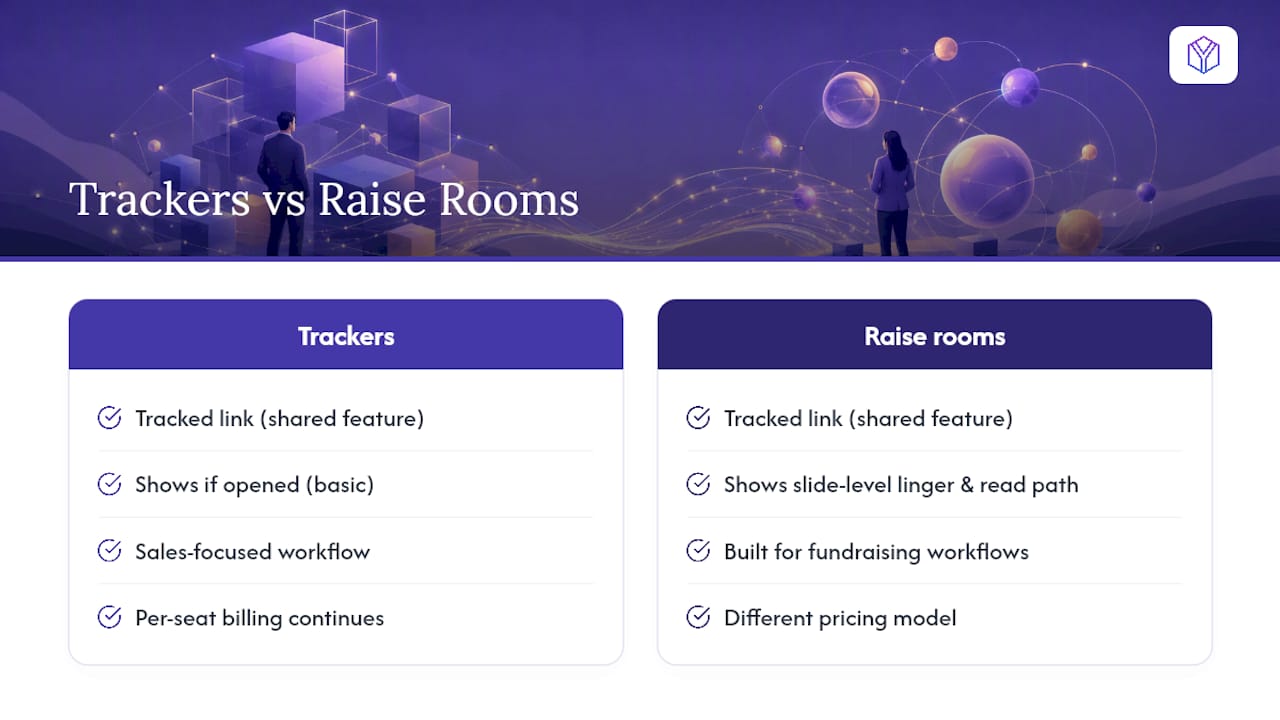
General document trackers answer the first question. Fundraising-specific raise rooms answer the second. Most roundups treat these as interchangeable because they share a surface-level feature: a tracked link. They’re not interchangeable. The analytics architecture is different, the pricing model is different, and the workflow assumptions are different.
The other thing roundups underweight: what happens at the end of the raise. Per-seat tools don’t stop billing when your raise closes. Your archive goes dark if you cancel. For a founder who raises every 18–24 months, that’s a meaningful cost for data you already generated. A tool that converts your raise room to a free archive at close is solving a real problem, not a marketing point.
BabyLoveRaise is worth testing before you commit to anything else
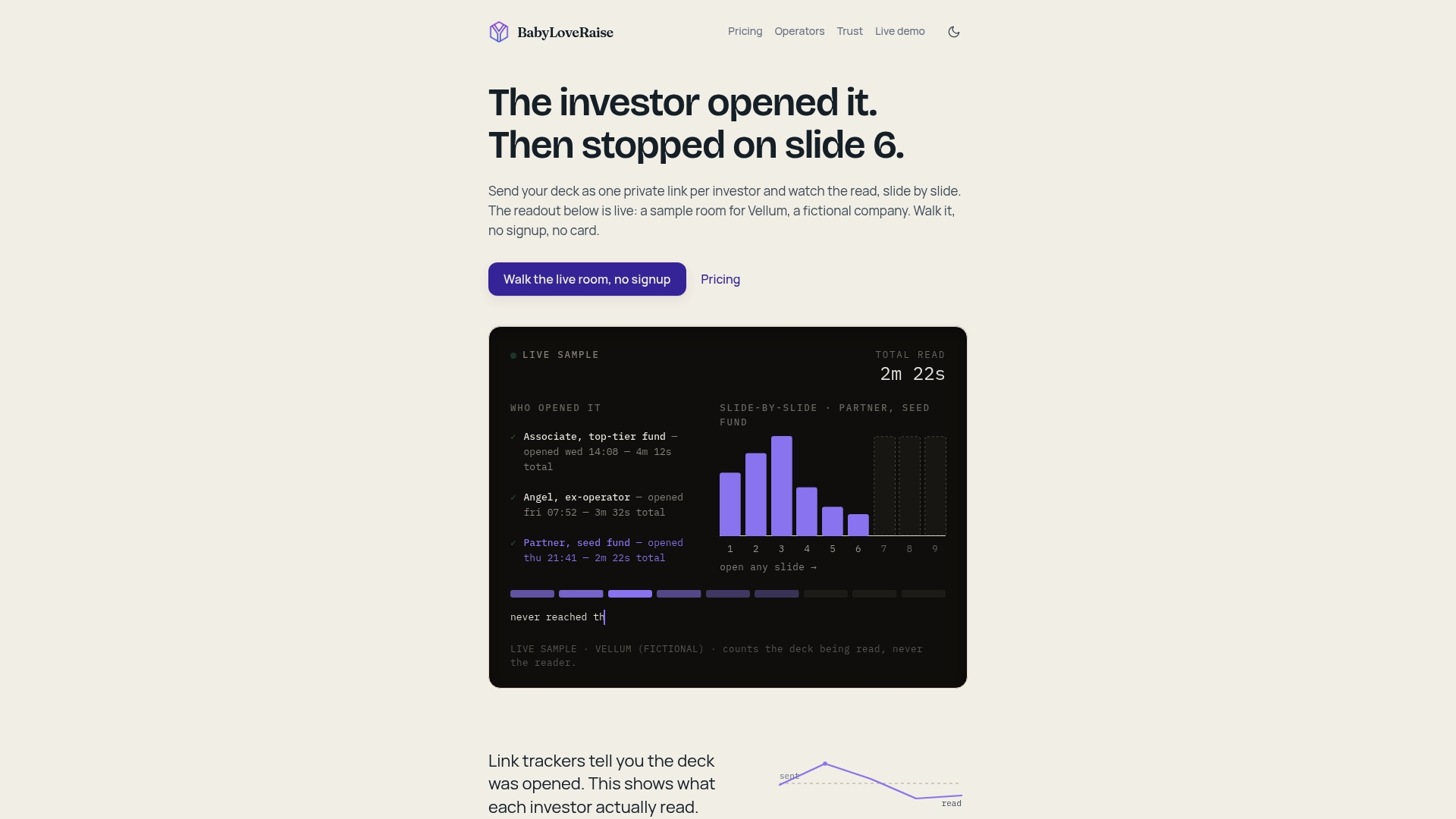
If you’re evaluating Papermark alternatives for an active raise, BabyLoveRaise is the place to start. The per-raise pricing means you’re not paying a seat fee between rounds. The per-slide analytics tell you which investors actually read the deck. And the Operator tier means fractional CFOs and fundraising advisors can run firm-branded rooms across every client raise without enterprise VDR pricing.
Here’s what to test in your trial:
- Upload your current pitch deck and send a tracked link to a test address. Verify that per-slide dwell data appears, not just an “opened” flag.
- Trigger a first-open notification and check how quickly it fires and where it lands (email, dashboard, or both).
- Test the watermarked download: request a download and confirm the identifier is visible.
- If you’re an advisor or fractional CFO, request access to the Operator tier demo and check the white-label room setup.
Check the pricing and plan details to confirm which tier fits your raise size, then visit BabyLoveRaise to set up your first raise room.
Useful sources for deeper reading
- Papermark Alternatives & Competitors - SaaSHub
- DocSend vs Papermark: Which Should You Use? (2026) | DeckExtract
- DocSend vs Papermark: Detailed Comparison
- Top 10 Alternatives to Papermark | Best Document Sharing and Tracking Tools - SaaS Reviewers
- Peony reviews | Capterra
- How to Securely Send a PDF: A 2026 Guide | BabyLoveRaise