
Founders' Raise Closing Checklist: Close Seed Rounds in 10–14 Days
Copy and run a founder's raise closing checklist to move from term sheet to wire in 10–14 days. Day-by-day tasks, cap table reconciliation, Form D timing,...
September 26, 2026 · 11 min read

Run one owner-led closing checklist that names every deliverable, every deadline, and who verifies the wire before funds move. Assign it to a single person, the founder or COO, with counsel supporting on the legal items. The rule that prevents last-mile failure is simple: never confirm a wire based on emailed instructions alone. Verify on a separate channel, every single time.
TL;DR:
- A comprehensive owner-led closing checklist with clear deadlines and verification steps prevents last-minute errors and ensures smooth wire transfers.
- Organize pre-close documents like the cap table and legal agreements early, and confirm they match signed paperwork before drafting continues.
- File Form D within 15 days of the first sale, tracking all state notices and amendments to avoid compliance gaps that could impact future diligence.
- Reconcile the cap table against signed documents and payments at least a week before signing to prevent delays caused by discrepancies.
- Use investor engagement tools to monitor deck reads and prioritize follow-ups, reducing delays caused by investor inattention or silent stalls.
BabyLoveRaiseKeep Investor Follow-Ups MovingBabyLoveRaise shows who opened, finished, or skimmed your deck, helping you focus closing follow-ups on actual investor engagement.Visit BabyLoveRaise
Table of Contents
- What Goes on a One-Page Closing Checklist?
- What Pre-Close Documents Does Investor Counsel Actually Check?
- When Do You File Form D, and Who Owns It?
- Why Does Cap Table Reconciliation Stall So Many Closings?
- Day-by-Day: Running the Close From Term Sheet to Wire
- How Do You Verify a Wire Without Getting Burned?
- What Happens Immediately After the Wire Lands?
- How Does a Raise Room Speed Up Closing Follow-Ups?
- Do You Need to Worry About State Laws Beyond the SEC?
- Practitioner Perspective: Deal Hygiene Under Deadline Pressure
- How BabyLoveRaise Keeps Your Closing Tracker Honest
- Sources
- FAQ
What Goes on a One-Page Closing Checklist?
Investors do not wire money because a term sheet exists. They wire because your checklist proves the round is real, tracked, and moving. A one-page tracker turns a fundraise from a pile of email threads into a status board you can act on daily.
Build it as a simple table with these columns: investor name, committed amount, executed document received (yes/no), wire expected date, wire received date, and owner.
Then run these items against every row:
- Bank account information collected and verified
- New commitments paused once you hit your target
- Final signature pages generated and sent
- Signatures confirmed received from each investor
- Wire receipt confirmed and logged against the row
Use the tracker to move investors through three states: prospect (soft yes, no signed docs), committed (signed, wire pending), and funded (wire confirmed, cap table updated). Follow-ups should always target the gap between committed and funded, not the ones still sitting in prospect. That distinction alone saves founders days of chasing the wrong people.
What Pre-Close Documents Does Investor Counsel Actually Check?
Confirmatory diligence at seed stage is rarely a deep audit. It is a fast check that your paperwork matches what the term sheet describes, and it is one of the areas where the SPA and its closing conditions do most of the work, since the agreement lists exactly what has to be delivered before funds move.
Assemble these before drafts go out:
- Certificate of incorporation, current bylaws, and any charter amendments on file
- A complete cap table covering SAFEs, convertible notes, options, and all signed copies
- IP assignment agreements and employment agreements, including 83(b) election filings
- Material contracts (leases, vendor deals, customer agreements over a meaningful dollar threshold)
- A clean disclosure schedule that flags exceptions instead of hiding them
Pro Tip: Upload the cap table and corporate documents to your data room on D+1, but keep the disclosure schedule and any sensitive contracts on hand for investor counsel to review directly. Handing over a messy disclosure schedule too early invites more redlines, not fewer.
A fundraising documents checklist built before the term sheet lands makes this stage close to instant.
When Do You File Form D, and Who Owns It?
The SEC requires you to file Form D within 15 calendar days after your first sale in a Reg D offering. If day 15 lands on a weekend or federal holiday, the deadline rolls to the next business day, not backward.
Miss it, and you are not automatically penalized, but you do create an unforced compliance gap that shows up in future diligence.
- File electronically through EDGAR, since Form D’s own instructions require it
- Track amendment triggers: material changes to offering terms or new information require an updated filing
- Note annual update requirements if the offering stays open past a year
- Track state notice (“blue sky”) filings and fees for every state where an investor lives
- Name one person as filings owner and put every deadline on a shared closing calendar
A clean seed with organized records commonly closes in 10 to 14 days after the term sheet, which leaves almost no slack for a missed filing deadline.
Why Does Cap Table Reconciliation Stall So Many Closings?
Most founders assume their cap table is accurate because it looks complete. It rarely is. The single most common closing blocker is a cap table that does not match the actual signed documents and payment records behind it, and it usually surfaces at the worst possible moment: after drafts have already gone out.
Before documents get drafted, match every SAFE, note, and option grant against its signed agreement and proof of payment. Any side letter or promised-but-unpapered grant needs to show up explicitly in the disclosure schedule, not live in someone’s inbox.
- Reconcile every instrument against signed paperwork before drafting starts
- Disclose all side letters and verbal equity promises in writing
- Name one owner responsible for cap table accuracy through closing
- Hold ledger updates until funds actually clear, not when documents get signed
Pro Tip: Do the reconciliation pass a full week before you expect signature pages, not the day term sheets get sent. A discrepancy found early is a five-minute fix. Found late, it reopens negotiations you thought were closed.
Day-by-Day: Running the Close From Term Sheet to Wire
Momentum is the resource founders burn through fastest during closing. A term sheet that sits for three weeks while nobody owns the next step is how rounds quietly die. Here is a workable D+1 through D+10 sequence for a straightforward seed round:
- D+1: Founder sends the cap table and corporate documents to counsel; counsel begins drafting the SPA and ancillary documents.
- D+2 to D+3: Counsel circulates first drafts; founder reviews for factual accuracy on the cap table and investor names.
- D+3 to D+5: Investor counsel runs confirmatory diligence and returns redlines; founder and counsel address comments together.
- D+5 to D+6: Final documents circulate for signature; founder confirms every investor has bank information verified.
- D+6 to D+8: Signature pages come back; CFO or founder logs each one against the closing tracker.
- D+8 to D+9: Wire instructions go out through a verified channel; investors initiate transfers.
- D+9 to D+10: Wires confirmed received; cap table updated; counsel issues the closing memo.
Delays almost always happen at step three, when confirmatory diligence surfaces a cap table gap, or at step six, when one investor’s paperwork lags behind everyone else’s. When that happens, re-sequence around the slow party instead of holding the whole round hostage. Close in tranches if you have to. A founder’s fundraising playbook covers how to structure a rolling close when one investor’s diligence runs long.
How Do You Verify a Wire Without Getting Burned?
Wire fraud is not a hypothetical for early-stage rounds. Never treat emailed wire instructions as sufficient on their own, no matter how legitimate the email looks.
Call a known contact at a known phone number, not one listed in the same email, and confirm account details verbally before any transfer goes out. If an escrow agent is involved, require a signed bank letter confirming the account.
- Verify wire instructions by phone before every transfer
- Require a bank letter when routing funds through escrow
- Have the CFO or founder confirm receipt directly with the bank, not just a wire notification email
- Keep wire confirmations and counsel’s closing memo archived permanently
Pro Tip: Treat every wire instruction change, even a “quick update,” as a fraud signal until verified by voice. That single habit blocks the most common closing scam.
What Happens Immediately After the Wire Lands?
The wire clearing is not the finish line. A round is not fully closed until the paperwork catches up with the money.
- Update the cap table and issue stock certificates or ledger entries for each investor
- File or amend Form D if terms changed, and calendar the annual update if the offering stays open
- Archive final signed documents in the data room and send an investor welcome packet
- Trigger a 409A revaluation and handle any related tax or corporate housekeeping
Set your investor reporting cadence in this same window, while the round is still top of mind for everyone involved.
How Does a Raise Room Speed Up Closing Follow-Ups?
Closing delays usually trace back to one problem: founders cannot tell who actually read the deck versus who is quietly ghosting. A raise room like BabyLoveRaise turns those two silences into separate, visible signals instead of one indistinguishable void.
Per-slide engagement data and first-read notifications let you triage investors the moment they open the deck, not days later when you finally ask around.
- Tag investors as never-opened, skimmed, read-and-passed, or committed
- Prioritize calls to investors who finished the deck but have not responded
- Send a targeted follow-up when a specific slide, like the cap table or use of funds, gets skipped
- Feed engagement tags directly into your closing tracker’s owner column
Pro Tip: A “read-and-passed” tag is not a dead lead. It tells you the deck did its job; something else stalled the yes. That is a different conversation than chasing someone who never opened the file. Founders comparing tools for this can check a breakdown of deck completion tracking methods.
Do You Need to Worry About State Laws Beyond the SEC?
Federal exemptions under Regulation D do not erase state-level obligations. Every state where you have an investor can require its own notice filing, sometimes with its own fee, even though state securities regulators generally cannot impose substantive review on offerings that qualify for federal preemption under Rule 506.
That preemption only covers the review itself. It does not cover the notice filing or the fee. If you have investors in California, New York, and Texas, you likely owe three separate state filings with three separate deadlines and three separate fee schedules, on top of your federal Form D.
Miss a state notice and the consequence is rarely dramatic on day one. It becomes a problem later, during your next round’s diligence, when new investor counsel runs a compliance check and finds a gap from two years back. Fixing it retroactively costs more time and legal spend than filing it correctly the first time.
Beyond blue-sky notices, check whether your state has its own definition of “accredited investor” or additional disclosure requirements for offerings to residents, since these occasionally diverge from federal standards in ways that catch first-time founders off guard. A due diligence documents guide is a useful companion here, since state compliance gaps often surface during the same diligence pass that catches cap table discrepancies.
Put every state filing deadline on the same closing calendar as your federal Form D deadline. Treating them as separate systems is how founders miss one while focused on the other.

Practitioner Perspective: Deal Hygiene Under Deadline Pressure
Name one owner for the checklist, then set hard deadlines and hold them. Treat every verbal “I’m in” as a prospect, not a commitment, until you have written confirmation in hand. Resolve small admin items, an unfiled 83(b), an undisclosed convertible, the week you find them. They never shrink with time; they only get more expensive to fix once documents are drafted.
— Paul
How BabyLoveRaise Keeps Your Closing Tracker Honest
Most closing delays are not legal problems. They are visibility problems: you do not know who actually engaged with your deck and who is quietly stalling. A hosted raise room replaces the guesswork with first-read notifications and per-slide engagement data, so you can see the moment an investor opens the deck and how far they actually read.
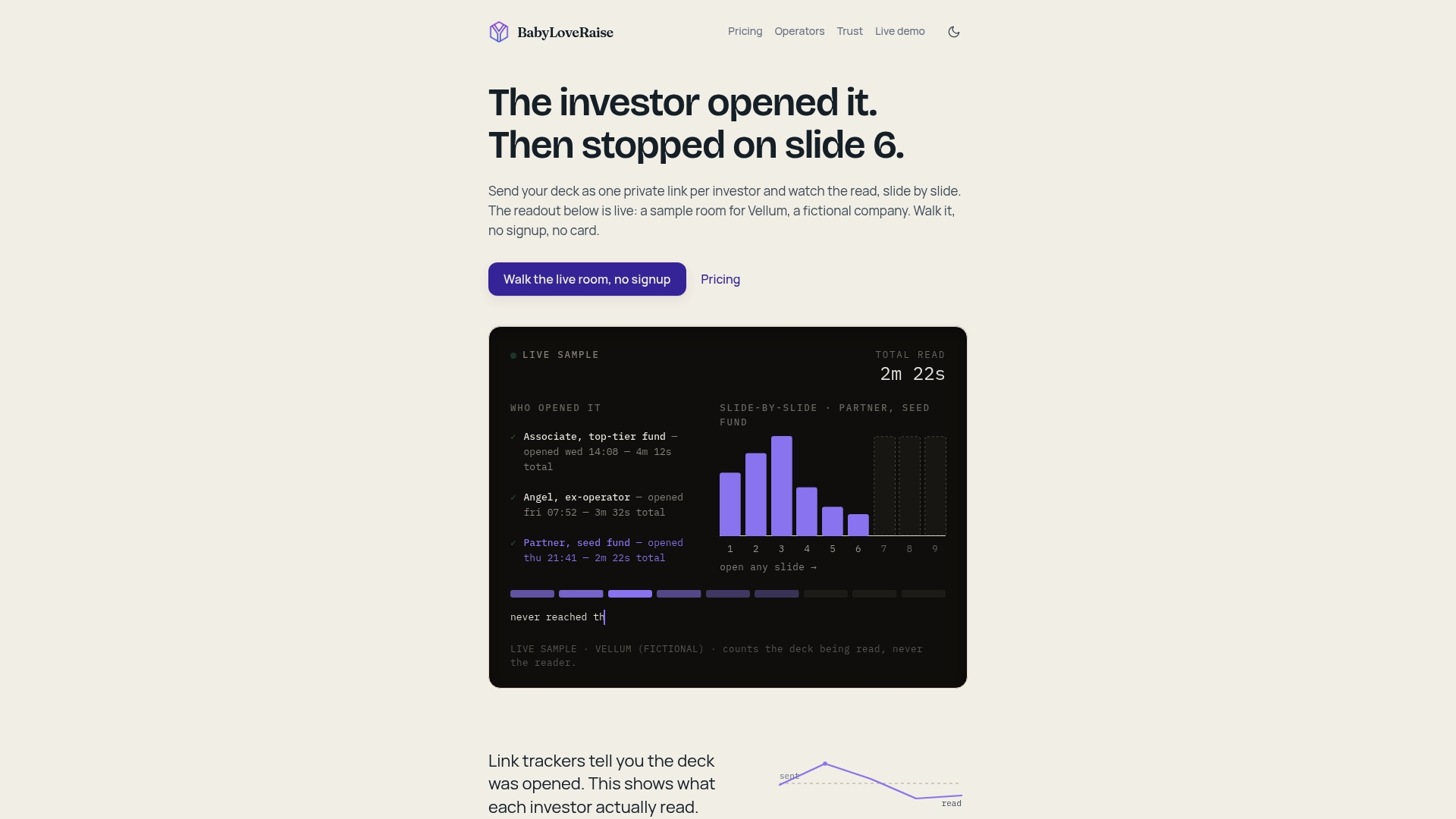
That data feeds directly into the closing tracker described above. An owner dashboard can turn “never opened it” and “read everything and passed” into two distinct, actionable tags, so follow-up calls go to investors who are actually engaged rather than the ones who ghosted. When the round closes, the room converts into a free permanent archive instead of expiring behind a paywall. Fundraising advisory firms and fractional CFOs running multiple client raises can run firm-branded rooms through the Operator seat, priced at $399 per month or $3,990 per year per seat. Founders can check current room pricing, including the $149 monthly or $399 quarterly raise room plans, on the BabyLoveRaise pricing page and set one up before your next round of investor calls.
Sources
Keep these on hand while you run your closing calendar:
FAQ
What Does a Closing Checklist Actually Look Like?
A working closing checklist is a single tracker listing every investor, their committed amount, document status, wire dates, and an assigned owner. It runs alongside a task list covering signatures, Form D filing, state notices, and wire verification, so nothing depends on memory or scattered email threads.
What Documents Do You Need Ready Before Closing?
Investor counsel typically checks your certificate of incorporation, bylaws, complete cap table, signed SAFEs or notes, IP assignments, 83(b) filings, and material contracts. Having a reconciled cap table and clean disclosure schedule ready before drafts go out is what keeps confirmatory diligence fast.
What Should You Confirm During a Final Pre-Close Review?
Before signatures go final, confirm every commitment amount matches the cap table, every signature page has actually been received, and bank details for wires have been verbally verified. Pause new commitments once you hit target so the final numbers stop moving underneath you.
What Should You Do Immediately After a Wire Lands?
Confirm the wire directly with your bank rather than relying on a notification email, then update your cap table and issue ledger entries or certificates. File any required Form D amendment, archive signed documents, and send investors a welcome packet with your reporting cadence.
How Long Does Closing Usually Take Once Terms Are Set?
A clean seed round with organized documents commonly closes in 10 to 14 days after the term sheet is signed. Rounds slow down most often when the cap table does not match signed paperwork or when a state filing gets missed.