
Founders: Run Four Pitch Deck Tests in One Sitting Using Per Slide Data
Run four quick tests in one sitting. Use audits plus per slide analytics to fix your deck and turn engagement signals into targeted investor follow-ups.
October 8, 2026 · 14 min read

The most effective way to test a pitch deck is to run four checks in one sitting: several quick passes: a fast investor scan, a titles-only read for story flow, a slow read for clarity, and checking engagement per slide once investors review the deck. Recurring reviewer comments and real read-through data, the kind platforms like BabyLoveRaise track per slide, tell you which fixes matter and who to follow up with first.
TL;DR:
- Running quick passes, including a 30-second and 150-second scan, helps identify core ideas and hesitation points that could sink investor interest.
- Structured peer reviews with specific prompts and role assignments ensure feedback is actionable and highlights genuine deck gaps across multiple reviewers.
- Analyzing post-send engagement data reveals where attention drops, distinguishing between unread decks and slides that fail to hold interest, guiding targeted improvements.
- Focus on simplifying and sourcing key metrics on each slide, especially traction and ask slides, to clarify messaging and increase the likelihood of investor commitment.
- Use simulated live pitches, including timed runs and Q&A practice, to catch issues that only surface under real presentation conditions.
BabyLoveRaisebabyloveraise.comSee Which Slides Hold AttentionBabyLoveRaise shows who opened your deck, who reached the last slide, and where investor attention dropped during the raise.Explore BabyLoveRaise
Table of Contents
- Quick checklist: the minimum tests every founder should run first
- How to run structured qualitative tests (peer reviews and investor reads)
- How to test with data: analytics, per-slide engagement, and measurable metrics
- Slide-by-slide audit checklist (what to check on each common slide)
- Design and processing fluency: when visuals move the needle (and when they don’t)
- Iterate, validate, and follow up: turning tests into better investor meetings
- Publisher perspective: how BabyLoveRaise-derived analytics change what ‘tested’ means
- Methods to simulate investor presentation conditions for live testing
- Common cognitive biases affecting investor reception and how to mitigate them
- Criteria for selecting test audiences to maximize relevance of feedback
- Author perspective: how I run a quick deck audit in one hour
- How BabyLoveRaise helps founders test and follow up
- FAQ
- Sources
Quick checklist: the minimum tests every founder should run first
Before recruiting reviewers or sending anything to investors, run this sequence yourself. It takes under thirty minutes and catches the problems that sink first impressions.
- 30-second scan: Flip through the deck fast and write down the one idea that stuck. If you can’t name the business in a sentence, neither can an investor.
- 150-second scan: Read it again at a normal pace and note which slide made you stop or reread. That hesitation point is usually where a real reviewer will stall too.
- Titles-only pass: Cover the body of every slide and read just the headlines in order. If the story doesn’t hold together from titles alone, the slide order needs work before the content does.
- 3-minute read test: Print the deck or read it on a single screen, uninterrupted, for exactly three minutes. Mark anything you had to reread.
Two more tests round out the first pass:
- A single-message check on each slide: can you point to one sentence or number that is the slide’s entire job?
- A quick headline A/B split, where you show two phrasings of a weak slide title to two different peers and see which one gets a faster, more accurate guess at the content below it.
Log everything in one template so feedback is comparable across reviewers: slide number, reaction (confused, bored, convinced), and the exact question asked. That structure matters more once you move to outside reviewers in the next test round.
How to run structured qualitative tests (peer reviews and investor reads)
A peer review only works if it’s structured. Unstructured feedback sessions produce vague encouragement, not usable data.
- Set a strict time limit, five to seven minutes to read, then five minutes of questions.
- Assign roles: one reviewer plays a skeptical seed investor, another plays a domain expert, a third just reacts as a generalist.
- Ask the same three prompts every time: “What does this company do?”, “What would make you say no?”, and “What’s missing?”
Recruiting matters as much as the script. A friend who likes you is not a substitute for someone who has sat through dozens of pitches. The Stanford lecture on giving a great pitch suggests using a small set of canonical reviewer profiles, a seed investor, an angel with relevant domain experience, a corporate business development contact, and logging which profile raises which objection. That lets you see whether an objection points to a real gap in the deck or just one reviewer’s specialty.
Log feedback with a simple table: slide number, timestamp, reaction, and the exact question asked. Only treat an issue as real once it shows up across two or more unrelated reviewers; a single complaint is noise.
Weight feedback by who gave it. An objection from someone who invests at your stage carries more than a polished comment from someone who doesn’t.
Pro Tip: Record the session audio (with permission) so you can go back and catch the exact phrasing of a question, not just your memory of it.
How to test with data: analytics, per-slide engagement, and measurable metrics
Qualitative tests catch confusion before a deck goes out. Analytics catch what happens after.
The core metrics worth tracking once the deck is live:
- Open rate, whether the link or file was accessed at all.
- Read-through, the share of opens that reach the final slide.
- Average dwell per slide, which slides hold attention and which get skimmed.
- Drop-off slide, the specific point where readers stop.
- Forwards and downloads, a signal the reader is sharing it internally.
A healthy read-through means most opens make it to the ask slide; a weak one means people are bailing early, often right at a dense traction or market slide. When dwell time on a specific slide is unusually short, that slide is being skimmed, not read, and is a candidate for simplification regardless of what reviewers said about it.
One well-documented finding changes how to weigh engagement data: both visual fluency and substantive quality increased investor time spent significantly and slides viewed moderately in a large-scale field and lab study (https://journals.aom.org/doi/10.5465/AMPROC.2025.456bp), but only substantive quality moved actual investment likelihood. That means a deck can look engaging and still fail to convert, so dwell time alone isn’t the goal, dwell time paired with a stronger ask is.
Once a fix is live, test it against the same cohort rather than a new batch of investors, since baseline differences between cohorts can make an unrelated improvement look like noise or vice versa.
This is where per-raise, per-slide signals change the follow-up strategy entirely. A platform like BabyLoveRaise distinguishes “never opened” from “opened and read to the end but didn’t reply,” two silences that look identical in an inbox but demand completely different follow-ups.
Slide-by-slide audit checklist (what to check on each common slide)
Run this checklist against each slide type, using the narrative structure most pitch guides converge on: intro, problem, solution, market, business model, go-to-market, competition, traction, team, ask.
- Cover: must state what the company does in one line; cut anything decorative that doesn’t serve that line.
- Problem: needs one concrete pain point with a real cost attached, not a general industry complaint.
- Solution: should show the product doing the thing, a screenshot or diagram beats a paragraph of description.
- Market: needs one credible sizing figure tied to a named source, not a stacked TAM-SAM-SOM guess with no citation.
- Traction: the single most important slide for commitment; show the metric that moved, not every metric you have.
- Team: one line per person on why they specifically can execute this, not a résumé dump.
- Ask: a specific number and what it funds for a specific period, vague asks read as unprepared.
Keep the deck to roughly 10 to 15 slides, a range investor-facing guides commonly recommend, and move detailed financials, technical diagrams, or long case studies to an appendix. Tighten headlines by cutting adjectives, “Our Revolutionary Platform” becomes “We Process 10,000 Orders a Day,” and simplify any slide with more than one chart or more than three bullet points.
Design and processing fluency: when visuals move the needle (and when they don’t)
Design matters, but not the way founders assume. The same field and lab study found that visual fluency and substantive quality each independently increase engagement, but only substantive quality predicted investment commitment. A beautiful deck gets read longer. A well-argued deck gets funded.
That doesn’t mean design is wasted effort, it just means design earns attention, not conviction. Practical rules that help without becoming the point:
- One message per slide, no exceptions.
- A font size readable at arm’s length on a phone screen.
- Consistent colors and spacing across every slide, inconsistency reads as rushed.
- A grayscale audit: print or screenshot the deck in black and white and check that hierarchy still works without color.
Two cheap experiments confirm whether design is doing its job. Run the printed 3-minute scan again after a redesign and see if comprehension improved. Run the grayscale version past a reviewer who hasn’t seen the color version and see if they still get the point of each slide.
Iterate, validate, and follow up: turning tests into better investor meetings
Not every piece of feedback deserves the same response. Prioritize by impact times effort: a confusing traction slide that three reviewers flagged outranks a font tweak nobody mentioned.
- Week one: fix the two or three highest-impact issues from your logs, rerun the titles-only and 3-minute tests to confirm they’re resolved.
- Week two: send the revised deck to a fresh small batch of reviewers or early investor contacts and track read-through and drop-off.
Segment outreach by what the data actually shows. Someone who never opened the deck needs a different nudge than someone who read to the end and went quiet, the first might need a shorter subject line, the second might need a direct question about their hesitation.
Recurring investor questions are data too. If three separate investors ask the same thing the deck doesn’t answer, that question becomes a new slide or an appendix entry, not just talking points for your next call.

Pro Tip: Keep a running log of every investor question across meetings; a question that repeats three times is a deck gap, not a coincidence.
Publisher perspective: how BabyLoveRaise-derived analytics change what ‘tested’ means
Testing a deck used to mean guessing from silence. A founder sent a PDF and heard nothing back, with no way to tell whether the investor never opened it or read every slide and passed anyway.
Per-slide engagement data closes that gap. A raise room that flags who opened the deck, who read to the final slide, and which slides held attention lets a founder split follow-ups into two real groups instead of treating every non-reply the same way. That distinction turns a vague “no response” into either a re-send with a sharper subject line or a direct question about what stopped a reader who clearly engaged.
For founders who want more than data, an editorial pass offers a second set of eyes on the narrative itself, and a white-label operator console lets fractional CFOs or advisory firms run the same analytics across every client raise they manage.
Methods to simulate investor presentation conditions for live testing
A deck that reads well on a screen can fall apart in a live pitch. Simulating real conditions before the actual meeting catches problems a solo read-through never will.
Set a strict clock, most seed pitches run 10 to 15 minutes with questions folded in, and have a reviewer play timekeeper who interrupts exactly as an impatient investor would. Practice the pitch standing up, out loud, in front of at least one person who asks follow-up questions mid-sentence instead of waiting politely.
Run the pitch over video call at least once, since screen-sharing lag, smaller visible text, and the lack of eye contact change how a deck lands compared to an in-person read. Record that call and watch it back, most founders catch filler words and rushed slides faster on playback than in the moment.
Finally, rehearse the Q&A separately from the pitch itself. Have reviewers fire the toughest questions they can think of, the weak market slide, the thin team bio, the unrealistic revenue projection, back to back with no warm-up, since that’s closer to how a skeptical partner meeting actually feels than a friendly solo run-through.
Common cognitive biases affecting investor reception and how to mitigate them
Investors are not neutral evaluators, and knowing which biases are in play helps you design a deck that survives them.
Confirmation bias means an investor who already has a thesis about your category will read your deck looking for evidence that confirms it, and skim past anything that doesn’t. Lead with the traction or market data that matches common theses in your space, then use later slides to introduce the parts of your story that complicate the simple narrative.
Anchoring means the first number an investor sees sets the frame for everything after it. If your market-size slide leads with an inflated figure, a reasonable valuation ask later can look greedy by comparison, so keep early numbers conservative and well-sourced.
The halo effect lets a polished design or a strong team slide create unearned trust in weaker slides elsewhere in the deck, which is exactly why the design-versus-substance research matters: a slick deck buys attention, not scrutiny-proof credibility.
Recency bias means the ask and the final slide stick longest in an investor’s memory after a meeting. End on your strongest, most specific point rather than a generic thank-you slide.
Mitigating this isn’t about manipulation, it’s about not letting a known perceptual shortcut accidentally undercut an otherwise strong case.
Criteria for selecting test audiences to maximize relevance of feedback
The wrong test audience produces confident, useless feedback. A former coworker with no investing experience will tell you the deck “looks great,” which tells you nothing about whether it survives a real partner meeting.
Match reviewers to your actual fundraising stage. Someone who only writes Series B checks will flag concerns that are irrelevant to a pre-seed raise, like a thin go-to-market slide that no pre-seed company has fully proven yet.
Prioritize reviewers with relevant domain exposure over reviewers with only general investing experience. An angel who has backed three companies in your exact category will catch a weak market slide faster than a generalist with a bigger portfolio but no category context.
Mix reviewer types deliberately rather than relying on one kind of feedback. A practitioner guide on building investor decks recommends logging each reviewer’s background and firm stage focus alongside their feedback, which lets you tell a structural weakness in the deck apart from one reviewer’s narrow specialty.
Avoid over-indexing on a single enthusiastic or harsh reviewer. Feedback only becomes actionable once the same issue shows up across reviewers with different backgrounds, which is the entire point of logging context alongside comments rather than just the comments themselves.
Author perspective: how I run a quick deck audit in one hour
My one-hour version: ten minutes on the 30-second and titles-only scans, twenty minutes on a slow read with a printed copy and a pen, twenty minutes drafting edits, ten minutes rereading just the ask slide and the traction slide twice.

Two edits that almost always help: cutting the market slide’s TAM number down to one sourced figure, and rewriting the cover line until a stranger could repeat it back after one read.
Three red flags that mean a rewrite, not an edit: no one can state the business model after reading the whole deck, the traction slide has no number at all, or the ask slide doesn’t say what the money funds.
— Paul
How BabyLoveRaise helps founders test and follow up
Once your deck passes the manual tests above, the harder problem starts: knowing what happens after you hit send. We built raise rooms specifically to answer that, tracking per-slide dwell time, flagging who read to the final slide, and separating real readers from the inbox silence every founder assumes is a rejection.
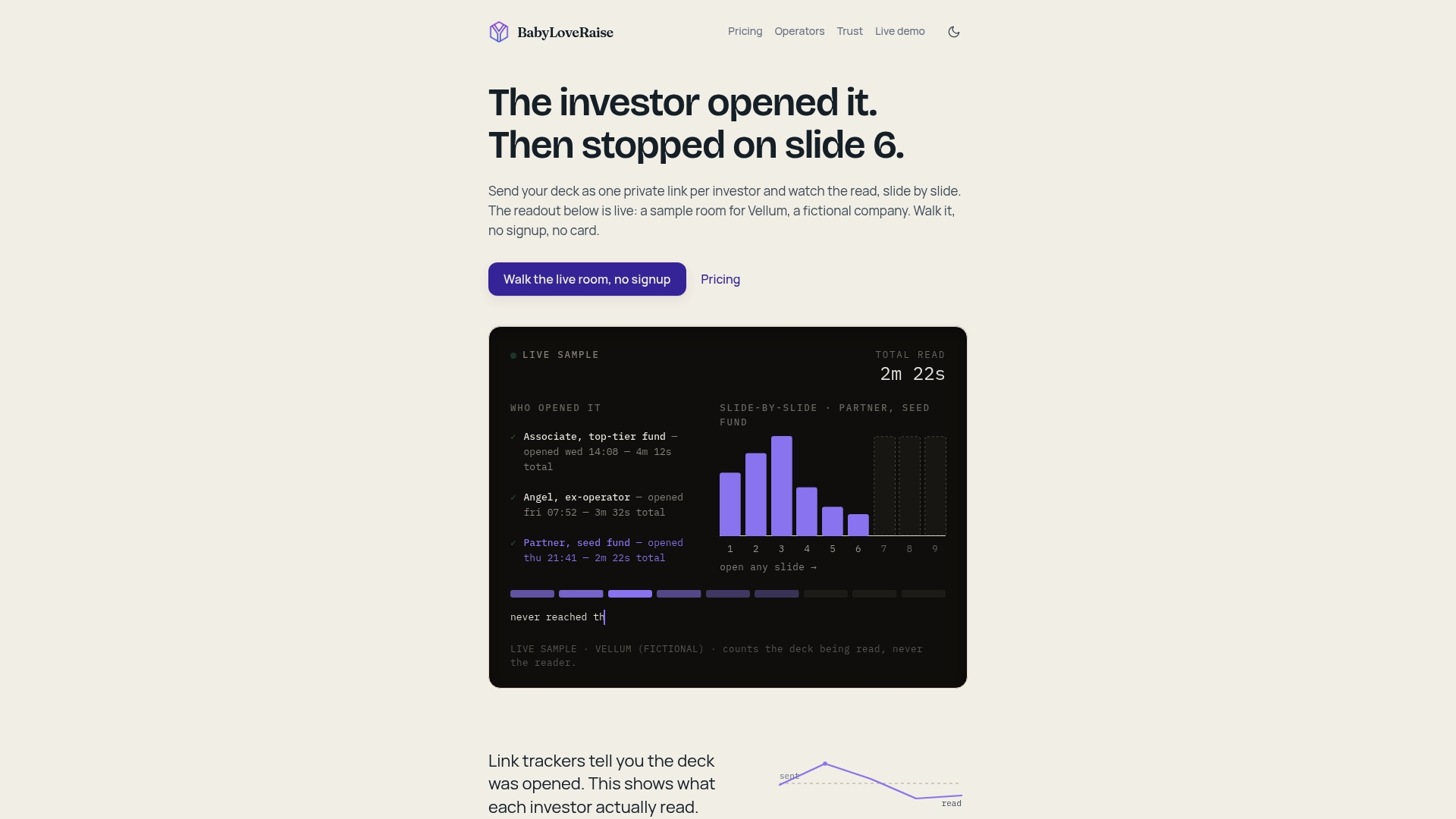
- Per-slide dwell data shows exactly where attention drops, so revisions target the slide that’s actually losing readers.
- Read-to-end flags turn ambiguous non-replies into a segmented follow-up list instead of one generic batch of “no response” names.
- Per-raise pricing means the room is built around a single fundraise, not a perpetual per-seat license.
The raise room runs $399 per quarter or $149 per month, and advisory firms running multiple client raises can check operator seat pricing for a white-label console. Founders who want editorial help on the deck itself can add that pass from the same pricing page.
FAQ
What is the 10/20/30 rule for pitch decks?
The 10/20/30 rule suggests a deck of no more than 10 slides, a presentation under 15 minutes, and text no smaller than 30-point font. It’s a rough heuristic for keeping a pitch concise rather than a strict standard every investor expects.
Can ChatGPT create a pitch deck?
ChatGPT can help draft slide copy, tighten headlines, and suggest a narrative structure based on common frameworks like problem, solution, market, and traction. It can’t replace testing the deck with real reviewers or tracking how investors actually engage with it once sent.
Is there a free tool I can use to create pitch decks?
Several free slide tools, including Google Slides and Canva’s free tier, let founders build a deck from scratch or from a template at no cost. For testing how a finished deck performs once it’s with investors, dedicated engagement tracking is a separate step from the design tool itself.
What are some good pitch deck examples?
The Smartcar deck that raised $2 million in seed funding from Andreessen Horowitz is a widely cited example of a concise, evidence-backed deck with a clear ask. Reviewing a handful of published decks that closed real rounds is a faster way to calibrate slide-by-slide expectations than guessing from templates alone.
How many slides should a pitch deck have?
Most investor-facing guides recommend keeping a core deck to 10 to 15 slides, with detailed financials or technical material moved to an appendix. A longer deck tends to lose readers well before the ask slide.
Sources
- Content vs. Design in Startup Pitch Decks: Evidence From Field and Lab Experiments | Academy of Management Proceedings
- Giving a great pitch (Stanford lecture)
- How to craft a winning pitch deck | Mercury