
Traceable Deck Watermarks: 5 Records Founders Need for Investor Follow Up
See how founders use traceable deck watermarks to match investor activity to copies, verify leaks, keep records, and guide follow up with clear disclosure.
October 11, 2026 · 10 min read

A traceable deck watermark embeds a recipient-specific identifier inside a pitch deck so a founder can link an opened, downloaded, or forwarded copy back to the person who received it. Paired with activity logs, it gives founders real attribution and a deterrent effect during outreach. Used responsibly, it requires clear disclosure to recipients and a well-kept registry, and never silent surveillance of investors.
TL;DR:
- Maintain a registry linking each recipient and organization to their email address, deck version, watermark ID, issue time, and link type; pair it with activity logs.
- Place a clear notice at the top of the share screen or first email line; obtain affirmative consent before reusing engagement data for another purpose.
- Use view only links for broad early outreach, private links and watermarked downloads for sensitive diligence, and forwardable links for trusted repeat investors.
- Watermark detection can fail after cropping or rephotography, and a match identifies the recipient’s copy, not who shared it; test detectors against likely leak scenarios.
- Watermarking controls distribution but cannot replace truthful offering materials that are not misleading or legal advice from counsel during a formal raise.
BabyLoveRaisebabyloveraise.comMake Deck Engagement Easier to ReadBabyLoveRaise records first reads, per-slide engagement, and measured watermarks in hosted raise rooms, helping founders follow up with more context.Explore raise rooms
Table of Contents
- How traceable deck watermarks work, including provenance, logs, and integrity
- What to record: the copy registry and activity evidence founders must maintain
- Privacy and compliance checklist: what to disclose and when to get consent
- Operational setup: link types, watermarked downloads, and your dashboard workflow
- How to verify a leaked copy and what evidence a watermark provides
- When to choose watermarking versus other controls
- How traceable deck signals change a founder’s follow-up
- BabyLoveRaise: a raise room built around these exact signals
- FAQ
- Sources
- Primary sources and technical references
How traceable deck watermarks work, including provenance, logs, and integrity
A traceable watermark is really three separate functions working together: a provenance mark embedded in the file, an activity log tracking what happens after the file leaves your hands, and an integrity check confirming the file hasn’t been altered.
- Provenance watermark: a visible or invisible marker, often a recipient ID, timestamp, or version tag, embedded in the deck itself.
- Activity log: a server-side record of opens, downloads, and time spent per slide, tied to the link or account used to access the deck.
- Integrity check: a hash or digital signature that confirms whether the file matches what you originally sent.
Covert watermarks hide the payload inside pixel data or text spacing so casual viewers never see it; overt watermarks print a visible identifier on each page, which doubles as a deterrent. Both can carry a recipient ID, a timestamp, and a deck version number.
Robustness has limits. Peer-reviewed research on PDF watermarking shows some methods survive print and scan attacks and JPEG compression under specific test conditions, but performance varies by method and isn’t guaranteed across every tool or file type. A watermark that survives a screenshot or a scrubbing attempt in one study may not in another. Test your detector against the leak scenarios you actually worry about, a re-uploaded PDF, a printed-and-scanned page, a cropped screenshot, rather than trusting a vendor’s general claim.
What to record: the copy registry and activity evidence founders must maintain
A watermark is only useful if you can match it to something. That means keeping a copy registry: a simple record connecting every deck you send to the person who received it.
- Recipient name and organization
- Email address used to send the deck
- Deck version and unique watermark ID
- Issue timestamp
- Link type (first-send, forwardable, or private)
Pair that registry with activity evidence: first open, completion to the final slide, per-slide dwell time, any download event where the watermark was applied, and print or export actions. On their own, these events are ambiguous. “Never opened it” and “read everything and went quiet” look identical in a plain email thread. Matched against registry entries keyed to watermark IDs, they become two different signals, one tells you to resend, the other tells you the slide where attention died and the deck needs work.
Pro Tip: Keep a versioned hash or signature alongside each registry entry so you can confirm later whether a leaked copy matches the original file or was altered.

Privacy and compliance checklist: what to disclose and when to get consent
Tracking a confidential pitch deck sits close to territory the Federal Trade Commission has flagged before. FTC guidance on confidential-context tracking warns against misrepresenting how tracking works when information is collected in a confidential setting, and notes that affirmative express consent may be required if that data gets reused for a different purpose than the recipient expected.
Practical disclosure doesn’t need to be a legal memo. A short, visible line works better than a buried privacy policy:
- “This deck includes a per-recipient identifier so we know who’s reviewed it. We don’t track anything beyond deck engagement.”
- “Opening this link lets us see when the deck is read. We use that only to follow up on your raise.”
Short disclosures placed at the top of the share screen or in the first line of the email outperform policy text buried in a footer, which matches FTC guidance on confidential-context tracking favoring clear, conspicuous notice over fine print.
Watermarking also has a ceiling on what it can do legally. Investor reminds issuers that distribution controls like watermarking don’t substitute for accurate, non-misleading offering materials. Tracking who has your deck doesn’t replace the legal obligation to keep that deck truthful, and founders running a formal raise should still involve counsel on disclosure language.
Operational setup: link types, watermarked downloads, and your dashboard workflow
Most of the decision-making happens before you hit send. Three link types cover nearly every founder scenario:
- First-send links go to one named recipient and are built for the first touch with a new investor.
- Forwardable links let a partner loop in colleagues, useful once an investor is engaged and bringing in their team.
- Private, non-forwardable links lock access to a single person or domain, suited for highly sensitive financials or late-stage diligence.
Whether to allow downloads depends on sensitivity and investor expectations. A view-only room tracks engagement without ever letting the file leave your control; a download with a measured watermark trades some control for convenience, useful once you trust the recipient and expect them to reference the deck internally. For a resource comparing password protection against per-viewer watermarking, the trade-offs come down to friction versus traceability.
Lifecycle choices matter too. Expiring links limit how long a stale copy stays active, and converting a room into a permanent archive once the raise closes avoids leaving dead links in investors’ inboxes. Fast notification timing, such as a prompt first-read alert, lets you act on real signal instead of guessing.
Pro Tip: Map each notification type (first open, completion, download) to a specific follow-up action in your CRM so alerts translate into outreach instead of just dashboard noise.
For more on access control setup, see how to configure pitch deck access for investors.
How to verify a leaked copy and what evidence a watermark provides
If a deck surfaces somewhere it shouldn’t, move carefully before you draw conclusions.
- Preserve the leaked copy exactly as found, don’t edit, re-save, or re-compress it.
- Run your watermark detector against the preserved sample.
- Compare any extracted ID against your copy registry to identify the original recipient.
- Keep your original files and detection tools on hand, since many extraction methods are non-blind and require the source file for comparison.
Watermark evidence is circumstantial, not conclusive. A determined leaker can crop, screenshot, or re-photograph a page in ways that defeat some detection methods, and a match only shows the copy originated from a given recipient’s file, not who physically shared it. Treat a confirmed match as the start of a conversation, not a verdict, and keep a simple chain-of-custody note (who found it, when, where) in case the matter needs legal follow-up.
When to choose watermarking versus other controls
Watermarking isn’t the only lever. The right mix depends on a few questions: how sensitive is the material, how wide is the intended audience, and do you need attribution after the fact or deterrence up front?
- Early-stage, broad outreach: a first-send link with view-only access and a visible notice usually covers it.
- Later-stage diligence with financial detail: private links, watermarked downloads, and an NDA together.
- High-trust, repeat investors: forwardable links with light disclosure, since friction here costs more than it protects.
The operational note worth remembering: the lightest control that still gets you the signal you need preserves investor trust better than stacking every protection on every send. For a deeper look at NDA alternatives, see confidentiality tiers that skip heavy legal friction.
How traceable deck signals change a founder’s follow-up
The biggest shift I’ve noticed in how founders use these tools isn’t the watermark itself, it’s what a first-read alert does to follow-up timing. Knowing a partner opened your deck twelve minutes ago changes what you say in your next email, and per-slide dwell data tells you whether your traction slide is landing or your market-size slide is losing people.
None of that works if investors feel surveilled. Disclosing the tracking plainly, in one line, keeps the relationship honest and actually makes investors more comfortable engaging, since they know what’s being measured and why.
If you’re running a raise right now, test a workflow that treats tracking as a follow-up tool, not a surveillance exercise. The signal is only as good as what you do with it.
— Paul
BabyLoveRaise: a raise room built around these exact signals
Everything in this guide, the watermarked downloads, the registry logic, the disclosure-first tracking, is what our raise room at BabyLoveRaise runs by default. Founders send one room link instead of a bare PDF, and the tool notifies them the moment a partner opens the deck for the first time, then tracks per-slide attention through to the end.
- Per-recipient download watermarking can be applied, so a downloaded copy can trace back to its recipient.
- Multiple link registers (first-send, forwardable, private) can match how far along a conversation is.
- An owner dashboard can distinguish silence as two signals: never opened versus read and went quiet.
- Expiring links during the raise, converting to a permanent archive once it closes, are possible.
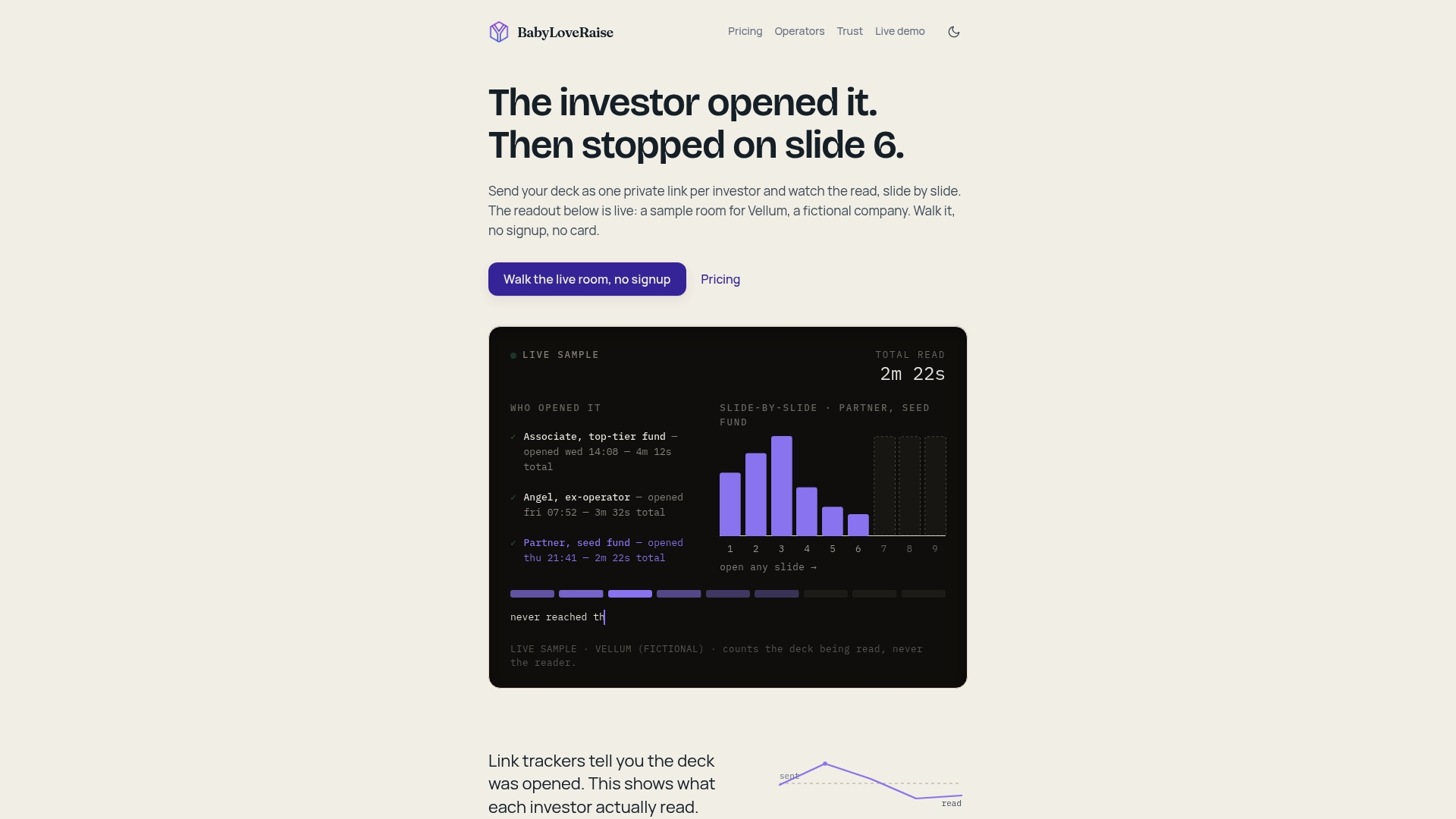
For advisors and fractional CFOs managing several client raises at once, an Operator tier can run firm-branded rooms across clients, and an editorial pass is available for founders who want a narrative review before the deck goes out. Check pricing for the raise room and editorial pass, or see Operator seat options if you’re running raises for clients.
This article is general information, not a substitute for advice from a qualified financial advisor. Consult a qualified financial professional about your own circumstances before acting on anything here.
FAQ
What makes a watermark “traceable” versus just decorative?
A traceable watermark carries a unique identifier tied to a specific recipient, deck version, or timestamp, so a copy can be matched back to who received it. A decorative or generic watermark just labels the file as a draft or confidential without any recipient-specific data.
Do I need investor consent to track deck engagement?
FTC guidance suggests that tracking collected in a confidential context may need affirmative express consent if reused for unrelated purposes, and clear disclosure is the safer default regardless. A short, visible notice at the top of your share link or email covers most founder scenarios.
Can a watermark survive someone printing and scanning the deck?
Some PDF watermarking methods have shown robustness to print-scan attacks and JPEG compression in peer-reviewed testing, but results vary by method and aren’t guaranteed universally. Always test your specific detector against the leak scenario you’re worried about before relying on it.
Does watermarking replace the need for accurate offering materials?
No. Investor.gov guidance is clear that distribution controls like watermarking don’t substitute for truthful, non-misleading offering materials or legal compliance during a raise.
What’s the difference between BabyLoveRaise’s raise room and a generic document-tracking tool?
Our raise room is built specifically around a fundraise: first-read alerts, per-slide dwell data, per-recipient watermarking, and a free permanent archive once the raise closes, priced per raise rather than per seat indefinitely. General document trackers treat a pitch deck like any other file share without that fundraising-specific workflow.
Sources
- Robust PDF watermarking against print–scan attack - PMC
- Reducing Risks Posed by Synthetic Content: An Overview of Technical Approaches to Digital Content Transparency
- Notice of Penalty Offenses Concerning Misuse of Information Collected in Confidential Contexts (FTC)
- Investor
Primary sources and technical references
- Robust PDF watermarking against print–scan attack - PMC
- Reducing Risks Posed by Synthetic Content: An Overview of Technical Approaches to Digital Content Transparency
- Notice of Penalty Offenses Concerning Misuse of Information Collected in Confidential Contexts (FTC)
- Notice of Penalty Offenses Concerning Misuse of Information Collected in Confidential Contexts (Beneficial/FTC)
- Investor