
Board Deck Tracking: See Who Reads Your Deck and Acts
Board deck tracking for founders: how to see who opened, read and forwarded your deck, what the data can't tell you, and how to follow up without spooking investors.
November 12, 2026 · 11 min read

Board deck tracking means sending your deck through a hosted link instead of an attachment, so you can see who opened it, how far they read and which slides held their attention. If you are raising a pre-seed or seed round, that turns “no reply” from a mystery into something you can act on. Below is what to track, how to set it up, what the numbers can’t tell you and how to keep it respectful.
A note on the phrase: people search “board deck tracking” for two jobs. One is tracking the pitch deck you send investors, the people who may one day sit on your board. The other is tracking how existing directors use quarterly board packs. This guide covers the first, because that is where silence costs a founder the most.
BabyLoveRaisebabyloveraise.comKnow What Happens After You ShareBabyLoveRaise tracks first reads and slide engagement in a hosted raise room, helping you follow up with readers and refine your deck.VisitTL;DR
- Send one hosted link per investor instead of a PDF, so every open, read-through and revisit is tied to one conversation.
- Track four signals: first open, completion, per-slide time and return visits. Treat each as a clue, never a verdict.
- Follow up on readers, not on everyone. Someone who reached the last slide and came back gets a different message than someone who never opened.
- Use slide-level patterns to revise the deck, but only after several readers show the same drop-off.
- Keep tracking about the document, not the person: say what you collect, limit downloads and keep the deck’s sensitive detail for later stages.
Table of Contents
- What deck tracking measures, and how it differs from a shared link
- How to tell whether an investor opened, read or forwarded your deck
- Setting up tracked sharing: links, permissions, downloads and watermarks
- What the signals mean, and what they don’t
- Turning engagement into follow-ups
- When to revise the deck
- Privacy, confidentiality and respect for the reader
- Our view
- Run your raise in one room
- FAQ
- Sources
What deck tracking measures, and how it differs from a shared link
A plain share link or an emailed PDF answers one question: did I send it? Tracking answers a better one: what happened after I sent it?
The core measurements are simple:
| Signal | What it shows | What it can’t show |
|---|---|---|
| First open | The deck reached a real inbox and someone clicked | Whether the person, an assistant or a link scanner opened it |
| Completion | How far into the deck the viewer went | Whether they understood or liked it |
| Per-slide time | Which slides held attention and which were skimmed | Whether a long pause meant interest or a phone call |
| Return visits | Someone came back, often before a partner meeting | Why they came back |
| Forwarding | The link reached a new viewer | What the new viewer thinks |
The difference from a Drive link is the feedback loop. With a Drive link you guess. With a tracked room you get a timeline per investor, and you can stop treating a quiet inbox as one single state.
That is the idea behind how we built BabyLoveRaise. Two situations look identical in your inbox today: the investor never opened your deck, and the investor read everything and passed. They call for opposite responses. Our guide to pitch deck analytics goes deeper into the metrics themselves.
How to tell whether an investor opened, read or forwarded your deck
Opened
The open notification is the simplest and most useful signal. It tells you the email landed and the link was clicked, so you can stop wondering whether it went to spam. If a week passes with no open, the problem is the email or the subject line, not the deck. Resend with a shorter note, or ask a mutual contact to nudge. We cover timing in pitch deck notifications.
Read
Completion tells you whether a reader reached the ask, the team and the traction slides, the parts most investors jump to. Look at it together with per-slide time. A reader who spends little time on slides 1 to 3 and then lingers on the traction and financial slides has told you something: they are scanning for numbers. A reader who drops off at the market slide has told you something different.
Forwarded
In practice, forwarding is how a deck moves from an associate to a partner. A forwardable link lets you see a new viewer appear without you having to ask. A founder who sends a deck as a closed PDF has no idea this happened. A founder using a tracked room sees a second or third viewer on the link and knows the deck is circulating inside the firm.
Because some investors prefer to forward and others want their reading kept private, we give share links three registers: first send, forwardable and private. Pick the one that fits the stage of the conversation. Our post on tracking investor engagement walks through when to use each.

Setting up tracked sharing: links, permissions, downloads and watermarks
The setup matters more than the tool. A messy setup produces data you can’t trust.
- One link per investor or firm. If you post a single link in a group email, you lose the ability to tell who read what. Separate links give you a clean list of readers.
- Start with the right deck. Cold outreach works best with a short teaser, and the full deck goes out after a conversation. Startup fundraising guidance on protecting your deck recommends exactly this tiering, along with holding detailed financials and contracts for a formal data room during serious diligence.
- Decide on downloads. Downloads are the one place where your tracking stops. Once a PDF is saved, you can’t see who reads it next. Many founders allow viewing in the browser at first and enable downloads when an investor asks for the file.
- Use watermarks where leaks matter. A watermark that stamps the viewer’s identity on a downloaded copy makes a leaked file traceable. In BabyLoveRaise, downloads can carry a measured watermark.
- Reserve the data room for diligence. Full virtual data rooms use granular permissions per user and per document, plus dynamic watermarks and download prevention, as this founder guide to sharing information with investors describes. That level of control suits later stages, not a first send. If you are weighing that step, see our comparison of data room alternatives for startups.
Whichever tool you use, the way you handle files matters beyond the deck itself. Knowing which secure file sharing methods fit a small team helps you decide who inside your company can see the cap table and contracts, and how.
What the signals mean, and what they don’t
This is where most founders go wrong. Engagement data is evidence, but it is thin evidence. Read it as a set of probabilities.
Patterns worth acting on
- Opened, read to the end, came back once. The deck is probably being discussed. A short, specific note is welcome, such as one new metric or an offer to answer questions before a partner meeting.
- Opened, stopped halfway. The reader may have been interrupted, or the middle of the deck lost them. If several readers stop at the same slide, that slide is the problem.
- Several viewers on a forwardable link. The deck is moving. Offer a call and a data point, not a nudge.
- Never opened. Fix delivery before you assume disinterest.
Patterns that mislead
- A very short open. It may be a mobile glance on the way to a meeting. It may also be an automated preview. One short visit is not a rejection.
- A long dwell on one slide. It may mean confusion rather than interest. A dense chart can hold attention because it is hard to read.
- No activity after a read. Silence after a full read is often a polite pass. That is useful too: it lets you stop chasing and move on to the next name.
- Skipped slides. Some investors jump straight to traction and team. Skipping is a reading habit, not a verdict on the slides they skipped.
Two cautions apply to everything above. First, don’t compare yourself to published averages as if they were a pass mark. The figures floating around for viewing time come from small samples and vary by stage and sector, so use them as color, not as targets. Second, a single investor’s behavior says little. Patterns across five or more readers say much more.
Turning engagement into follow-ups
Follow-ups work when they add something. “Just checking in” adds nothing. Tracking gives you a reason to write something better.
After a full read and a return visit. Send a short note with one fresh fact, such as a new customer, a signed pilot or a revenue milestone, and offer 20 minutes. Our guide on following up after a second visit covers wording.
After an open with no read-through. Wait a few days, then send a one-line summary of the deck’s strongest point and ask if a call is easier than reading.
Before a meeting. If an investor reopens the deck the day before your call, open with the slides you know they revisited. See investor meeting prep for how to use read data in the room.
Timing. Reopens are often a timing signal. A return a week later may mean the deck reached a partner meeting. Our piece on reading reopens as timing explains how to use that.
Build a simple target list. One column for each investor, one for status (not opened, opened, finished, returned) and one for your next action. After a week you’ll see where your effort should go.

When to revise the deck
Revise on patterns, not on individual reactions. A workable rule: wait until you’ve sent the deck to at least five or six investors, then look for a slide where several of them dropped off or skimmed.
Then ask three questions:
- Is that slide too dense, or too late in the deck?
- Does it answer a question the previous slide raised?
- Would moving it, cutting it or splitting it help?
Change one thing at a time, so you can tell what helped. If you swap three slides at once, the next group’s behavior tells you nothing. Our overview of pitch deck engagement metrics lists what is worth showing and tracking.
Some founders want a second pair of eyes on the narrative. That is what our editorial pass is for: a human review of the deck, rather than only a dashboard.
Privacy, confidentiality and respect for the reader
Investors know decks are tracked. What they dislike is feeling watched. The line between the two is how you collect and how you use the data.
- Track the document, not the person. Slide time and completion describe how a deck performs. A profile of an individual investor’s habits is something else, and it is rarely useful.
- Never quote the data back. A message that says “I saw you opened the deck at 11:42 last night” is creepy. “Happy to walk through the traction slide if useful” is not.
- Don’t over-protect. Pushing NDAs on investors tends to hurt more than it helps; the guide on protecting a pitch deck calls an early NDA request a red flag. Tiered decks and controlled downloads protect you more sensibly.
- Know your own data. Know what your tool stores, who on your team can see it and what happens when the raise ends.
We wrote a longer piece on this: pitch deck tracking without turning investors into profiles. You can also read how we handle data on our trust page.
If the deck holds anything legally sensitive, such as unreleased customer names or regulated financial claims, talk to your startup attorney before deciding what goes in the first send.
Our view
A solo founder doesn’t have a cofounder who can read the deck cold and say where it dragged. Per-slide attention is the nearest substitute we know of, and that is why we built BabyLoveRaise around the raise rather than around generic file sharing.
Most tools in this space treat a fundraise like any other document share and charge per seat, forever. A raise has a beginning and an end. We price per raise, and when it closes the room becomes a free permanent archive, so you aren’t hit with a paywall on the way out.
We also think tracking should be honest. It should report on the document, never surveil the person. That is why we offer three link registers and a measured watermark rather than hidden profiling. And for founders who want a person involved, we offer an editorial pass and a narrative Build Map.
The two silences, “never opened” and “read it and passed”, should never look the same on your screen again.
Paul
Run your raise in one room
If you are actively raising, the raise room gives you one link per investor, first-read alerts, per-slide engagement and a dashboard that separates readers from non-readers. It costs $149 per month or $399 per quarter. A draft room and the editorial pass are also available; see the pricing page for what each includes.
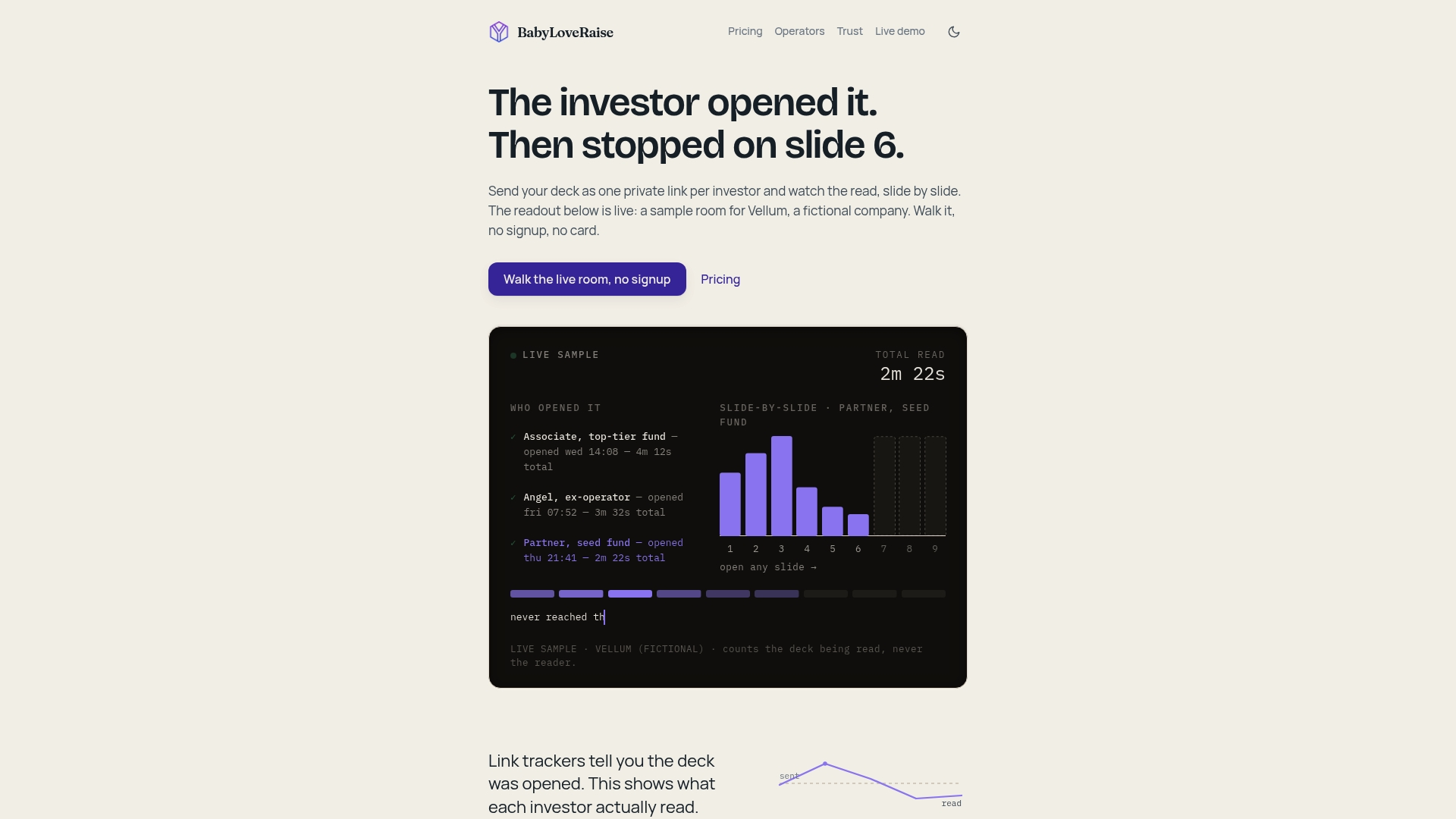
Fractional CFOs and advisory firms running several client raises can use firm-branded rooms through the Operator tier, at $399 per month per seat or $3,990 per year per seat. You can start from our home page.
FAQ
Can I tell if an investor forwarded my pitch deck?
Yes, if you send a forwardable link and your tool logs each new viewer. You’ll see additional visitors appear on that link. You won’t see who they are in every case, and a downloaded PDF can be passed on with no trace.
How many slides should I expect an investor to read?
There is no reliable single number. Reading patterns vary by investor, stage and how the deck arrived. Look at your own pattern across several readers, and treat a repeated drop-off on the same slide as the signal.
Is deck tracking something investors object to?
Most investors expect hosted links. Objections arise when tracking feels like surveillance. Be open that you see opens and slide engagement, don’t quote timestamps back and offer a private link if someone asks.
Should I use a data room instead of a tracked deck link?
They serve different stages. Use a tracked link for first sends and early conversations. Move to a data room when an investor starts diligence and needs contracts, financials and cap table details under tighter permissions.
Does tracking replace asking for feedback?
No. Data tells you where attention went, not why. Use it to decide who to contact and what to ask, then ask directly on a call.
Sources
- How to Share Information With Investors
- How to Protect Your Pitch Deck Without Scaring Off Investors
- Secure file sharing methods for business