
Email Tracking vs Document Tracking: Which One a Founder Needs
Email tracking counts opens and clicks on a message. Document tracking shows who read your deck, and which slides. Here is how to choose for a raise.
November 16, 2026 · 11 min read

Email tracking tells you something happened to a message. Document tracking tells you what happened to the file inside it. For a pitch deck, the second is the one that changes what you do next: it separates the investor who never opened your deck from the one who read to the last slide and passed. We built BabyLoveRaise around that difference, and this guide explains where each method helps, where each one misleads, and how to set up a send that gives you a signal you can act on.
BabyLoveRaiseSee What Investors Read in Your DeckBabyLoveRaise tracks first reads and per-slide engagement, helping founders distinguish an unopened pitch deck from one an investor read.VisitTL;DR
- Email tracking measures opens, clicks and replies on a message. Document tracking measures what a recipient does with the file behind a link: who opened it, how far they read and which pages held attention.
- Email opens are the weakest signal in the stack. Privacy features and security scanners can load a tracking pixel before a human sees the email.
- For a high-stakes file such as a pitch deck, replies and per-slide reading data are more reliable than open counts.
- Use email tracking for the message, document tracking for the deck, and send each investor their own link so the data maps to a person.
- Tracking the file is not a legal gray zone in the US, but a sender should still keep it honest and disclose it where a recipient would reasonably expect to know.
Table of Contents
- The difference in one minute
- What email tracking can and cannot tell you
- What document tracking adds
- When email tracking is enough
- When document tracking earns its place
- Set up a send that gives you a clean signal
- Privacy and legal rules in the US
- Our perspective
- Where the raise room fits
- FAQ
- Sources
The difference in one minute
Email tracking lives in the message. A tiny invisible image (a tracking pixel) is embedded in the email. When the recipient’s mail app loads that image from the tracker’s server, the tool logs an open. Click tracking rewrites each link so it passes through a tracking server first. Apollo’s documentation describes both mechanisms and notes that email tracking covers opens, clicks and replies.
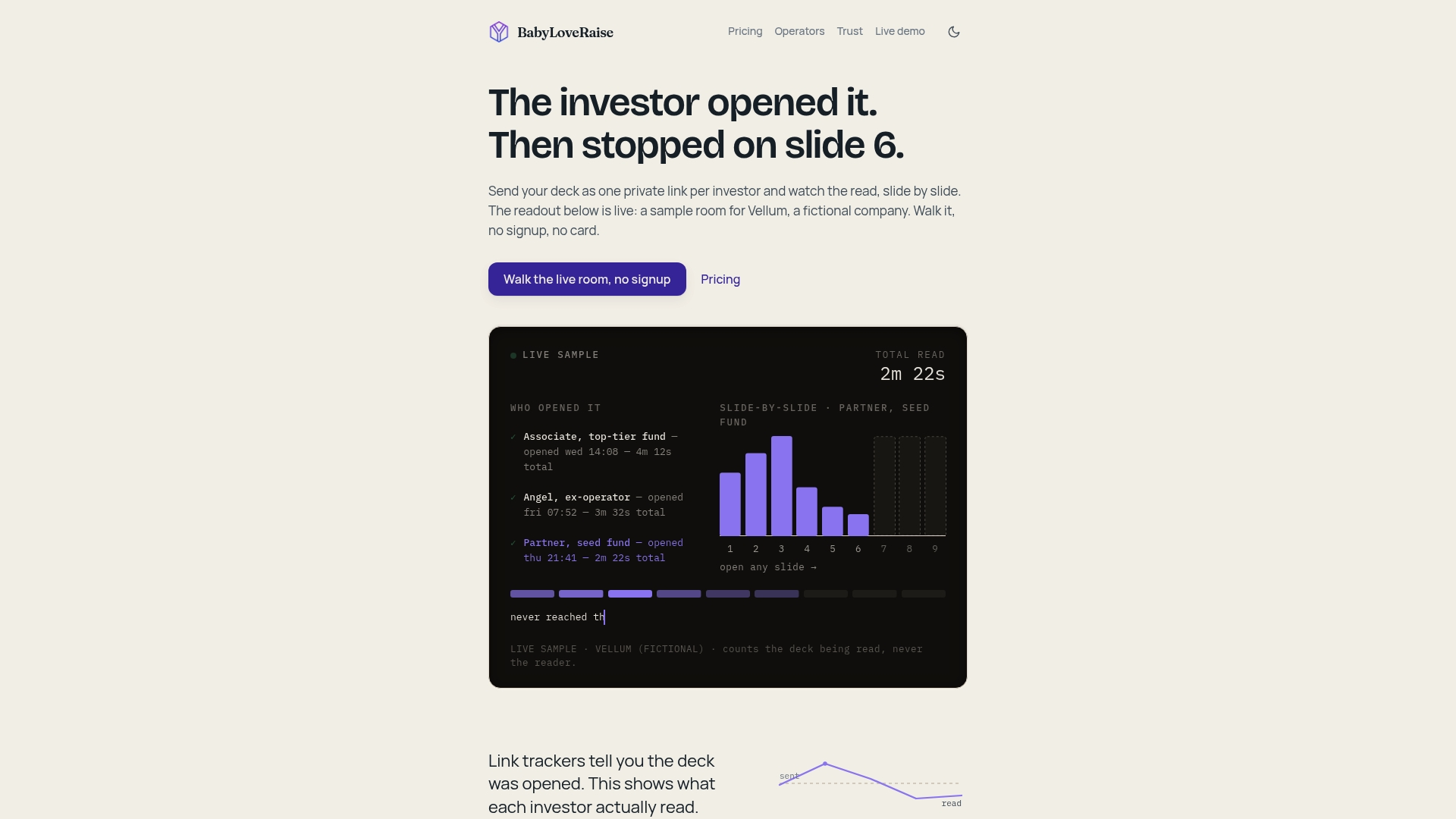
Document tracking lives in the file. Instead of attaching a PDF, you share a link to a hosted copy. When someone clicks, the page records the session: when it started, how long each page was on screen and whether the reader reached the end. The email is only the delivery truck.
| Email tracking | Document tracking | |
|---|---|---|
| What it watches | The message | The file behind a link |
| Typical signals | Opens, clicks, replies | First read, time per slide, completion, repeat visits |
| Biggest weakness | Opens can be machine-generated | Stops when a reader downloads a copy |
| Answers the question | “Did my email land?” | “Did they read the deck, and where did they stop?” |
| Best for | Outreach volume and reply follow-up | A small number of high-stakes files |
What email tracking can and cannot tell you
A founder sending 40 investor emails wants to know who saw them. Open tracking looks like the answer, but it is the least dependable number you can collect.
Apple’s Mail Privacy Protection, launched on September 20, 2021, pre-fetches tracking pixels through Apple’s proxy servers before a person ever sees the email, producing what the industry calls machine opens. Litmus also reported that Apple devices held more than 46% of combined email opens in 2020. Gmail’s image handling and corporate security gateways add noise. Infobip’s documentation states that open tracking is not 100% accurate because blocked images prevent the open event, and that automated tools such as security gateways and link-preview services can follow links within seconds of delivery.
That last point matters for investors. Many funds and corporate inboxes run security scanners. A click that arrives two seconds after delivery was probably a robot, not a partner.
The practical ranking of email signals, drawn from SyncGTM’s 2026 guide, runs like this:
- Replies are the most reliable. A human wrote them.
- Link clicks are high reliability, with the scanner caveat above.
- Pixel opens are medium at best, contaminated by privacy proxies and image blocking.
- IP-based location is low, because of VPNs, proxies and relay services.
So email tracking is good at one job for a founder: confirming a reply landed and nudging when it did not. It cannot tell you whether anyone read your deck.
What document tracking adds
The deck is the thing you are selling, so the useful questions are about the deck:
- Did anyone open it at all?
- Did they open it once and leave, or come back the next day?
- Did they reach the last slide?
- Which slides held attention and which were skimmed?
Those answers turn two states that look identical in a sent folder into two different ones. “Never opened it” and “read everything and passed” both look like silence in an inbox. In a tracked room they call for different moves. The first gets a short nudge, maybe a resend to a different address. The second gets a question about what held them back, or a revision to the slide where attention dropped.
Document tracking has its own limits. Measurement stops at a download: someone who saves a copy and reads it offline leaves no further trace. Per-slide time is a stand-in for interest, not proof of it. A long dwell on your financials slide could mean careful reading or a phone call. Treat it as a reason to ask, not as a verdict.
If you want the deeper mechanics for founders, our guides on how to track investor engagement with your pitch deck and fundraising document analytics go through the metrics one by one.
When email tracking is enough
Email tracking alone is a reasonable choice when the email itself is the whole deliverable. A short intro note asking for a call, a thank-you after a meeting or a warm-introduction request does not need a hosted file. A reply is the outcome you want, and replies are the most trustworthy email signal you will get.
It is also the right layer for outreach volume. If you are sending a few hundred cold notes to list-build before you have a deck link to share, click and reply data show which subject lines draw a response.
Once the message carries a deck, a financial model or a board update, an open count stops being useful. You are no longer asking whether the email arrived. You are asking whether the document did its job.
When document tracking earns its place
Use it when three things are true: the file is high-stakes, the audience is small and named, and your next step depends on whether they read it.
A seed raise fits all three. You might have 30 to 60 investors, each one a decision, and you will not get a second chance to send a first impression. The same is true for a fractional CFO sending a plan to a client’s board, an accelerator sending a cohort’s materials to partners, or an agency sending a proposal to a committee. Our piece on board deck tracking covers that last group.
There is also the cofounder-read problem. A solo founder has no one to watch a stranger read the deck over their shoulder. Per-slide time is the closest substitute: it shows where a reader slowed down and where they flipped past.
Set up a send that gives you a clean signal
The tool matters less than the setup. These steps work for any founder, and they are the ones we build into the room.
1. Send one link per investor
A single link posted to ten investors tells you that someone read it. A link per investor tells you who. Our guide on tracked share links shows the pattern. In a raise room you can choose among three link registers: first send, forwardable and private.
2. Decide how forwarding should work
Investors forward decks to partners and colleagues. That is a good sign, and it is how deals move. A forwardable link lets it happen while the room still records the new reader’s activity. A private link keeps a deck with one named person. Pick on purpose, not by default. See how to track deck forwarding for the reasoning.
3. Decide what to do about downloads
Downloads are where measurement ends. If you allow them, a measured watermark on the copy keeps some accountability attached to the file. If a deck is early-stage and you want it read in the browser, consider switching downloads off.
4. Check the recipient experience
A founder is asking a busy investor for attention. If the link demands an account, a password or an email gate, some readers will skip it. Our posts on loginless document tracking and anonymous document analytics explain how to track the document without making the reader sign up for anything. Open the link on your phone before you send it. Many investors will read your deck there first.
5. Read the data with a time limit
A first-read notification is most useful when you can act on it. We write about a 48-hour follow-up window in several guides because a reader who just finished your deck is a warmer conversation than one you reach a week later. Use the notification to send a specific note, not a generic nudge.
6. Do not build a decision on opens
If you also track the cover email, follow the ranking above: replies first, clicks second, opens as background. When the document data and the email data disagree, believe the document data. An email pixel can fire from a proxy; a reader reaching slide 14 of a hosted deck is a much stronger sign of a human.

For guidance on weighing engagement numbers when scanners and privacy features distort them, measuring engagement with the right KPIs is a useful frame to borrow.
Privacy and legal rules in the US
There is no federal statute aimed specifically at email tracking in the United States. According to a March 2026 Pillsbury Consumer Protection Dispatch, plaintiffs who challenge it usually rely on federal wiretap and stored-communications laws, and pixel-based tracking is hard to fit into either. State laws tend to regulate how engagement data is disclosed and used rather than ban the practice.
The federal CAN-SPAM Act governs commercial email. As summarized in a 2026 privacy and data security legal guide, it requires accurate headers, a valid physical postal address, honest subject lines and an opt-out honored within 10 business days, with civil penalties of up to $16,000 per violating message. It does not itself regulate tracking pixels. A one-to-one note to an investor you are courting is not a bulk marketing blast, but keep the honest-headers habit anyway.
The point for a founder is less about liability than about trust. A recipient who looks at the source of an email can see the tracking image pointing at a tracker’s domain, so no email tracking is invisible to a careful reader. Investors are careful readers. A tracking approach that reports on the document and not on the person fits a fundraising relationship better than one that tries to profile the reader. Do not guess a person’s location, intent or consent from a pixel hit.

This is general information, not legal advice. If you are sending to recipients in the EU or UK, or you plan to run bulk outreach, talk with your startup counsel before you decide how to disclose tracking.
Our perspective
Most founders ask whether to track the email or the document because they want the same thing: to stop guessing. The honest answer is that email tracking watches a envelope and document tracking watches the letter.
When we built BabyLoveRaise, we started from the raise itself, not from file sharing in general. A raise has a small cast of named investors, a deck that took months to write, and a long silence after each send. The most useful thing we can give a founder in that silence is a way to tell the two kinds of quiet apart: the investor who never opened the deck, and the one who read all of it and passed.
That is why we measure per-slide attention, notify you on first read and show which investors finished the deck. It is also why we keep our tracking honest: it reports on the document, not the person. And when your raise ends, the room becomes a free permanent archive, so you are not left with a paywall on your own history.
Paul
Where the raise room fits
If your next step is sending a deck to investors, a raise room replaces the PDF attachment and the shared-drive link with one room link. You get a notification on first read, per-slide engagement, and a target list of who finished the deck. Pricing is per raise, not per seat forever: the raise room is $149 per month or $399 per quarter. If you want help with the deck itself before it goes out, the pricing page also lists an editorial pass.
Fractional CFOs and advisory firms running several client raises can see our Operator seat plans, at $399 per month per seat or $3,990 per year per seat, which carry firm-branded rooms.
FAQ
Is email tracking the same as document tracking?
No. Email tracking records what happens to a message: opens, clicks and replies. Document tracking records what happens to the file behind a link: who opened it, how long each page was on screen and whether the reader finished. For a pitch deck, the document data is the more useful of the two.
Can I trust an email open as proof an investor read my note?
Not on its own. Privacy features and security scanners can load the tracking pixel before a person sees the message, so opens are best treated as indicative. A reply is the clearest signal, and a click is next, with the caveat that scanners can click too.
What happens if an investor downloads my deck?
Tracking generally stops at the download, because a copy read offline sends nothing back. You can decide whether to allow downloads at all, and a measured watermark on a downloaded copy keeps some accountability attached to the file.
Is it legal to track opens and reads in the US?
There is no federal law aimed specifically at email tracking, and CAN-SPAM governs commercial email without addressing pixels directly. State rules mostly concern disclosure of engagement data. For anything beyond a one-to-one investor note, check with your own counsel.
Sources
- Email Tracking Overview, Apollo
- What Mail Privacy Protection Means for Email Marketers, Litmus
- Email tracking types, Infobip documentation
- Guide to Email Tracking Software, SyncGTM
- Email-Tracking Technology: Emerging Compliance Expectations, Pillsbury Consumer Protection Dispatch
- A Legal Guide To Privacy and Data Security 2026