
Permanent Deck Link for Founders: Prioritize Outreach with Slide Data
Use a permanent deck link to track per slide engagement and prioritize investor follow ups. Setup, key features, and pricing for founders.
October 5, 2026 · 8 min read

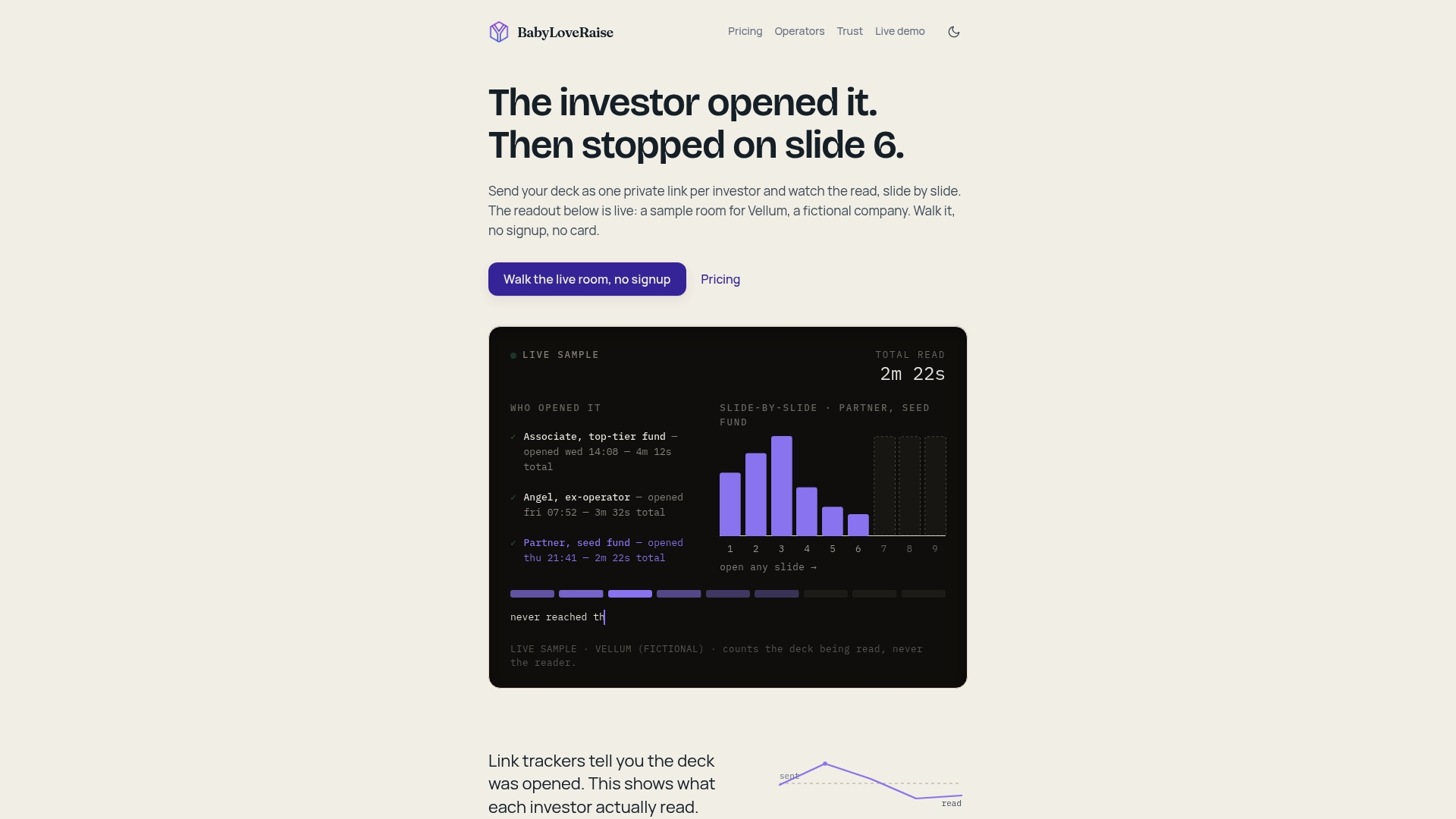
A permanent deck link, also called a raise room, is a hosted, persistent URL that archives your investor deck and records fundraising-specific engagement: per-slide dwell, first-read notifications, and viewer identity. It beats emailing a PDF or sharing a Drive link because you can follow up based on who actually read your deck, not on guesswork. If you’re running a raise right now, set one up before your next investor send.
TL;DR:
- A raise room tracks investor engagement at the slide level and remains accessible after the round, preventing lost data from expiring links.
- Key features include per-slide dwell metrics, first-read notifications, multiple share-link controls, and a permanent activity log integrated with CRM systems.
- Setting up a raise room requires finalizing one deck version, configuring access controls in advance, and tagging viewers for effective follow-up.
- Engagement signals such as repeat views or long last-slide dwell are more indicative of investor interest than initial opens alone.
- Costs for BabyLoveRaise start at $399 per quarter, with options for advisory firms to add operator seats, and transparent controls influence sharing and privacy management.
BabyLoveRaiseGive Your Raise a Trackable HomeBabyLoveRaise helps founders share one permanent deck link, see slide engagement, and follow up with investors based on actual reading.Visit BabyLoveRaise
Table of Contents
- What is a permanent deck link (raise room)?
- Why founders choose a permanent deck link during a raise
- Must-have features to demand from a permanent deck link service
- Step-by-step: set up and share a permanent deck link during your raise
- How to read engagement analytics and convert views into effective follow-ups
- Security, access control, and privacy: practical settings founders should use
- Pricing models and what to budget for
- A founder’s view on making engagement data actually useful
- How BabyLoveRaise gives your raise a permanent, trackable home
- FAQ
- Curated resources to help you set up and learn more
What is a permanent deck link (raise room)?
A PDF attachment or an expiring Drive link gives you nothing after the click: no record of who opened it, how far they read, or whether they came back. A raise room is different. It’s a hosted URL that stays live, tracks engagement at the slide level, and keeps working after your round closes instead of expiring or vanishing behind a paywall.
The core components are a stable hosted link, engagement tracking, multiple share-link registers, access controls, and a permanent archive. That last piece matters more than founders expect: investors who passed on your seed round sometimes resurface for a Series A, and a dead link means you’ve lost the paper trail entirely.

Why founders choose a permanent deck link during a raise
The real value shows up in how you spend your limited outreach time. Instead of calling every investor on your list with the same energy, you can see who opened the deck in the first hour, who came back for a second read, and who never clicked at all.
- You prioritize follow-up calls around actual first opens and repeat views instead of a flat calendar cadence.
- You spot which slides lose attention and revise the deck before your next batch of sends.
- You keep one permanent, versioned link instead of five different PDF attachments floating in different inboxes.
- Advisory firms and fractional CFOs run operator-style rooms to manage several client raises from a single dashboard.
That last point matters for anyone running fundraises on behalf of founders rather than their own: a single operator console keeps every client’s analytics in one place instead of digging through individual email threads.
Must-have features to demand from a permanent deck link service
Not every document-sharing tool is built for a fundraise, so the feature list matters more than the brand name on the login page.
- Per-slide dwell and completion metrics: shows which slides hold attention and which get skimmed, so you know where the pitch loses people.
- First-read notifications and viewer identity: tells you the moment someone opens the deck, not two weeks later when you check a dashboard.
- Share-link registers: separate links for a first send, a forwardable copy, and a private, non-forwardable version give you control over where your deck travels.
- Measured watermarked downloads: lets investors save a copy while discouraging uncontrolled redistribution.
- Permanent archive with exportable logs: keeps your activity history available after the round closes and lets the data feed into a CRM workflow.
A view-only link that notifies you within the first two days of a send is worth more than a dozen features you’ll never open.
Pro Tip: Before you send your first link, confirm your tool distinguishes “never opened” from “opened and read everything.” Those are two different problems and they need two different responses.
Step-by-step: set up and share a permanent deck link during your raise
Setting up a raise room takes less time than drafting your next investor email, but the order matters.
- Finalize one canonical deck file. Multiple competing versions floating around make your analytics meaningless, since you can’t tell which version someone actually read.
- Create the raise room and configure access. Set watermarking and download permissions before your first send, not after.
- Choose the right share-link register for each recipient. Use a first-send link for warm intros, a forwardable link for investors likely to loop in partners, and a private link for anyone you don’t want sharing further.
- Add investor metadata to each link. Tagging viewers by name or firm, and connecting the room to your CRM, turns raw opens into a sortable pipeline.
- Monitor first-read notifications and set your follow-up cadence around them. A read within hours deserves a same-day follow-up; silence after a week deserves a different message entirely.
How to read engagement analytics and convert views into effective follow-ups
Raw opens tell you almost nothing on their own. The signal is in the combination of dwell time, completion, and repeat visits.
- A first open with fast scroll-through and no return visit usually means low interest. Don’t burn a follow-up slot there yet.
- A repeat view or a long dwell on your last slide is a strong buying signal and deserves a prompt, direct follow-up.
- Weak slides show up as a consistent drop in dwell time across multiple viewers, which tells you exactly where to revise before your next batch of sends.
- Advisory firms running several client raises can batch this data across rooms to spot patterns, like which slide types consistently lose attention across different decks.
Per-slide analytics work best when you treat them as a filter, not a verdict. One short dwell on a slide doesn’t kill a deal, but a pattern across five investors tells you something real.
Pro Tip: Wait for a second read or a long last-slide dwell before sending a hard follow-up. A single, fast open usually isn’t worth the outreach.
Security, access control, and privacy: practical settings founders should use
Invite-only links give you tighter control but can create friction if an investor wants to forward your deck to a partner without asking first. Forwardable links solve that friction but give up some control over who ultimately sees your numbers.
Measured watermarking and disabled downloads act as a deterrent rather than a lock, which is usually the right balance for a fundraise where goodwill matters as much as protection. Tell investors upfront that the room tracks reads; most expect it, and transparency avoids any sense that you’re monitoring them covertly. Keep your activity logs and archive available well past the raise, since diligence requests and later funding rounds often reference the same deck.

Pricing models and what to budget for
Per-raise pricing tends to fit single fundraises better than per-seat licensing, since you’re paying for one event rather than ongoing organizational use. Advisory firms and fractional CFOs running multiple client raises typically lean toward an operator-style seat instead, since it consolidates billing and dashboards across clients.
Concierge add-ons, like a deck editorial pass, cost more but save founder time during a period when every week counts. The real test of value isn’t the subscription cost itself: it’s whether the analytics measurably improve your outreach efficiency and how many investor conversations actually convert to term sheets.
A founder’s view on making engagement data actually useful
Per-slide data changes how you follow up far more than it changes how you pitch. A typical sequence looks like this: send the first-register link, get notified within hours when it’s opened, then wait for a second read or a long dwell on the closing slide before sending a targeted note referencing a specific slide. Founders who build that habit stop guessing who’s actually interested.
— Paul
How BabyLoveRaise gives your raise a permanent, trackable home
We built BabyLoveRaise around the raise itself, not generic file sharing. Every room gives you per-slide analytics, three share-link registers, measured watermarked downloads, and a free permanent archive once your round closes.
The raise room runs $399 per quarter or $149 per month, and advisory firms running multiple client raises can pick up an operator seat starting at $399 per month per seat. Check pricing and set up your first room today.
FAQ
What is a permanent deck link?
A permanent deck link, or raise room, is a hosted URL that archives your investor deck and tracks engagement like per-slide dwell and first-read notifications, rather than expiring after a set time.
How is a raise room different from a Drive or PDF link?
A Drive link or PDF attachment gives you no record of who opened it or how far they read, while a raise room tracks viewer identity, per-slide attention, and repeat visits so you can follow up based on real signals.
How much does a permanent deck link cost?
BabyLoveRaise prices the raise room at $399 per quarter or $149 per month, with operator seats for advisory firms starting at $399 per month per seat.
Can investors forward my deck link to other people?
It depends on the link register you choose: a forwardable link allows sharing within a firm, while a private link restricts access to the original recipient only.
What happens to my deck link after the raise closes?
Instead of expiring or hitting a paywall, a raise room can convert to a free permanent archive so you keep the deck and activity logs available for later diligence or reference.
Curated resources to help you set up and learn more
For a deeper look at how permanent links compare to expiring ones, see our piece on expiring deck links that track every slide. If you’re deciding between link types for your next send, view-only links that trigger fast follow-up walks through the registers in more detail.
For cross-industry context on persistent link tracking, WarmDoc’s feature page covers similar analytics for sales documents, and QRlytics documents durable redirected links for offline-to-online campaigns. When you’re ready to set up your own room, start at pricing or the operator console.