
Pre Reads for Founders: Turn Deck Read States Into Meetings
Build a concise investor pre read with a clear meeting ask, then use tracked opens, skims, and full reads to send the right follow up and book meetings.
October 16, 2026 · 13 min read

Send investors a hosted pre-read that opens with a two-to-four sentence executive summary and carries one measurable ask, such as a meeting before a named date. Then let tracked reads decide your follow-up: opened, skimmed, or finished. Founders who do this contact real readers instead of guessing. We built BabyLoveRaise to give you the tracking and editorial support behind it.
TL;DR:
- Make each slide stand on its own, with one metric and annotation, and repeat the same meeting ask in the summary and final slide.
- Send only with prior context, shortly before the meeting; nudge the next day if unopened, and follow up only when the meeting is hours away.
- Match follow-ups to read depth: nudge unopened readers, ask skimmers about a specific slide, and request next steps from investors who finish.
- Assume the deck may circulate: keep source code and contract protected customer data out, and share sensitive material only after a meeting is confirmed.
- Review drop offs and long dwell times across investor batches, change one slide at a time, and use repeated questions to fill content gaps.
BabyLoveRaiseTurn Investor Reads Into Better Follow-UpsBabyLoveRaise gives founders a hosted raise room with first-read alerts and per-slide engagement, helping make investor follow-ups more informed.Explore the raise room
Table of Contents
- What should a pre-read checklist include?
- How do you write the executive summary and slide annotations?
- When should you send a pre-read, and how often should you remind?
- Which engagement signals matter, and how should you follow up?
- What templates and scripts can you copy?
- What mistakes do founders make when preparing a pre-read?
- How does the pre-read fit your fundraising timeline and outreach plan?
- What legal and confidentiality points apply when sharing a pre-read?
- How do you turn engagement data into a better deck?
- How do you turn a finished read into a committed meeting?
- Author perspective: why engagement-first pre-reads beat blind sends
- Product fit: how our raise room implements this pre-read strategy
- FAQ
- Internal resources and product pages to implement the advice
What should a pre-read checklist include?
A pre-read is not your full pitch deck with a polite email on top. It is a stripped-down, scannable version built so a busy investor can decide quickly whether to take the meeting. Use this checklist before you hit send:
- Open with a concise executive summary that states your traction and the exact meeting ask.
- Order slides tightly: cover, TL;DR, problem, solution, traction, business model, team, ask. Our pitch deck strategy guide walks through why that sequence holds attention.
- Share through a hosted link. an attachment. Skip logins and forced email gates, and check that every slide reads cleanly on a phone, because many investors skim between meetings.
- Consider a measured watermark on downloads, so you know a file traveled without making the investor feel watched.
- Keep appendices out of the main read. Put the financial model, cap table, and product demo behind optional links at the end.
- Cut anything that needs you in the room to make sense. If a slide only works with narration, it belongs in the meeting, not the pre-read.
Notice what the list leaves out: no agenda slide, no company history, no logo wall. Every slide earns its place by moving the investor toward your ask.
How do you write the executive summary and slide annotations?
The executive summary is the most-read part of your pre-read, so build it from slots. Fill in your lead traction metric, your market, and your ask, in that order. A workable pattern: “[Company] helps [customer] do [outcome]. We reached [metric] in [timeframe]. We are raising [amount] to [milestone], and we would like to meet with you before [date].”
Then craft the slides themselves:
- Add a one-line annotation to every slide. Tell the investor what to notice and why it matters, for example “Retention remains strong across cohorts since launch.”
- Show one metric per slide. Two competing numbers split attention, and investors will pick the wrong one.
- Keep the deck concise. Past that, readers start skipping, and your per-slide data will show exactly where.
- Keep the text on each slide concise, with charts doing the heavy lifting. We Are CreativeCo publishes useful thinking on visual strategy and attention design if your slides feel crowded.
- Write the ask twice: once in the summary, once on the final slide, worded identically.
Pro Tip: Lead with your strongest metric and put the ask inside the first two sentences. An investor who stops reading after the summary should still know what you want.
When should you send a pre-read, and how often should you remind?
Timing turns a good pre-read into a read one. Send it shortly before the meeting. Send it earlier for a long partner meeting with several attendees, and closer to the meeting for a quick intro call with a busy angel. Earlier than that and it gets buried; later and nobody reads it.
- Nudge once, the day after sending, if the link is still unopened. Keep it to two lines and include your calendar link.
- Send a same-day reminder only when the meeting is hours away, and keep it shorter still.
- For partner meetings, send the hosted link to every attendee, each with a short individualized note. Partners forward decks internally, and a forwardable link keeps you in control of what circulates.
- Never send a pre-read to a cold contact without context. A deck dropped into an inbox with no prior connection or warm intro reads as spam, and it poisons your engagement data because opens from people who did not ask for it tell you nothing.
Work backward from the meeting date, not forward from your own schedule. The reminder cadence above gives you a limited number of touches before the meeting, which respects the investor’s time and still gives you a clear signal about who is engaged.
Which engagement signals matter, and how should you follow up?
Track signals such as the first-open notification, the percentage of slides viewed, per-slide dwell time, and download activity. Together they separate the two silences that look identical in a plain email thread: “never opened it” and “read everything and passed.” Our guide to pitch deck analytics goes deeper on reading these numbers.
Match each read state to one action:
- Unopened: send a short nudge with your calendar link. Do not resend the whole deck.
- Skimmed (few slides, short dwell): ask a micro-question about one specific slide, such as “Did the retention chart answer your question on churn?”
- Read to the end: ask for next steps or a follow-up call while the deck is fresh.
Watch for false negatives. A brief open on a phone between meetings is not a meaningful read, so wait for the second visit before concluding disinterest. If dwell spikes on one slide and nothing else, ask a clarifying question about that slide instead of pitching again.
Be transparent about tracking. Our approach, described on our trust page, reports on the document, never on the person. Say in your note that the link shows whether it was opened, and never quote an investor’s own behavior back at them.
Pro Tip: Set a target for yourself before you send, such as turning a set share of full reads into meetings, then adjust the deck whenever the real rate falls short.
What templates and scripts can you copy?
Use these as starting points and personalize the first line every time:
- Subject lines: “[Company]: [one-line traction] + 30 minutes before [date]?” or “[Your first name] from [Company]: pre-read for [meeting day].”
- Executive summary: “[Company] helps [customer] [outcome]. We reached [metric] in [timeframe]. We are raising [amount] to reach [milestone]. We would like 30 minutes with you before [date].”
- Unopened nudge: “Quick note in case this got buried: the pre-read is here, and my calendar is open at [link].”
- Skimmed follow-up: “One question on slide [number]: does the [metric] there match what you see in your portfolio?”
- Finished-read follow-up: “Thanks for going through it. Could we talk this week about [specific topic]?”
- Calendar confirmation: “Confirmed for [time]. I will bring the model and one open question for you.”
Tone matters more than polish. Name one thing you noticed about the investor’s portfolio in your first sentence, keep every message concise, and ask exactly one question.
What mistakes do founders make when preparing a pre-read?
Most failed pre-reads fail in the same few places, and you can avoid every one of them.
Sending the full deck unedited. A long fundraising deck written to be presented is not a pre-read. Cut it to the slides that stand on their own, and move the rest into optional links.
Burying the ask. If the meeting request appears only on the last slide, a skimmer never sees it. State it in the executive summary and repeat it at the end.
Using attachments or logins. Every extra click costs you readers, and an attached PDF gives you no signal at all. A plain hosted link removes the friction and gives you data.
Treating every investor identically. An angel writing a first check cares about the founder and the story; a VC partner cares about market size and return math. Adjust the summary line, not the whole deck.
Skipping the follow-up logic. Founders often send one email and wait. With read data you can send the right message to the right reader instead.
Ignoring the phone. Tiny chart labels and dense tables fall apart on a small screen. Open your own link on your phone before you send it.
A useful final test: ask someone outside your company to read the pre-read for a short time and tell you what you want from them. If they cannot answer, neither can an investor.

How does the pre-read fit your fundraising timeline and outreach plan?
Treat the pre-read as one step in a sequence, not a standalone document. Before you contact a single investor, finish the deck, set up your hosted link, and write your executive summary. Then sort your target list into tiers: warm intros first, then second-degree contacts, then everyone else.
Within each tier, run the raise in tight waves. Send pre-reads to a batch of investors close together, so you compress the timeline and create real momentum. Meetings that cluster together also give you honest comparison points, and an investor who learns you have several conversations in progress moves faster than one who thinks you are idle.
Use the pre-read at key moments: before a first meeting, before a partner meeting, and before a follow-up where you answer open questions. Each version can be slightly different, with the executive summary updated to reflect new traction. Our investor meeting prep guide covers how to turn reads into next steps across that sequence.
Keep a simple tracker with four columns: investor, send date, read state, and next action. Update it after every open. This is the single best defense against the usual raise chaos of forgotten follow-ups and double-sent messages. Over time, the tracker also shows you which tier of investor actually reads, which tells you where to spend the next round of outreach.
What legal and confidentiality points apply when sharing a pre-read?
A pre-read should contain nothing that would hurt you if it left the room. That is the simplest rule, and most legal risk follows from breaking it.
Investors rarely sign NDAs for a first look at a pitch deck, and many will refuse. So decide in advance what you will and will not share. Keep source code, detailed customer lists, unreleased pricing, and anything covered by a customer contract out of the main read. If you must share sensitive material, put it behind a separate link that you send only after a meeting is confirmed.
Practical protections that do not slow investors down:
- Use a revocable hosted link instead of an attachment, so you can shut off access if a raise ends or a contact goes sideways.
- Mark the deck “Confidential” in the footer and executive summary as a courtesy signal, even though it is not a legal shield by itself.
- Use a measured watermark on downloads so you can trace where a file went.
- Avoid sharing third-party data you do not have rights to republish, especially customer names and revenue figures covered by agreements.
Securities rules about who you may solicit and how you describe your raise vary by jurisdiction and by investor type. Before you send your first pre-read, check your plan with a startup attorney, and do not rely on a blog post, ours included, for that call.
How do you turn engagement data into a better deck?
Per-slide data is free feedback, and most founders never use it. After your first batch of reads, look for patterns instead of individual behavior.
Check where readers leave. If many drop off at the same slide, that slide is the problem, not the investors. Rewrite it, shorten it, or cut it. Check where dwell is high: long time on a slide means interest or confusion, so read the follow-up conversations to tell which. A spike on your pricing slide, for example, might mean investors love the model or that they cannot parse it.

Then run changes one at a time. Our walkthrough on running deck tests in one sitting shows a practical way to compare versions without waiting weeks. Change the traction slide, send the next batch, and compare reads. Change one thing per batch so you know what caused the shift.
Carry findings into the room, too. If readers skim your market slide but linger on your team slide, open the meeting with your team story instead of a market overview. If nobody reaches the ask, move it earlier.
Finally, write down every investor question that arrives after a read. Repeated questions point to missing content, and answering them inside the deck often removes an entire round of back and forth.
How do you turn a finished read into a committed meeting?
A finished read is your best window, and it closes fast. Reply promptly while the deck is still in the investor’s head. Reference one thing they spent time on, then make a specific, low-effort request: “Could we talk on Thursday or Friday?” beats “Let me know if you want to chat.”
Offer two concrete time slots instead of an open calendar. It reduces decisions for the investor, and it signals that you run a tight process. Include your scheduling link as a backup, never as the only option.
When someone agrees, confirm in writing promptly: date, time, attendees, and one line on what you will cover. Then send a lighter second pre-read, such as the financial model or a product demo link, shortly before the call. This keeps the sequence going and gives you a fresh read signal.
If a reader finished the deck but did not reply, wait a little, then send one follow-up that adds new information, such as a customer win or a milestone. Never send a reminder that adds nothing. After two touches with no response, move on and keep your tracker honest.
For partner firms, ask who else should see the deck. A single forwardable link lets the champion carry your story into the next room, and the extra reads show you who is actually involved.
Author perspective: why engagement-first pre-reads beat blind sends
I have watched the same pattern repeat: founders who send a deck and wait treat silence as rejection, while founders who see read data treat it as information. A finished read with no reply deserves a sharper follow-up, not a shrug. A never-opened link deserves a nudge, not a rewrite. Investor time is scarce, so make every pre-read earn it.
— Paul
Product fit: how our raise room implements this pre-read strategy
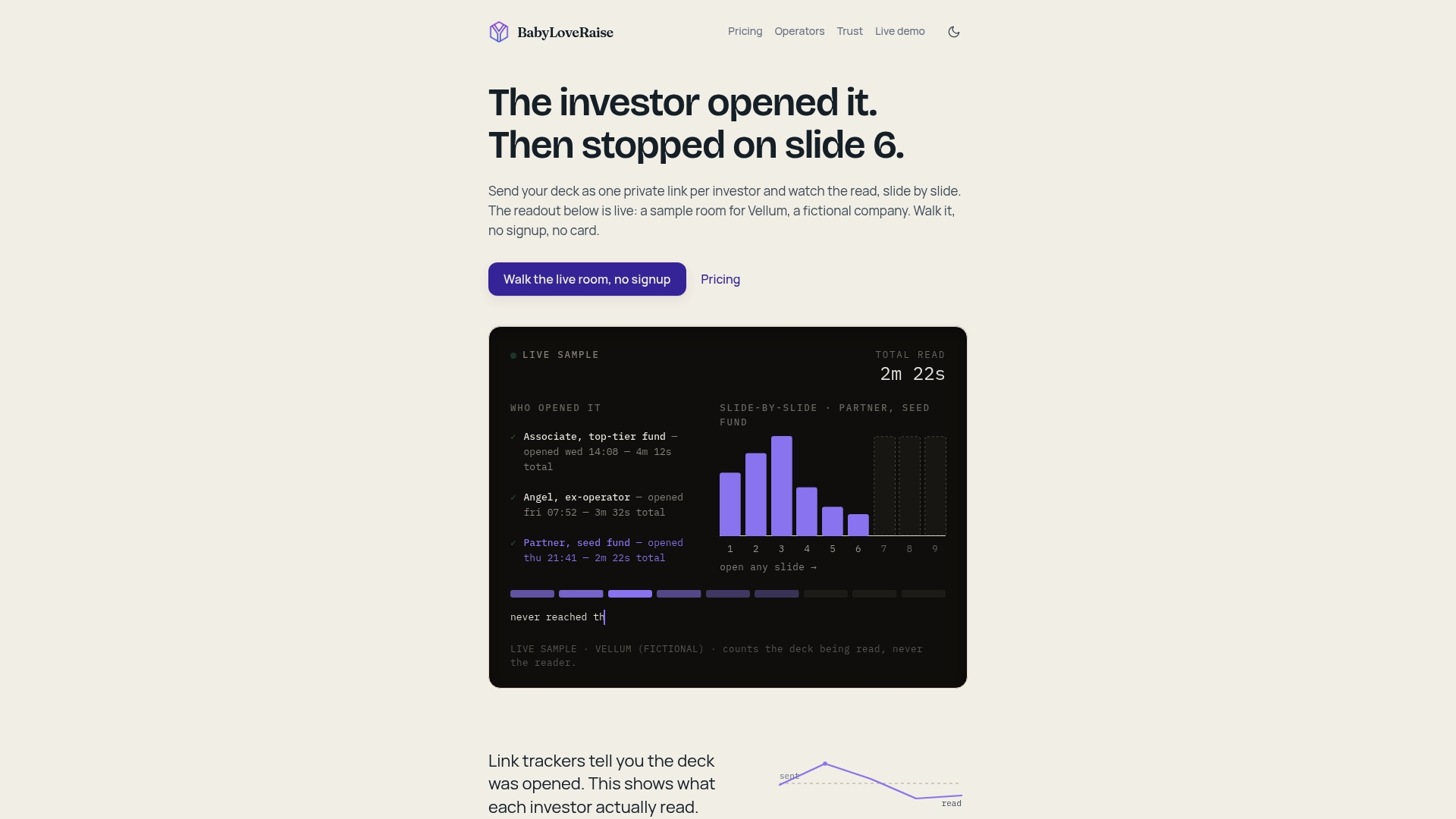
Our raise room gives you first-open notifications, per-slide dwell, and finished-read reports in one link, helping you tailor follow-ups to reader activity. Prefer hands-on help? Our editorial pass offers pitch deck editorial support. See the raise room and editorial pass plans, or explore our operator seats for advisory firms. Start your next investor send there.
FAQ
How far ahead should you send a pre-read?
Send it shortly before the meeting. Use the longer window for partner meetings with several attendees and the shorter one for quick intro calls. Anything earlier tends to get buried.
Should a pre-read include the full pitch deck?
No. A pre-read should be a tight, self-explaining version of the deck, ordered from cover to ask, with extra documents kept as optional links. Cutting length makes it far more likely that an investor reaches your ask.
What should you do if an investor never opens the pre-read?
Wait a little, then send a short nudge with your calendar link. Do not resend the whole deck or rewrite it, since an unopened link says nothing about its quality.
Is it okay to track whether investors read your deck?
Yes, when you track the document and not the person, and you say so plainly in your note. Reporting opens and slide views is standard practice, but quoting an investor’s own behavior back at them damages trust.
What is the single most important part of a pre-read?
The executive summary at the top. It should state your lead traction metric and a specific ask in the first two sentences, so even a skimmer knows what you want.
Internal resources and product pages to implement the advice
- Turn deck views into meetings: a raise room checklist
- Investor meeting prep for founders
- Pricing, raise room, and editorial pass