
Pre-Seed Data Room Checklist: What to Include in 2026
A pre-seed data room checklist for U.S. founders: the documents investors expect, how to organize and share them, and what to skip until someone asks.
November 20, 2026 · 13 min read

A pre-seed data room needs a short list of documents: your deck, a clean cap table, incorporation and governance records, basic financials, and evidence of traction. Everything else can wait until an investor asks. Build the room before you start pitching, keep it organized so nobody hunts for a file, and watch how investors read the deck, because the deck is the one document every investor opens first. That is where we built BabyLoveRaise to help: one raise room link for the deck, with a notification on first read and per-slide engagement.
BabyLoveRaisebabyloveraise.comKnow Who Read Your Pitch DeckBabyLoveRaise gives your deck a hosted raise room, with first-read notifications and per-slide engagement to guide investor follow-ups.VisitTL;DR
- Pre-seed rooms are lean: the deck, cap table, formation and governance documents, financial basics, and traction evidence cover most of what investors ask for.
- Prepare the room before you kick off the raise, then add materials as investor questions come in rather than front-loading every contract you own.
- Organize by folder, name files consistently, separate signed documents from drafts, and release deeper folders only to investors who show serious interest.
- Check that numbers match across the deck and every spreadsheet tab before anyone sees them.
- Track who actually read the deck, so follow-ups go to real readers and revisions target the slides where attention dropped.
Table of Contents
- What a pre-seed data room is, and when to build it
- The pre-seed data room checklist
- How to organize the room so investors find things fast
- Share in layers, not all at once
- Check the room before anyone sees it
- Maintain the room during the raise
- The part most checklists skip: knowing who actually read your deck
- Where BabyLoveRaise fits
- Our perspective
- FAQ
- Sources
What a pre-seed data room is, and when to build it
A data room is an organized collection of documents that investors use to understand your company and run due diligence. Cooley GO defines it as a physical or virtual space for sharing contracts and corporate documents securely for legal or financial diligence. At the pre-seed stage it is a folder structure with a handful of files, not the multi-hundred-document vault a Series B company assembles.
Timing matters more than size. Andreessen Horowitz advises preparing the room before the fundraise officially begins, then treating it as a work in progress and adding materials as investor questions arise. Founders who start the room after a partner says “send me what you have” spend the next week pulling a cap table together while the investor’s attention cools.
For a pre-launch company the same guide suggests the room may start with just the deck, team information, a roadmap, and any beta or pilot evidence. If that is you, a thin room is normal. A thin room that is accurate beats a thick room with contradictions.
If you want the timing argument in more depth, our piece on treating your data room as an evergreen fundraising tool walks through it.
The pre-seed data room checklist
Use this as a working list. The first five categories are the core. The rest depend on your company.
| # | Folder | What goes in | Priority at pre-seed |
|---|---|---|---|
| 1 | Pitch deck | Current deck as the first thing investors open | Essential |
| 2 | Formation and governance | Certificate of incorporation, bylaws, board and stockholder consents | Essential |
| 3 | Cap table | Fully diluted cap table including SAFEs and convertible notes, vesting schedules | Essential |
| 4 | Financials | Historical P&L, burn, runway, budget; projections with assumptions | Essential if you have spend or revenue |
| 5 | Traction and product | Usage data, pilot or beta results, roadmap, LTV/CAC where relevant | Essential if you have users |
| 6 | Team and people | Founder bios, advisor and contractor agreements, IP assignment | Expected |
| 7 | Legal matters | Pending or threatened disputes, material contracts | Expected, often just a short statement |
| 8 | Optional extras | One-pager, FAQ document, investment memo, short video | Only if they save investor time |
1. The pitch deck
The deck is the front door. Andreessen Horowitz says it should cover your thesis, product vision, competitive landscape, traction, team, roadmap, and intended use of funds. Keep one current version in the room. Old versions floating around under different file names are how an investor ends up quoting a number you changed two weeks ago.
Because the deck is the first document read, it deserves more attention than any other file on this list. Our guides on pitch deck strategy for founders and what changes between pre-seed and seed decks cover what to put in it.
2. Formation and governance records
Investors want proof that the company exists as you describe it and that you own what you say you own. Cooley GO’s sample VC due diligence request list asks for current charter documents and bylaws, and for records of board and shareholder actions. Klehr Harrison’s 2025 seed-stage checklist likewise lists incorporation and governance records and board and shareholder consents.
In practice, put these in the room:
- Certificate of incorporation and any amendments
- Bylaws
- Signed board and stockholder consents, such as the one approving your option plan or a SAFE round
- Any document that issued equity to a founder
Andreessen Horowitz notes that board minutes are generally unnecessary at this stage unless requested. Keep them filed and ready so you can share them the day someone asks, but you do not need to upload them on day one.
3. The cap table
The cap table is the document investors scrutinize hardest, because it determines what they will own and how much dilution is already baked in. A founder-friendly spreadsheet is not enough. Klehr Harrison calls for a fully diluted cap table that includes SAFEs and notes. A SAFE is a simple agreement for future equity: it does not show up as shares until it converts, so your table needs to model what it converts into.
Alongside the table, include:
- Shareholder and option holder lists
- Vesting schedules for founders and early employees
- The agreements covering how securities were issued
The Cooley GO list asks for shareholder and optionee lists, vesting schedules, and agreements concerning securities issuance, so having them ready removes a predictable follow-up email.
4. Financials
At pre-seed, investors do not expect an audited model. They expect to see where the money went and how long what is left will last. Andreessen Horowitz lists a historical P&L and burn, plus usage data and LTV/CAC and payback period where they apply. Klehr Harrison adds a budget and runway forecast, and projections with their assumptions written out.

Burn rate is your net cash spent per month, and runway is how many months of cash that leaves. If you want a refresher on the math, this walkthrough on how to calculate and use burn rate shows the calculation.
What can wait: the Andreessen Horowitz guide says detailed projections, tax returns, audits, office leases, offer letters, and market-sizing materials are generally unnecessary unless requested. If you have a three-year model you are proud of, hold it until an investor asks for it. A model with bold assumptions invites a debate you do not need at the first meeting.
5. Traction and product evidence
If you are live, add usage data and the handful of metrics you actually track. If you are pre-launch, the same guide points to team information, a roadmap, and beta or pilot data if you have any. A letter of intent, a waitlist export, or three customer interview summaries all count as evidence at this stage. Label each for what it is.
6. Team, advisors, and IP
Founders, advisors, and contractors should all have signed agreements, and anyone who built part of the product should have assigned their work to the company in writing. This is the quiet gap that surfaces late in diligence. Contractor and advisor agreements are easier to find when you manage them in one system. A tool for contract and licensing management can help you keep signed agreements in one findable place, so the folder you export to the data room is current.
7. Legal matters
The Cooley GO list asks about pending or threatened litigation and material disputes. For most pre-seed companies the honest answer is none. Say so in a one-line note rather than leaving the folder empty, so the investor knows you considered it.
For a longer version of what investors may ask for across stages, see our due diligence documents guide for founders and the live raise checklist of fundraising documents.
How to organize the room so investors find things fast
An investor with twenty minutes will not hunt. Klehr Harrison’s advice is to mirror the checklist in logical folders so any document is two or three clicks away, use consistent file names, archive superseded drafts, and keep executed documents apart from drafts.
A workable structure:
- 01 Deck and summary: the current deck, plus an optional one-pager
- 02 Corporate: charter, bylaws, consents
- 03 Cap table and equity: cap table, vesting, SAFEs and notes
- 04 Financials: P&L, burn, runway, projections
- 05 Product and traction: usage data, roadmap, pilot results
- 06 Team and agreements: founder, advisor, contractor, IP
- 07 Legal: disputes statement, material contracts
- 99 Archive: superseded versions
Name files the same way every time, for example 2026-11_CapTable_FullyDiluted_v3_SIGNED.pdf. The date prefix makes sorting trivial, and the word SIGNED tells an investor which version is binding.
Share in layers, not all at once
You do not need to give every investor every file. Klehr Harrison recommends progressive disclosure: a deck layer for everyone, a core layer for investors with serious interest, and a deeper layer for lead investors. The same guidance recommends watermarking critical PDFs, disabling bulk downloads for the deepest layer, and rotating access passwords after a fundraising tranche closes.
In practice:
- Layer one: the deck, available to anyone you pitch.
- Layer two: cap table, financial summary, and corporate documents once an investor asks a second round of questions.
- Layer three: contracts, detailed models, and IP documents for the investor who is preparing a term sheet.
This also gives you a natural signal. When an investor asks for layer two, they have told you something. Our practical guide to secure data rooms for startups covers access control in more detail.
Check the room before anyone sees it
Most damage in diligence comes from inconsistency, not from bad news. Before you share, check these, drawn from the Andreessen Horowitz guide:
- Numbers in the deck match the numbers in every spreadsheet, including across tabs.
- Historical financials cover the full age of the company.
- Actuals and projections are clearly separated.
- Metrics are presented honestly, not cherry-picked.
Then do one more pass yourself: open the room in a private browser window as an investor would, click through every folder, and confirm each file opens and carries the right version. A broken link in the cap table folder costs you more credibility than the missing document would have.
Maintain the room during the raise
Treat the room as a living thing. Each investor question is information about what the market wants to see, so add the answer to the room once and every later investor benefits. Keep a short change log for yourself, move replaced files to the archive folder, and rotate access after each closing tranche, as the Klehr Harrison guidance recommends.
Between meetings, spend ten minutes a week on three questions: which documents did investors ask for that were not in the room, which were requested twice, and did anything change in the business that makes a file stale. If the same question arrives twice, the answer belongs in the room.
The part most checklists skip: knowing who actually read your deck
A checklist tells you what to upload. It does not tell you what happens after you send the link. Sent as an email attachment or a Drive link, a deck produces two silences that look identical: an investor who never opened it, and one who read every slide and passed. You respond to both the same way, which means you follow up with the wrong people and revise the wrong slides.
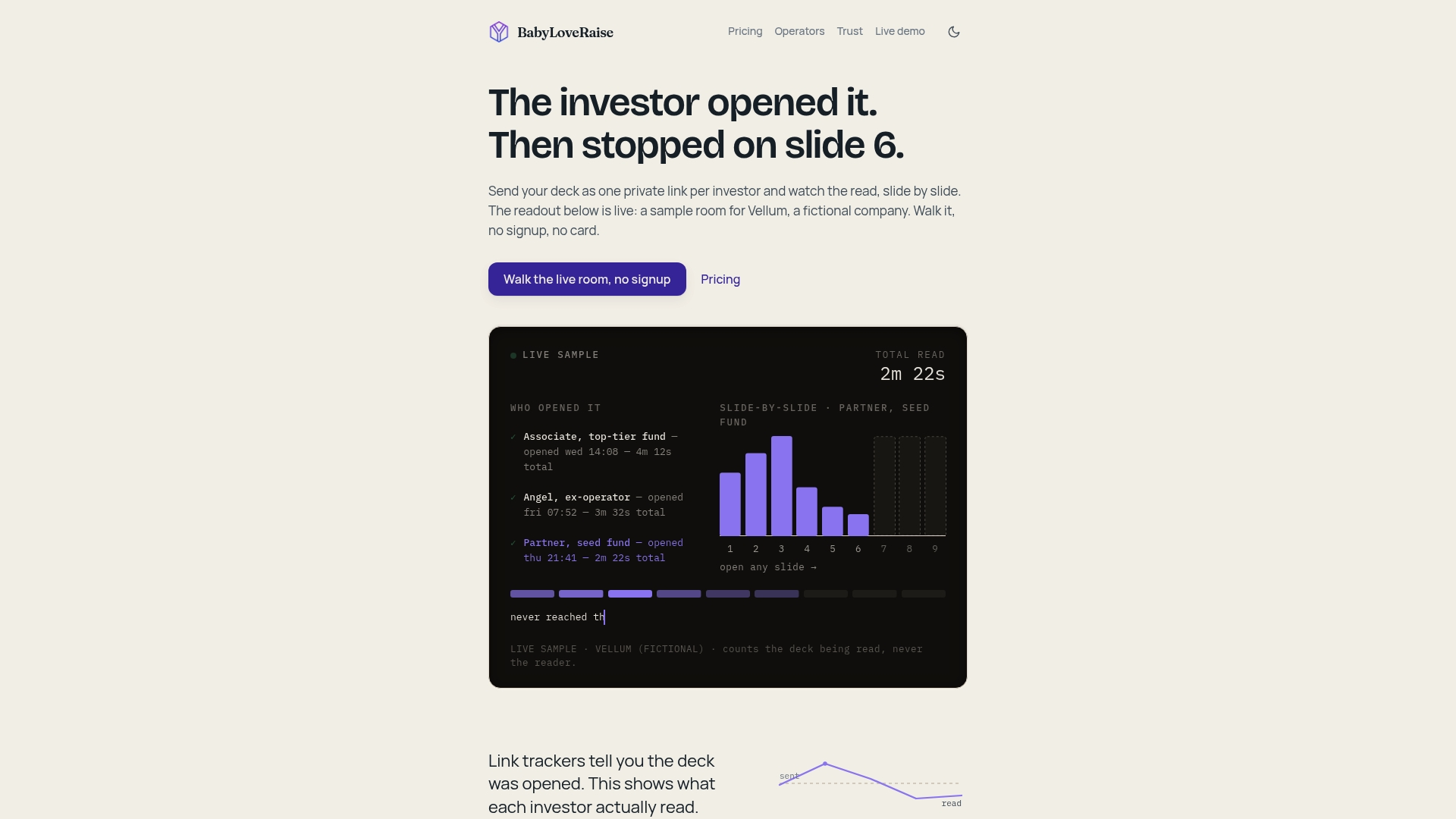
A hosted room breaks that tie. When the deck lives in one room link, you can see that someone opened it, whether they reached the last slide, and where attention fell off. Founders who raise alone have no cofounder to read the deck cold and say “I lost interest on slide seven.” Per-slide engagement is the closest substitute you can get. Our piece on five steps to a ready raise room explains how the deck and the wider room fit together, and pitch deck benchmarks for pre-seed and seed founders gives a reference point for what a deck should look like.

Where BabyLoveRaise fits
The raise room is our hosted room for your pitch deck. You send one link instead of a PDF. It notifies you on first read and records per-slide engagement, so you can see who opened the deck, who read to the last slide, and which slides held attention versus got skimmed. Your owner dashboard turns “never opened it” and “read everything and passed” into two different states, so follow-ups go to actual readers and revisions go to the slides where attention died.
Share links come in three registers: first send, forwardable, and private. Downloads can carry a measured watermark. When the raise closes, the room converts to a free permanent archive.
The raise room is $399 per quarter or $149 per month, priced per raise rather than per seat forever. If you want hands-on help with the deck itself, we also offer an editorial pass. Details are on the pricing page.
If you are a fractional CFO or an advisory firm running several raises, the Operator tier gives you firm-branded rooms across your clients, at $399 per month per seat or $3,990 per year per seat. See the operators page.
Our perspective
A data room is a promise: everything you say in the pitch can be checked, and you are not afraid of it. At pre-seed, the checking starts with the deck, long before anyone opens a cap table.
We built BabyLoveRaise around that moment. Most founders we design for are raising without a cofounder who can read the deck cold, so we treat per-slide dwell as the stand-in for that second reader. It tells you which slide earned attention and which one lost it.
We also think the tracking should be honest. Our register reports on the document, not on the person: it tells you what was read, not who an investor is as a human being. And because a raise has an end, we price per raise and turn the room into a free permanent archive when it closes, rather than leaving you with a paywall at the exact moment you stop fundraising.
Build the lean checklist, keep it accurate, and let the deck do the early work. Then follow up with the people who actually read it.
Paul
FAQ
How many documents should a pre-seed data room have?
Fewer than most checklists suggest. The core is a deck, cap table, formation and governance records, financial basics, and whatever traction evidence you have. Andreessen Horowitz says items like tax returns, audits, leases, and offer letters are generally unnecessary at this stage unless requested.
Do I need a data room before I send my first pitch deck?
You need the deck and a clear plan for the rest. Andreessen Horowitz recommends preparing the room before the raise begins and adding materials as questions arise. That way the cap table is ready when the first investor asks, without having to be public from day one.
Should I put projections in the room?
Include a budget and runway forecast. Klehr Harrison also lists projections with their assumptions. Detailed multi-year models are generally unnecessary unless an investor requests them, so hold those back and share them when asked.
How do I keep sensitive documents safe?
Share in layers: deck first, core documents for serious investors, and deeper files for lead investors only. Watermark critical PDFs, disable bulk downloads on the deepest layer, and rotate passwords after each tranche closes, as Klehr Harrison recommends. Ask your startup lawyer to review anything covered by an NDA or a confidentiality term before you upload it.
What happens to the room after the round closes?
Keep the documents current for the next round and archive superseded versions. With our raise room, the room converts to a free permanent archive when the raise closes.
Sources
- The Insider’s Guide to Data Rooms, Andreessen Horowitz
- Definition of Data Room, Cooley GO
- Sample VC Due Diligence Request List, Cooley GO
- Startup Evolution: Due Diligence Ready, Klehr Harrison
- Project burn rate: how to calculate and use it
- Contract and licensing management