
Pre-Seed vs. Seed Pitch Decks: What Actually Changes
Pre-seed and seed decks share slide titles but differ in evidence, length, and financials. See what to change at each stage and how to tell if investors read it.
November 15, 2026 · 12 min read

The slide titles barely change between a pre-seed and a seed deck. The evidence on those slides changes completely. A pre-seed deck asks an investor to believe in a founder and a thesis. A seed deck asks them to believe in numbers. Once you know that, you also know what to cut, what to add, and which slides to watch when you send the deck out. We built BabyLoveRaise’s raise room so you can see which slides investors actually read.
BabyLoveRaiseSee Which Slides Hold Investor AttentionBabyLoveRaise tracks deck opens and per-slide engagement, helping you distinguish unread decks from investor reads and spot where attention drops.VisitTL;DR
- Pre-seed decks fund a thesis: founder insight, a prototype or MVP, and early demand signals. Seed decks fund a path to product-market fit and need quantitative proof.
- Core slides (problem, solution, market, team, ask) stay broadly the same. What changes is the proof underneath each one.
- Plan on roughly 8 to 10 slides at pre-seed and 10 to 12 at seed, and keep a reading version separate from the version you present live.
- Financials scale with the stage: a simple assumptions tab and cash plan at pre-seed, a driver-based model with unit economics at seed.
- Whichever stage you are at, track how the deck is read, so you revise the slides where attention drops rather than guess.
Table of Contents
- The real difference: what the investor is betting on
- Pre-seed vs. seed deck at a glance
- Slide by slide: same titles, different proof
- What to show when you have no traction
- Financials by stage
- One deck is not enough: reading, live, and teaser versions
- Mismatches that make a deck read as the wrong stage
- How to know whether your stage-appropriate deck is working
- Send the right deck from one room
- Our view: the deck is a conversation starter you can measure
- FAQ
- Sources
The real difference: what the investor is betting on
At pre-seed there is little to measure, so investors measure you. CRV’s stage guide says a pre-seed round funds a thesis: investors assess the founders’ grasp of a problem, an MVP or working prototype, and early demand signals such as waitlists, pilots, or letters of intent (LOIs, which are non-binding statements that a customer intends to buy). Antler puts it as less to prove and more to explain: the bet is on the founder, the founder’s thinking, and whether the problem is real enough to support a company.
At seed the bet shifts. The same CRV guide says seed funds the path to product-market fit, so investors look for a working product, paying customers, and the early shape of a repeatable way to acquire them. CRV’s separate pitch-deck guide adds that seed investors are less willing than before to fund an idea and a deck alone.
Sky9 Capital describes the same shift as a change in the type of evidence: qualitative conviction becomes numbers. Its sign of a well-spent pre-seed round is a short seed conversation, because the investor can see exactly what the money bought. That is a useful test for your own deck. Could a stranger tell, after one read, what your last round proved?

Pre-seed vs. seed deck at a glance
Stage definitions vary by investor, so treat these as typical ranges, not rules. The figures below come from a Pitch Deck Guide glossary and a Sky9 Capital comparison.
| Pre-seed deck | Seed deck | |
|---|---|---|
| Typical round size | $250,000 to $2M | $1M to $4M (Sky9 cites up to $5M) |
| What is being funded | A thesis and a founding team | The path to product-market fit |
| Product on the solution slide | Concept or early prototype | The real product, with screenshots or a demo |
| Demand evidence | Interviews, waitlists, pilots, LOIs | Revenue, growth rate, customer count, retention |
| Financials | Assumptions and a cash plan | Unit economics and a projected model |
| Length | About 8 to 10 slides | About 10 to 12 slides |
| Diligence that follows | Light, conviction-based | Structured, including customer calls |
Sky9 also reports that pre-seed diligence commonly runs 4 to 8 weeks and seed diligence 8 to 14 weeks. If you are planning the calendar around your deck, our guide to a 6 to 12 week pre-seed raise shows how to pace the follow-up.
Slide by slide: same titles, different proof
Launch Deck’s comparison makes the key point: problem, solution, market, team, and ask appear in both decks. Here is how the weight moves on each.
Problem
At pre-seed, this is your strongest slide. Show that the problem is real with customer-interview quotes and specifics only someone who has talked to the people affected would know. At seed, the problem slide gets shorter because your traction now proves it.
Solution and product
At pre-seed, a concept or early prototype is enough. At seed, show the actual product with screenshots or a demo. Seed’s extra slides generally support deeper traction, product, and business-model detail.
Traction
At pre-seed, this slide is often a validation slide: what you have learned, who has committed, and how you know. At seed, it moves up the deck and becomes the proof. StartupRocket’s seed order, for example, places traction and testimonials right after the solution, shifting the emphasis to KPIs and customer proof.
Market and business model
Pre-seed investors want to see that you understand who pays and why. Seed investors want to see that you are acquiring those customers at a cost that works. CRV notes that seed diligence commonly examines CAC, LTV, burn rate, CAC payback, revenue growth, and retention, especially for B2B SaaS and infrastructure companies. (CAC is customer acquisition cost; LTV is customer lifetime value.)
Team
Team matters at both stages, and CRV says it carries the highest weight in a typical seed deck. At pre-seed it is close to the whole case. Say why this team is the one to solve this problem, and name the gaps you plan to fill.
The ask
At pre-seed, tie the round to what it will prove. The Pitch Deck Guide advises closing with a slide on what the round will prove in 12 to 18 months, since investors fund plans, not hope. At seed, the same logic applies, but the milestone is a metric: the revenue, retention, or growth that sets up the next raise.
For ordering, see our investor-focused slide order, and for what strong decks look like in practice, our pitch deck examples.
What to show when you have no traction
Many pre-seed founders worry that an empty traction slide sinks the deck. It does not, if you replace revenue with credible signals. Antler says pre-seed traction need not be revenue: LOIs, pilot customers, waitlists, interviews, and tested prototypes all count. It also names a red flag: spending months building without speaking to prospective customers.
The Pitch Deck Guide’s list of real signal without revenue is specific: direct customer-interview quotes, signed LOIs or pilot commitments, a working prototype, active design partners, and a waitlist from a real channel. Fluenta’s playbook recommends five signed, non-binding LOIs that state a price at which customers intend to buy once the product is live.
A few habits make this evidence land:
- Quote real customers, with permission, rather than summarizing them.
- Say where a waitlist came from. A list from a real channel beats a large unexplained number.
- Label what is a commitment and what is interest.
- Explain what the ask will fund, and what you expect to have learned by the next raise.
If you are still collecting those signals, an outside program built around pre-seed validation and demand signals can help you get them before you build the deck.
Financials by stage
Do not build a seed model for a pre-seed conversation. ForumVC’s guide says an initial pre-seed deck need not contain detailed projections until a later meeting, though pricing, business model, and high-level forecasts can explain the revenue opportunity. StartWise describes the difference in models: at pre-seed, a one-tab model of assumptions plus an 18 to 24 month cash and hiring plan; at seed, a driver-based model with real unit economics over a 24 to 36 month horizon, including LTV-to-CAC, payback, and retention.

The rule is proportion. Give an early reader enough economics to orient them, and keep detailed cohorts and funnels for the follow-up.
One deck is not enough: reading, live, and teaser versions
The second big difference between decks is the job each one does, at either stage. Whitepage separates three formats:
- A teaser of about 5 slides for cold outreach and intros, just enough to earn a meeting.
- A read-ahead deck of 12 to 18 slides sent by email, which must stand alone because no presenter is there to fill gaps.
- A live deck of 10 to 12 slides for meetings and demo days, kept lean because your voice carries the story. Whitepage suggests 15 to 18 minutes of presenting in a 30-minute meeting.
Visible.vc agrees that you should keep separate reading and presenting decks: the reading version carries enough context to stand alone, while the live version uses less text. Detailed cohorts, funnels, unit economics, and security material can go in a separate data deck so they do not bloat the core story.
The pre-seed deck has a narrower job than founders assume. Broadstone says its primary purpose is to set up a good first meeting and a follow-up conversation, not to answer every diligence question. A seed deck carries more of the case because it faces structured diligence sooner.
Mismatches that make a deck read as the wrong stage
- A seed-style model in a pre-seed deck. Heavy projections suggest precision you cannot have yet.
- A pre-seed story in a seed deck. All vision and no usage data reads as a team that has not yet found traction.
- Unsupported claims. Heavybit’s guide says unsupported claims and excessive technical detail weaken an early narrative, and recommends an appendix for deep technical material and an overview of competitors.
- A deck that depends on links. Product videos and background documents can supplement the deck, but the central case should stand alone.
- Too many slides. Heavybit suggests a maximum of 10 to 12 for early stage.
For current slide-count and format numbers, see our pitch deck benchmarks.
How to know whether your stage-appropriate deck is working
Building the right deck is half the job. The other half is learning how investors read it. Reviewers commonly screen a deck in roughly 5 to 10 minutes before deciding on a call, so a deck you cannot observe is a deck you cannot improve. When a PDF goes quiet, two very different things look identical: nobody opened it, or someone read everything and passed.
This is the problem we built the raise room around. You send one room link instead of a PDF. The room notifies you on first read and records engagement slide by slide: who opened the deck, who reached the last slide, and which slides held attention versus got skimmed. Follow-ups then go to people who read, and revisions go to the slides where attention dropped. The practice is covered in our guides to per-slide analytics and investor meeting prep.
Send the right deck from one room
The raise room is a hosted room for your deck, priced per raise: $399 per quarter or $149 per month. Share links come in three registers (first send, forwardable, and private), downloads can carry a measured watermark, and when the raise closes the room converts to a free permanent archive. If you want hands-on help getting the stage-appropriate story right, we also offer an editorial pass. For firms running several client raises, the Operator tier is $399 per month per seat or $3,990 per year per seat. Details are on the pricing page.
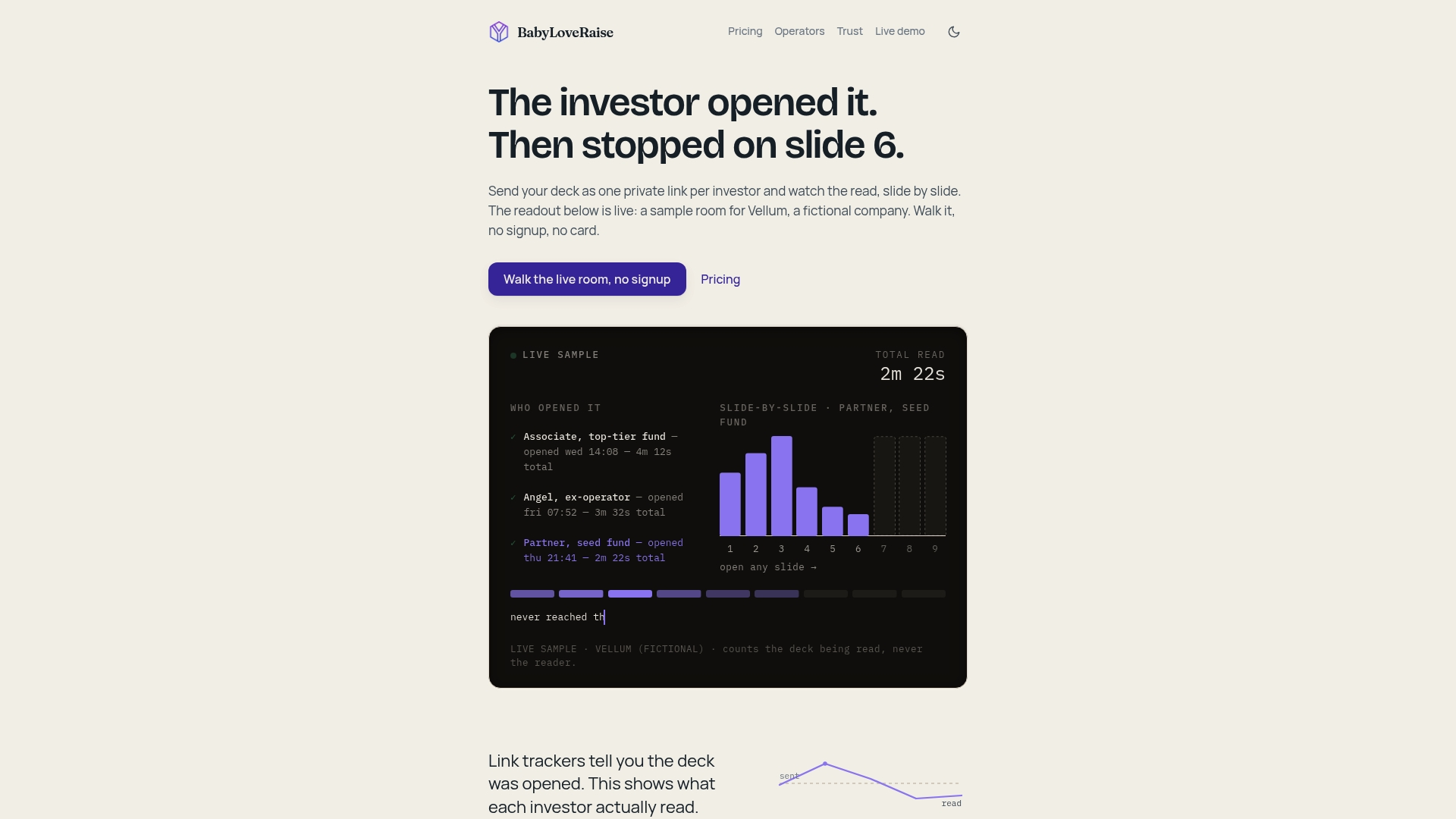
If you keep a teaser, a reading deck, and a data deck, each can sit in the room you control, so you know which version each investor actually opened.
Our view: the deck is a conversation starter you can measure
Founders at pre-seed often have no cofounder who will tell them which slide is dead weight. The only honest feedback loop is the reader’s behavior: where they slowed down, where they left, whether they finished.
That is why we think of a deck at either stage as a document you tune, not a document you send once. A pre-seed deck that earns a first meeting and a seed deck that survives structured diligence both improve fastest when you can see which slides held attention and which got skimmed.
We built tracking that reports on the document, never on surveilling the person. And we price per raise, because you are raising once, not buying a seat forever. When the raise closes, the room becomes a free permanent archive.
Paul
FAQ
Is a pre-seed deck shorter than a seed deck?
Usually, yes. Visible.vc recommends about 8 to 10 slides for pre-seed and 10 to 12 for seed. The extra seed slides generally support deeper traction, product, and business-model detail.
Do I need financial projections in a pre-seed deck?
Not detailed ones. High-level economics such as pricing and business model can orient the reader, and a simple assumptions tab with a cash and hiring plan is the typical pre-seed model. Save detailed projections for a later, substantive conversation.
What counts as traction before I have revenue?
Interviews, waitlists, pilots, LOIs, design partners, and a tested prototype all count, according to Antler’s guide. Show each as specifically as you can, with real quotes and sources.
Should I use the same deck for email and live pitches?
It is better to keep two. The version you email has to stand alone, with enough context for a reader without you. The live version uses fewer words and relies on your narration, as Visible.vc advises.
When do I move from a pre-seed deck to a seed deck?
When you can show a live product people pay for. HubSpot for Startups, quoting a Fuel Ventures partner, says seed investors expect that, while pre-seed investors expect an MVP or prototype and some bootstrap traction.
Sources
- Seed Stage vs. Pre-Seed Funding (CRV)
- What Investors Look For in Your Pitch Deck (CRV)
- What a VC Wants to See in Your Pitch Deck (Antler)
- Pitch Deck Terms (The Pitch Deck Guide)
- How to Build a Pre-Seed Pitch Deck When You Have No Traction (The Pitch Deck Guide)
- Pre-Seed vs. Seed Pitch Deck: What Changes (Launch Deck)
- Pre-Seed vs Seed Funding (Sky9 Capital)
- Best Practices for Creating a Top-Notch Investment Presentation (Visible.vc)
- Investor pitch deck and communication strategies (StartupRocket)
- Pre-Seed Funding playbook (Fluenta)
- What Financial Model Do Investors Want by Stage? (StartWise)
- How Many Slides in a Pitch Deck? (Whitepage)
- How to Create The Best Pitch Deck for Pre-Seed Funding (ForumVC)
- What every first time founder should know about a pre-seed fundraising deck (Broadstone)
- How to Build an Effective Pitch Deck (Heavybit)
- How investors read your pitch deck (Form + Function)
- Deck best practices (founder-skills)
- Pre-Seed vs. Seed Funding: The Complete Guide (HubSpot for Startups)
- Pre-Seed Accelerator (Format 3)