
Pre Seed Fundraising: Run a 6–12 Week Raise With Investor Follow Up
Plan a milestone driven pre seed raise, set a clear funding target, build a 10 to 12 slide deck, and track investor follow up toward a six to twelve week...
October 13, 2026 · 9 min read

Most pre-seed rounds vary but often fall within a range that founders typically prepare for; the fastest path to a close starts the same way every time: write a tight 10-to-12-slide deck, build a sizable target investor list, and start outreach promptly. Deep-tech teams should look at non-dilutive grants alongside investor outreach. Once outreach begins, a well-run raise typically closes in six to twelve weeks.
TL;DR:
- Budget salaries, tools, hardware, and compliance costs across a 12 to 18 month runway, then add at least one extra month for fundraising delays.
- SAFEs close quickly but stack and defer valuation; convertible notes add interest and a maturity deadline, while priced equity sets valuation upfront but costs more.
- Prepare for two to six weeks, segment 40 to 50 targets, contact investors in batches, and follow up once after one week.
- Track deck opens and slide engagement separately: follow up with readers who reached the end, but do not chase investors who never opened it.
BabyLoveRaisebabyloveraise.comKnow Who Read Your Pitch DeckBabyLoveRaise tracks first reads and slide engagement, helping you focus follow-ups on investors who reached the end of your deck.Explore deck tracking
Table of Contents
- What Pre-Seed Funding Is and Where It Sits Relative to Seed
- How Much to Raise: Ranges and a Milestone-Driven Formula
- Where Pre-Seed Capital Actually Comes From
- What Pre-Seed Investors Expect: The Checklist
- Step by Step: The Fundraising Process and Timeline
- Materials Checklist: Deck, Data Room, and Tracking Engagement
- What Founder-Led Fundraising Actually Teaches You
- The Part of Pre-Seed Fundraising Most Advice Gets Wrong
- How BabyLoveRaise Supports a Time-Boxed Pre-Seed Raise
- FAQ
- Sources
What Pre-Seed Funding Is and Where It Sits Relative to Seed
Pre-seed is the capital that gets a founding team from an idea or early prototype to the traction markers that justify a seed round. Seed investors generally expect a working product, some revenue or usage signal, and a sharper go-to-market story; pre-seed investors are betting mostly on the team and the thesis.
Three instruments dominate pre-seed deals:
- SAFEs: fast and cheap to execute, but they stack and defer the valuation conversation to the next round.
- Convertible notes: similar speed, with interest and a maturity date that creates a deadline for the company.
- Small priced equity rounds: set valuation immediately, which some founders prefer, but they cost more in legal fees and time.
Bootstrapping makes sense when a founder can reach meaningful traction without outside capital. Raising pre-seed makes sense when the milestone to reach seed requires hires, paid tools, or sustained runway a founder cannot self-fund.
How Much to Raise: Ranges and a Milestone-Driven Formula
The right number is not an average, it is whatever covers the runway to your next seed-ready milestone. A capital-intensive hardware or biotech idea needs more than a software team validating a first paid pilot.
A practical way to set the number:
- Define the milestone a seed investor will want to see (paid pilots, a specific revenue run rate, a working prototype with usage data).
- Estimate the months needed to hit that milestone, typically a 12 to 18 month runway plan built around 3-month and 6-to-12-month checkpoints.
- Add burn (salaries, tools, any hardware or compliance costs) across that runway, then add a buffer for a slower-than-expected raise.
Pro Tip: Budget for the raise taking longer than planned, add at least one extra month of runway on top of your milestone math.
Say a team raises $750,000 on a $6 million cap: that works out to roughly 11% dilution if the round later converts at the cap.
Where Pre-Seed Capital Actually Comes From
Capital at this stage comes from a handful of channels, each with its own pace and expectations.
- Angel investors and angel syndicates: check sizes often range from $10,000 to $100,000, move fastest through warm introductions, and respond well to a concise thesis.
- Micro-VCs: write larger checks than most angels, run a lighter diligence process than larger funds, and expect a clear sense of the next milestone the money unlocks.
- Accelerators: contribute smaller checks plus structure and investor access, but run on fixed application cycles, so timing your application matters.
- Friends and family: fast to close, but require the same documentation discipline as any other investor to avoid messy cap tables later.
- Grants and non-dilutive funding: no equity given up, but proposals take longer and suit eligible deep-tech teams best. The NSF SBIR/STTR solicitation offers Phase I awards up to $305,000 for six to eighteen months of research and development, with Phase II awards up to $1,250,000 for teams that qualify.
Cold outreach works best as a short pitch: who you are, the problem, the traction signal, and a single clear ask for a short call. Accelerator applications should go out well ahead of published deadlines, and grant proposals are worth starting in parallel with investor outreach rather than after it, since they extend runway without diluting the cap table.
What Pre-Seed Investors Expect: The Checklist
Pre-seed investors are underwriting a team more than a business model, so preparation should map directly to what they will probe.
- Team fit: clear roles, relevant domain expertise, and evidence the founders can execute on the specific problem.
- Early traction: whatever you have, whether it is a waitlist, a paid pilot, or usage data from a prototype, presented with numbers, not adjectives.
- A tight thesis: two to three sentences covering the problem, who has it, and why now is the moment to solve it.
- Use of funds: a direct line from the dollars raised to the next milestone, not a vague “hire and build” statement.
Pro Tip: Practice your thesis as a two-sentence answer you could give a stranger in an elevator; if it takes longer than that, it needs editing.
Diligence at this stage is light but real: expect questions about cap table structure, any existing SAFEs or notes, founder vesting, and basic IP ownership.
Step by Step: The Fundraising Process and Timeline
A pre-seed raise moves in three phases, each with its own time box.
- Preparation sprint (2 to 6 weeks): finalize your narrative, build the deck, and compile a 40-to-50-name target list segmented by angel, micro-VC, accelerator, and grant opportunities. Keep this phase separate from outreach, mixing the two slows both down.
- Outreach sequencing: send to your list in batches rather than all at once, follow up once at the one-week mark if there is no response, and prioritize anyone who engages with your materials over anyone who stays silent.
- Pitch and diligence workflow: run intro calls, triage interest by who asks for a second meeting or data, and keep a simple log of where each investor stands.
- Closing mechanics: once you have a lead check, negotiate the term sheet, loop in counsel for the final documents, and plan for wire transfers and cap table updates before you consider the round closed.
From first outreach to close, six to twelve weeks is a realistic window for a well-prepared raise. For a deeper walkthrough of this sequence, see our founder’s playbook on raising startup funds.
Materials Checklist: Deck, Data Room, and Tracking Engagement
Your deck should run 10 to 12 slides: problem, solution, market size, traction, business model, team, roadmap, and ask, in that order of priority. Cut anything that does not directly support one of those eight points.
- Deck essentials: problem, solution, market size, traction, business model, team, roadmap, ask.
- Data room basics: cap table, incorporation documents, any existing SAFEs or notes, founder IP assignments, and basic financials.
- Engagement tracking: knowing who opened your deck and which slides held attention lets you prioritize follow-up toward investors who actually read it.
Pro Tip: Treat “never opened it” and “read it and passed” as two different signals, they call for two different follow-up messages.
For slide-by-slide guidance, our pitch deck strategy guide and deck examples that won funding are useful references, and our guide to due diligence documents covers what to have ready before investors ask.
What Founder-Led Fundraising Actually Teaches You
Every raise that worked for a founder I have watched had the same shape: a fixed prep window, a short list, and a follow-up rhythm driven by who actually engaged with the deck, not who seemed friendliest on a call. Measure attention, then act on it.

The Part of Pre-Seed Fundraising Most Advice Gets Wrong

Most pre-seed advice treats fundraising as a networking problem: meet more people, get more warm intros, attend more events. That is not wrong, but it misses the operational failure that kills more raises than a weak network does, which is founders losing track of where each investor actually stands. A 45-name target list run with discipline beats a 200-name list run loosely.
The conventional wisdom also underrates how much signal sits in silence. A founder who never follows up with someone who read the whole deck twice is leaving a warm lead on the table, and a founder who keeps chasing someone who never opened the file is wasting a week they do not have. The milestone-driven, time-boxed approach outlined here works because it forces founders to treat the raise like a project with checkpoints, not an open-ended social campaign. Prioritize your target list and your follow-up discipline before you worry about polishing your thirtieth slide revision.
— Paul
How BabyLoveRaise Supports a Time-Boxed Pre-Seed Raise
A pre-seed raise runs better when you can see what is actually happening after you hit send. With BabyLoveRaise, we give founders a hosted raise room instead of a PDF attachment or a Drive link that goes quiet: one link per investor, a notification the moment it gets opened, and per-slide engagement data showing who read to the last slide and which slides lost attention.
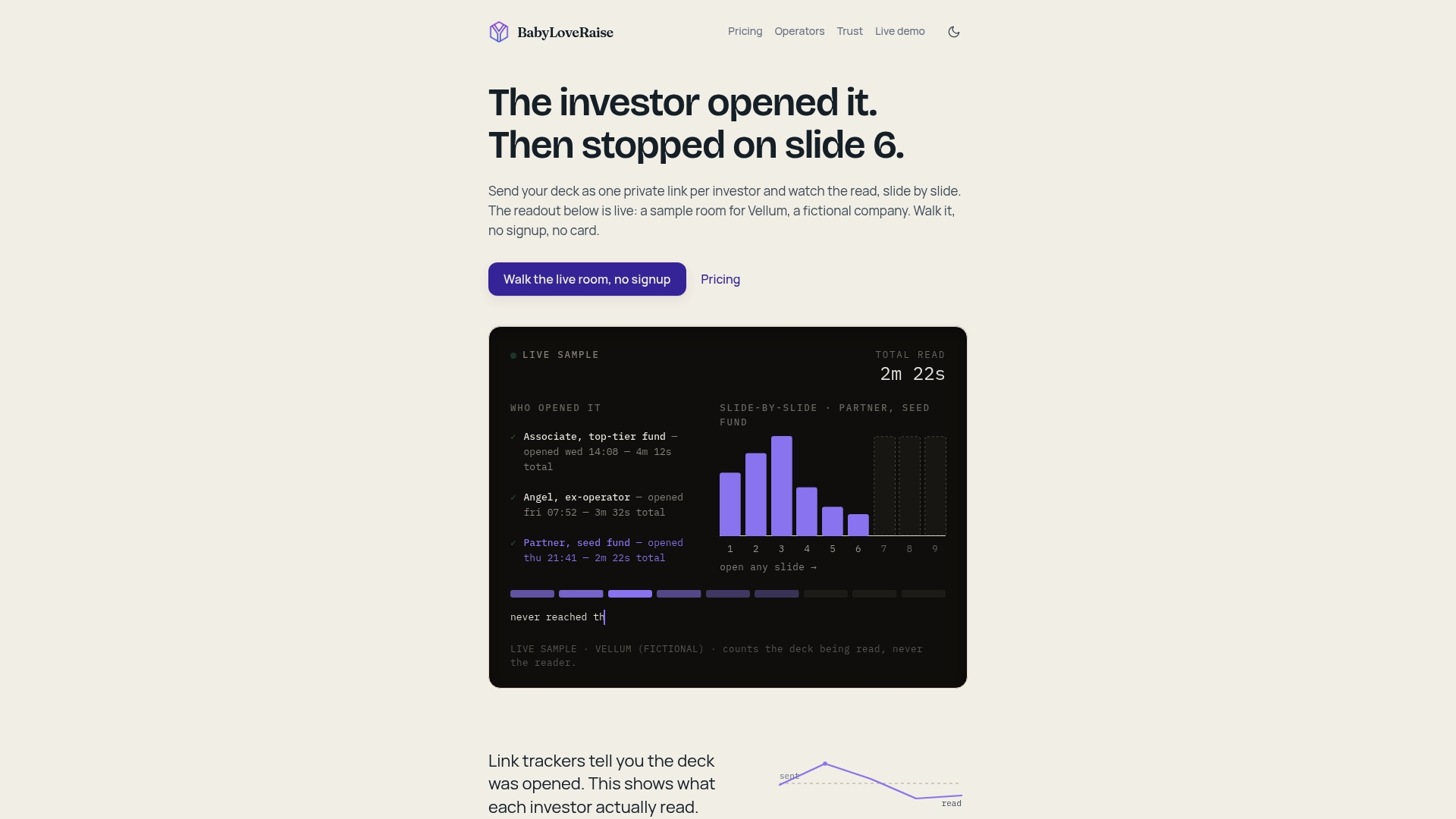
That turns the two silences that look identical, never opened and read-then-passed, into two different signals you can act on, which matters most during the outreach phase described above. Share links come in three registers (first send, forwardable, private), and when your round closes the room converts to a free permanent archive rather than disappearing behind a paywall. For founders who want editorial help tightening the deck itself, we also offer an editorial pass, and advisory firms running multiple client raises can use our white-label Operator tier. Full plan details are on our pricing page.
FAQ
What is seed money for a start-up?
Seed money is early capital a startup raises, typically after pre-seed, to fund the team and product work needed to reach the traction that justifies a larger Series A. It usually comes from venture capital firms, angel syndicates, or seed-focused funds rather than friends and family.
What not to tell investors?
Avoid vague or unverifiable claims about market size or traction, and avoid promising unrealistic timelines you cannot defend in diligence. Investors probe cap table structure, team roles, and use of funds closely, so inconsistencies between your pitch and your data room tend to surface quickly.
How much to raise seed funding?
A milestone-driven budget tied to a 12 to 18 month plan is more defensible to investors than a round number.
What’s after seed funding?
After seed, startups typically raise a Series A once they have clearer revenue or usage metrics and a repeatable go-to-market motion. The milestones investors expect at that stage are more specific than at pre-seed, usually centered on growth rate and unit economics rather than team and thesis alone.