
How VCs Read Decks: What Happens in the First Three Minutes
How VCs actually read a pitch deck: the time they spend, the slides they check first, what earns a second read, and how founders can see where attention drops.
November 18, 2026 · 14 min read

Most VCs read a pitch deck in about three minutes, in a fixed order, and they decide in the first few slides whether the rest is worth their time. They flip to traction early, check the team, look for the ask, and go back to the problem only if the numbers earn it. You can’t see any of that from your side of the email. That is the real problem for a founder: a silent inbox looks the same whether the investor never opened the deck or read it all and passed. If you send your deck through one tracked room link, such as a BabyLoveRaise raise room, you can see who opened it and which slides held attention.
This guide covers how long investors spend, what they check and in what order, what earns a re-read, and what usually happens next, written for founders who are raising or about to.
BabyLoveRaiseSee How Investors Read Your DeckShare one raise room link to see who opened your deck, which slides held attention, and where investors stopped reading.VisitTL;DR
- First-pass reads are short: published estimates run from roughly two and a half to just over three minutes per deck, and a warm-intro deck gets far longer than a cold one.
- The first two slides decide whether the investor keeps going. They must state the customer, the product and why it is meaningfully better.
- Investors often jump to traction and the team before they read the problem slides, so those slides must work out of order.
- A deck that needs you in the room to make sense gets passed. It has to stand alone when forwarded inside a firm.
- Per-slide engagement data turns a silent inbox into two states: people who read, and people who never opened it.
Table of Contents
- How long a VC spends on your deck
- What happens in the first 90 seconds
- The order investors actually scan in
- Market size, business model and differentiation
- What earns a second read
- Why the deck has to stand alone
- What you can’t see: the two silences
- Reading the investor’s read: what per-slide data tells you
- What happens after a VC reads your deck
- Put it to work on your raise
- Before you send: a short checklist
- FAQ
- Sources
How long a VC spends on your deck
The number you will see most often is about 2 minutes 47 seconds per deck. TechCrunch’s 2021 interview with Norwest’s Lisa Wu cites it as a stat investors use to calibrate whether to move forward. Other estimates land in the same range. Viktori’s 2026 guide reports a first-pass average of 2 minutes 24 seconds, down from 3 minutes 44 seconds in 2015.
The averages hide a gap that matters more than the average itself. The same guide reports that cold decks average about 2:31 and convert to meetings at 3 to 5 percent, while decks that arrive through a warm introduction average 4:18 and convert at 40 to 50 percent. Where a deck comes from changes how it is read. If you are deciding how to reach investors in the first place, our piece on warm intros versus cold email goes through it.

At the slide level, Octopus Ventures’ Edward Keelan says a VC may spend roughly 8 seconds per slide on a first pass of a Series A deck. Treat all of these as ranges, not promises. Firms differ, stages differ, and a partner reading on a phone between meetings reads differently from an associate working through a queue.
What the numbers agree on is this: you are not getting a careful read from slide one to slide twenty. You are getting a scan that either earns more attention or ends.
What happens in the first 90 seconds
According to Viktori’s guide, the first 90 seconds are typically an associate screen of slides one and two. The screen checks vertical, stage, geography and raise size against the fund’s focus. This is a fit check before it is a quality check. A strong company outside the fund’s stage or sector ends here, and it says nothing about your business.
If you pass the fit check, the reader asks a more basic question. Keelan says that by the end of the first few slides he should be able to explain three things: who the customer is, what the product does, and why it is meaningfully better. Test your own deck this way. Hand slides one to three to someone outside your company and ask them to say those three things back. If they can’t, the deck is spending its best seconds on something else.
Keelan also warns about decks that spend ten slides on the history of the problem, so the reader reaches slide 14 still unsure what the company does. In his words, a pitch deck is not a thriller, and you do not need to save the reveal for the end. Put the answer first. Our slide order guide lays out a sequence built for this kind of reader.

The order investors actually scan in
Founders build decks in story order: problem, solution, market, product, traction, team, ask. Investors do not always read in that order. The raisemoney.ventures guide describes a scan that goes title slide first, to categorize the company, then traction, then team, then the ask, and only then problem, solution, product and market.
Two other sources fit that pattern. Keelan says traction is usually the most impactful slide after seed, and that VCs often flip through the first 15 slides to find ARR (annual recurring revenue) before deciding whether to keep reading. And at the earliest stage, Lightspeed’s Gaurav Gupta and Grafana’s Raj Dutt say the team slide should be front and center the earlier the company is, and that founders should almost always start with the team slide at seed.
The practical lesson is that every important slide must work if it is the first one the reader lands on. A traction slide that only makes sense after the problem slide has been read is a traction slide that can fail.
Traction slides: what makes a number readable
The raisemoney.ventures guide is specific about how investors want to see numbers:
- Monthly figures, not cumulative ones, so growth is visible.
- Cohorts, not averages.
- Net revenue with a clear definition.
- Growth shown alongside spend.
- Absolute values next to percentages.
What counts as traction depends on stage. CRV’s 2026 seed guidance says the bar has risen since 2021. SaaS investors now expect revenue, paid pilots or executed proofs of concept, and a working demo is close to a requirement. For AI and devtools, deep technical differentiation can partly substitute for revenue, but not for validation such as pilots, letters of intent, customer interviews or a waitlist. If your product is an agent-based tool, a roadmap on scaling AI agents from pilot to enterprise shows the kind of pilot evidence that gives that validation a shape.
Pear VC’s Pepe Agell adds that traction looks different by stage: at pre-seed it validates the idea, at seed it shows product love rather than growth at any cost, and at Series A it shows the quality and repeatability of revenue. Show the kind of traction your stage can honestly claim.
The team slide
At seed, the investor is betting on you as much as on the product. CRV says seed investors weigh execution over credentials, real problem insight over market trends, and coachability over complete answers. Pear VC evaluates teams on three axes: execution (can you build, sell and hire), market and customer knowledge (have you lived the problem), and character. Pear also notes that founder dynamics, such as who talks, who defers and who interrupts, reveal more than the deck. So the team slide should say in one concrete sentence why this team wins this market.
The two slides that absorb the most attention
CRV notes that two slides draw disproportionate attention. The first is how money flows through the company, which works best as a chart or simple diagram. The second is competition. The old two-by-two matrix with your company in the top-right corner no longer works. Investors want to see that you understand where you sit in the market.
Market size, business model and differentiation
For market size, method matters as much as the number. CRV says investors want to see the methodology, and that a bottom-up analysis built from a specific customer segment and a price is clearer than a top-down figure from an industry report. Pear’s Agell makes the same point: customer count times revenue per customer is more compelling than a top-down slice. CRV also finds conservative growth models outperform hockey-stick projections at seed.
For differentiation, show how you win, not that you are different. A mapped market position with real competitors beats a claim that nobody does what you do.
If a deck fails on several of these at once, it rarely survives. Viktori describes investors mentally scoring nine dimensions: team, market, product, traction, moat, unit economics, go-to-market, risks and process fit. If three or four are missing or weak, the deal is dead before the conversation starts. The same guide says a visual gut check counts too, with cluttered, text-heavy decks signaling poor communication, and it puts the share of decks that fail on design alone at 10 to 20 percent.
What earns a second read
Getting past the scan is different from getting a close read. The raisemoney.ventures guide lists what makes a reader go back:
- A traction chart with a clear inflection and a stated cause.
- A market framing the reader hasn’t heard before, backed by bottom-up numbers.
- Unusual founder-market fit, said in one concrete sentence.
- Customer evidence, such as named logos or contract values.
- A candid risk slide, which is rare enough to change the reader’s posture.
Notice that none of these is polish. Each one is a specific fact placed where a skimming reader will meet it.
Why the deck has to stand alone
Haje Jan Kamps reviewed more than 1,000 decks for TechCrunch and named the most common mistake: decks that can’t stand on their own when emailed to investors or passed around a firm. He adds that without a clear ask, covering milestones, timing, cost and an appropriate round size, the deck is useless.
This is where your deck’s journey matters. The first reader is rarely the decider. A deck is forwarded to a partner, who may open it on a phone with no context from you. Y Combinator’s Dalton Caldwell, speaking to TechCrunch in 2022, says that when you are one of thousands of applications, words are your currency, and he values clear, concise, blunt writing without buzzwords.
A fair counterpoint from Wu: the deck is only a screening tool, and your real goal is the meeting where the story unfolds. She even suggests sending a short teaser blurb and delaying the full deck until the meeting where possible. Both ideas lead to the same design: the deck earns the call, and the call does the rest.
What you can’t see: the two silences
Here is the founder’s blind spot. You send a PDF or a file link. Days pass. Two very different things can have happened:
- The investor never opened it. The follow-up is a short, well-timed nudge, or a different route in.
- The investor read every slide and passed, or read halfway and stalled on the same slide as everyone else. The follow-up is a question, or a revised deck.
With an attachment, both look identical. Pear VC’s account of the process shows why this costs you: “no” decisions take up most of the investor’s time, while a “yes” is short and leads straight to scheduling, with a first meeting normally about 30 minutes to test fit. If an investor is in the “yes” path, you want to catch that moment, and if the deck is dying at slide six, you want to know it before the next ten investors see it.
Reading the investor’s read: what per-slide data tells you
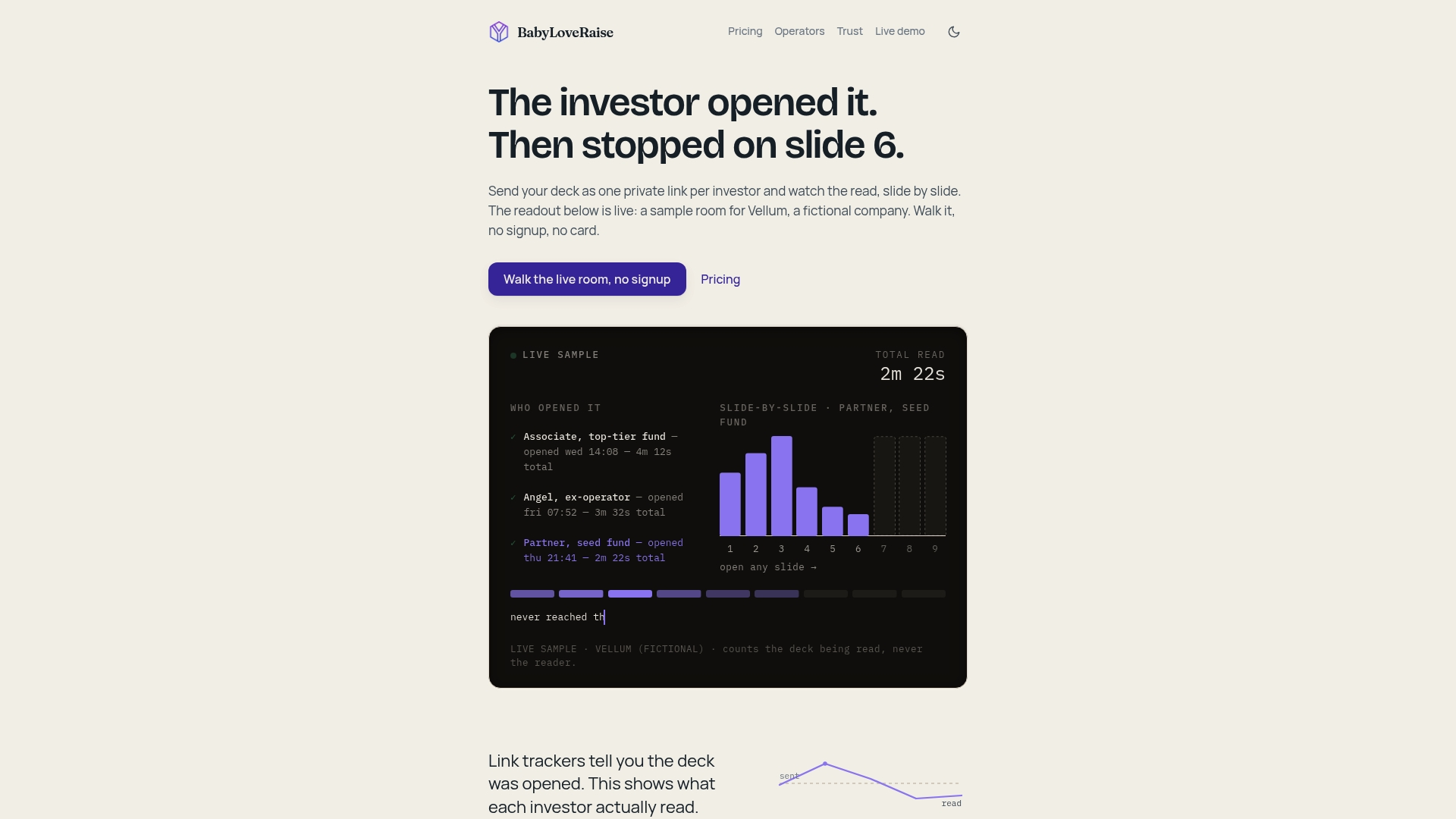
A hosted deck room closes that gap. With a BabyLoveRaise raise room, you send one link instead of a PDF or a Drive file. The room notifies you on first read and records engagement slide by slide. The owner dashboard shows who opened the deck, who read to the last slide, and which slides held attention and which were skimmed.
Here is how to use it against what you now know about investor reading:
| What you see | What it likely means | What to do |
|---|---|---|
| Never opened | The email or intro didn’t land | Resend through a warmer route or tighten the subject line |
| Opened, left after slides 1 to 2 | Fit or clarity problem in the opening | Rewrite the first two slides so customer, product and edge are obvious |
| Long time on traction, quick exit after | The numbers drew a read but did not convince | Rework the chart and the stated cause of growth |
| Read to the last slide | A real read | Follow up with a specific question or a meeting request |
| Same slide skimmed by many investors | A weak slide in your deck | Revise it before the next batch goes out |
Per-slide dwell time is a useful stand-in for something solo founders lack: a cofounder who reads the deck cold and says where they got lost. It is a signal about the document, not a verdict, and a quick skim can also mean the slide is simply clear. Use it to find patterns across several readers, then change the slides where attention dropped. Our walkthrough on running four deck tests in one sitting shows how, and the pitch deck benchmarks article gives you reference points for stage.
The room also offers three kinds of share link, for a first send, a forwardable link and a private one. That fits the reality above: your deck will be forwarded, so you can choose how each link behaves. Downloads can carry a measured watermark, and tracking reports on the document, not on the person.
What happens after a VC reads your deck
The path runs from deck to first meeting, to a deeper interview meeting, to diligence, to a check. Each step has one job, and the deck’s only job is the first. After a partner meeting, NextView’s Melody Koh says the team debriefs straight away, and the most common outcome is “interesting, but doubts about something”, which becomes the list of diligence questions. You should expect to hear from the lead partner within 24 to 48 hours with a clear yes, a clear no, or a request to do more work on a named issue.
Koh also says the lead partner is not automatically “in the bag”. Every new data point can strengthen or weaken conviction, so frame your follow-up answers to help your champion respond to other partners’ concerns. A founder who knows which slides an investor revisited before the meeting can prepare for exactly those questions. Our guide to investor meeting prep covers that.
Our view: the deck is a conversation you can’t hear
We built BabyLoveRaise around one observation. Founders spend weeks on a deck and then lose all feedback the second they hit send. Investors don’t owe you an explanation, and most won’t give one. The deck itself is the only witness.
We think a raise deserves its own tool, not a generic file share. Fundraising has a first-read moment, a last-slide moment and a target list of who finished the deck. That is why a room is priced per raise instead of per seat forever, and why we turn the room into a free permanent archive once the raise closes.
The point is not to watch investors. It is to stop guessing which silence you are in, and to put your next hour into the slides that lost people. If you want a human eye as well, our editorial pass is there for that.
Paul
Put it to work on your raise
The raise room costs $399 per quarter or $149 per month. It gives you the first-read notification, per-slide engagement, three link types and an archive once the raise ends. If you would rather have a hands-on edit before you send, the editorial pass is listed on the same page. Firms running several client raises can look at the Operator seat, at $399 per month per seat or $3,990 per year per seat.
Before you send: a short checklist
- Can a stranger name your customer, product and edge after three slides?
- Does the traction slide work as the first slide someone lands on?
- Are numbers monthly, with defined revenue and absolute values next to percentages?
- Is your market size bottom-up, with the method visible?
- Does the team slide give one concrete reason this team wins?
- Does the deck have a clear ask: amount, stage and what the money buys?
- Does it read cleanly on a phone, with no one narrating it?
- Have you chosen a share link that matches how the deck may be forwarded?
For more depth, see our investor reading patterns article and the full pitch deck strategy guide.
FAQ
How long do VCs spend reading a pitch deck?
Published estimates cluster around two and a half to three minutes per deck. Viktori reports 2 minutes 24 seconds in 2026, and the Norwest stat is 2 minutes 47 seconds. Warm-intro decks get a longer read than cold ones.
Do VCs read a deck in order?
Not always. Many jump to traction and the team before the problem slides. Design every key slide so it makes sense on its own, and put the customer, product and edge near the front.
Which slide matters most?
It depends on stage. Keelan says traction is usually the most impactful slide after seed, while at the earliest stage the team slide carries more weight. Competition and how money flows through the company also draw extra attention, according to CRV.
How do I know whether an investor actually read my deck?
Send it through a hosted room instead of an attachment. A BabyLoveRaise room notifies you on first read and shows which slides each reader viewed, so you can tell an unopened deck from a finished one.
Sources
- Norwest’s Lisa Wu explains how to think like a VC when fundraising (TechCrunch)
- How VCs Actually Evaluate Your Pitch Deck (Viktori)
- What a VC is Thinking About When They Read Your Pitch Deck (Octopus Ventures)
- What VCs actually read in a startup deck (raisemoney.ventures)
- Lightspeed’s Gaurav Gupta and Grafana’s Raj Dutt on pitch decks (TechCrunch)
- What Investors Look for in a Seed Pitch (CRV)
- Raising your first round: What early-stage VCs actually look for (Pear VC)
- I reviewed 1,000+ pitch decks: the most common fails (TechCrunch)
- How to get into Y Combinator, according to Dalton Caldwell (TechCrunch)
- How Decisions Are Made After The Partner Meeting (NextView)
- Scaling AI Agents: Pilot to Enterprise