
48 Hours to Follow Up With Investors Who Read Your Deck
Learn when to follow up after a pitch, how to rank investors by deck opens and slide reads, and how BabyLoveRaise signals can guide each next step.
October 14, 2026 · 11 min read

Send your first follow-up promptly after the meeting, and prioritize investors who opened your deck, read to the final slide, or asked a specific question over anyone who stayed silent. Pair that speed with one clear ask, a meeting time, a piece of feedback, or a requested document, so every message moves the conversation forward instead of just checking in.
TL;DR:
- Send the first note within 24 to 48 hours, then add new information after 3 to 7 days if the investor has not replied.
- Partner meetings, stated investor deadlines, and competing offers shorten the cadence; follow requested timing, and tell other investors when an offer sets a clock.
- Use a tracked deck link, answer outstanding questions, attach requested materials, and propose two meeting times in a personalized note of three to six sentences.
- Prioritize investors who read through the deck, asked specific questions, or requested a partner meeting; hold back from nudging investors whose decks remain unopened.
- Make each later touch useful with fresh evidence; send monthly updates to engaged investors, then pause after about two months of silence.
BabyLoveRaisebabyloveraise.comFollow Up With Investors Who ReadBabyLoveRaise tracks deck opens and per-slide engagement, helping you distinguish investors who read through from those who never opened your deck.Explore BabyLoveRaise
Table of Contents
- How often should you follow up with investors?
- What should your first follow-up include?
- How do you keep following up without annoying investors?
- Which investors should you follow up with first?
- How should you word a follow-up without sounding needy?
- How engagement data changes who and when you follow up
- Making follow-ups an engine of fundraising momentum
- How BabyLoveRaise supports faster, better-targeted follow-ups
- FAQ
- Sources
How often should you follow up with investors?
Investor memory fades fast. A founder who waits a week to send a thank-you note is competing against a dozen other pitches the partner has seen since. Firms that move quickly after a VC partner meeting often reach an internal decision within 24 hours, which means your window to add context or answer a lingering objection is short.
A cadence that works for most founders looks like this:
- First touch: within 24 to 48 hours of the meeting, with a thank-you, any promised materials, and one next step.
- Second touch: 3 to 7 days later, if there has been no response, with new information rather than a repeat of the first message.
- Third touch: 1 to 2 weeks after that, often shifting to a brief update rather than a direct ask.
- Ongoing cadence: monthly updates for investors still engaged, then a final note or pause after about two months of silence.
Three situations change this rhythm. A partner meeting compresses everything, since firms that convene the full partnership tend to move fast and may call within a day. An investor who gives you an explicit deadline or asks you to wait sets the schedule for you, and you should follow their stated timing over any generic rule. A live term sheet or competing offer also shortens every interval, since other investors need to know the clock is running.
Founders who treat fundraising as a long game, not a single sprint, tend to get better outcomes from this cadence. Stanford GSB’s research on fundraising describes it as a marathon that starts months before the formal raise, which means your follow-up habits are really relationship habits that started long before the pitch.
What should your first follow-up include?
The first message after a meeting carries more weight than any later one, so it needs to do five things in a short space:
- Open with a personalized thank-you that references something specific from the conversation, not a generic line.
- Attach a tracked deck link rather than a static PDF, so you know when it gets opened and how far the investor reads.
- Answer any outstanding questions from the meeting directly, even if the answer is “we don’t know yet and here’s our plan to find out.”
- Include requested materials such as a cap table, financial model, or reference list, named exactly as the investor asked for them.
- Propose one clear next step, ideally with two specific meeting times rather than an open-ended “let me know when works.”
A tracked link matters more than it seems. A raw PDF tells you nothing once it leaves your inbox. A tracked deck link tells you whether the investor opened it, how long they spent on each slide, and whether they forwarded it to a partner, which turns a guessing game into a decision you can act on.
A simple three-sentence structure covers most of this without feeling like a form letter: thank them and restate the one metric or story that landed best in the room, answer the specific question they raised or attach what they asked for, then ask for a fixed next step with two time options. Founders preparing for the meeting itself often find that the materials they get right beforehand are exactly what shortens this follow-up later.
How do you keep following up without annoying investors?
Every follow-up after the first one needs to carry something new. Repeating the same pitch with a different subject line reads as pressure, not progress, and investors notice.
- Add new evidence each time, whether that’s a revenue milestone, a notable new hire, or a warm introduction from someone they respect.
- Vary the channel when it fits, moving from email to a short LinkedIn message for a gentle nudge rather than a third identical email.
- Avoid copy-paste repetition, since a message that looks recycled signals that nothing has changed on your end.
- Match the content to the touch number: a short product update for touch two, a milestone highlight for touch three, a request for an intro or reference for touch four.
- Set a stop rule in advance, such as a final closing note after four touches or roughly two months, so you’re not chasing indefinitely.
A short monthly update works well for investors who are engaged but not yet ready to commit. A reusable update template with a consistent format makes this easy to sustain across a dozen or more relationships at once without reinventing the message every time.
The stop rule also doubles as a re-engagement trigger. If an investor goes quiet after your final note but later opens your deck again or responds to a public milestone, that’s a signal to restart the cadence, not evidence the relationship is dead.
Which investors should you follow up with first?
Not every investor on your list deserves the same effort on the same day. A simple tiering system turns a long, undifferentiated list into a short queue of calls to make this week.
- Tier A: read the deck to the final slide, asked a specific follow-up question, or requested a partner meeting. These investors get a same-day or next-day response and a direct ask for a call.
- Tier B: opened the deck, showed clear strategic fit with your sector or stage, but haven’t engaged further. These get a thoughtful second touch within the week, not a generic nudge.
- Tier C: never opened the materials or showed no sign of fit. These get a low-effort monthly update and little else until a signal changes.
Weight the signals rather than treating them as equal. An investor who read to the end and asked a question outranks one who merely opened the deck, and a request for a partner meeting outranks almost everything else on the list. This kind of triage is only possible when you can actually see who did what, which is where engagement data earns its place in the process rather than guesswork based on reply speed alone.
How should you word a follow-up without sounding needy?
Length and tone matter as much as timing. A good follow-up runs three to six sentences, states something specific, and never reads as anxious or apologetic for taking up the investor’s time.
- Keep it short, three to six sentences is usually enough to thank them, add new information, and ask for a next step.
- Reference something specific, a portfolio company they’ve backed, a question they raised, or an intro you can offer them in return.
- Make the ask concrete, two proposed meeting times or one specific piece of feedback you want, rather than an open “thoughts?”
- Stay appreciative, not eager, thank them for their time without implying you’re waiting anxiously for a yes.
Stanford GSB’s work on seed fundraising points out that investors respond to coachability and genuine fit as much as to the numbers, so a follow-up that shows you understood their feedback often lands better than one that just restates your pitch louder.
Pro Tip: End every follow-up with a single question that’s easy to answer in one sentence, since a vague “let me know your thoughts” gets ignored far more often than a specific yes-or-no ask.
How engagement data changes who and when you follow up
Two silences look identical from an inbox: an investor who never opened your deck, and one who read every slide and quietly passed. Without visibility into which one you’re dealing with, founders either chase too hard or give up too soon.
Deck-level engagement data removes that ambiguity. Knowing that a partner opened the deck within an hour of your email, read to the final slide, and spent extra time on your financial model tells you to escalate to a direct call request. Knowing that attention dropped sharply on your competitive landscape slide tells you exactly what to address in your next message, a short clarification rather than a generic “just checking in.”
- Escalate to a call when a partner reads the full deck, since full reads plus a partner meeting ask often move fast.
- Send a targeted answer when engagement data shows attention dropped on a specific slide, addressing that gap directly instead of resending the whole deck.
- Hold back outreach when a deck has gone entirely unopened for more than a few days, since a nudge before anyone has even looked rarely helps.
Per-slide dwell time and read-to-end data turn an ambiguous non-response into a specific next action, which is the core idea behind using engagement signals to prioritize follow-ups rather than guessing based on reply speed alone.
Operationally, this means picking the right link type for the right moment. A first send to a new investor should be a standard tracked link, a forward to an associate or partner should use a forwardable link so you can see when it reaches someone new, and sensitive financial details are often better shared through a private link with a watermark. Logging each open, read-through, and slide-level pause into your pipeline, whether that’s a spreadsheet or dedicated investor tracking software, turns a pile of individual emails into a prioritized queue you can work through every morning.

Making follow-ups an engine of fundraising momentum
Follow-up discipline is what separates founders who close rounds from those who send one email and wait. The founders who raise fastest treat every open, every reply, and every slide-level pause as a data point, not a mystery, and they act on it the same day rather than the same week.
Part of that discipline is public, not just internal. Founders who publicly and specifically thank investors who gave useful feedback, even ones who passed, build a reputation that makes the next round easier to raise. Momentum compounds quietly, one well-timed message at a time.
— Paul
How BabyLoveRaise supports faster, better-targeted follow-ups
We built our platform around the problem this article describes: knowing who actually read your deck, and where their attention went. Instead of a static PDF, you send one link that logs first opens, read-to-end moments, and per-slide dwell time, so your follow-ups go to real readers, not guesses.
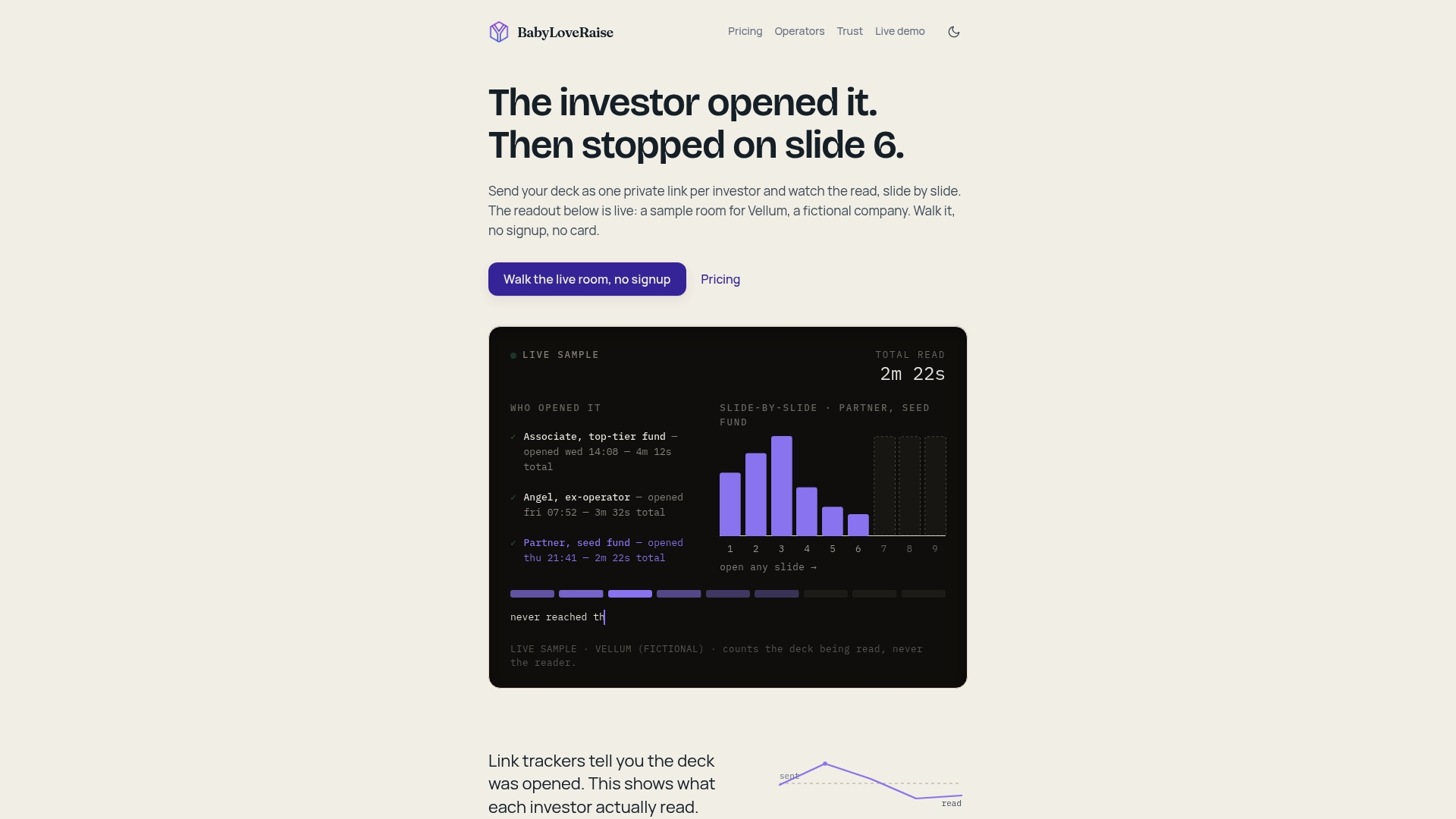
- Three share registers (first send, forwardable, private) let you match the link type to the moment, from a cold intro to a partner forward.
- Measured watermarking on downloads keeps sensitive materials traceable without slowing anyone down.
- An editorial pass gives you a human review of your deck before it goes out, and an Operator tier lets advisors run white-label rooms across client raises.
A raise room starts at $149 per month or $399 per quarter, and if you’re coordinating follow-ups around funding milestones with your finance team, it’s worth reviewing your financial strategy alongside your outreach plan. Visit our pricing page to set up a room for your next round.
FAQ
What is the 10% investor rule?
Some founders use informal rules of thumb about dilution per round, but these vary widely by stage and deal structure, so it’s worth confirming any specific percentage with your own legal and financial advisors rather than treating it as universal.
Who is the best investor to follow?
There’s no single “best” investor to follow since fit depends on your sector, stage, and the specific value an investor brings beyond capital. Prioritize investors who show clear strategic fit with your business and who engage directly with your materials, reading your deck fully or asking specific questions, over anyone with name recognition alone.
What should you avoid saying to investors?
Avoid vague, unverifiable claims about traction or market size that you can’t back up if asked a follow-up question. It also helps to avoid sounding desperate for a yes. Research on seed-stage fundraising notes that investors respond to coachable founders who show genuine fit, so defensive or overly eager language tends to work against you.
What is the best way to follow up with a potential investor after a pitch?
Send a short, specific message within 24 to 48 hours that thanks the investor, answers any open questions, and proposes one clear next step, like a specific meeting time. Prioritize investors who engaged with your deck or asked follow-up questions, and add new information with each subsequent touch rather than repeating the same message.
Sources
- Here’s what you can really expect when pitching your seed-stage startup at a VC partner meeting
- Fundraising: It’s a marathon not a sprint | Stanford Graduate School of Business