
Secure Financial Model Sharing for Fundraising Founders
How to share a financial model with investors without leaking it: clean the file, pick the right format, control access and read who actually opened it.
November 21, 2026 · 11 min read

The safest way to share a financial model is to send investors a controlled view of it, not the working file. Clean the workbook first, choose the most restrictive format that still lets an investor do real diligence, give each reader access that matches how far along they are, and watch who opens what. A model attached to an email loses all four of those controls the moment you press send. A raise room such as ours keeps them in one place: one link, a notification on first read, per-slide engagement, and watermarked downloads.
This guide is for pre-seed and seed founders, fractional CFOs, advisory firms and accelerators who send financial projections to people they do not fully know yet.
BabyLoveRaisebabyloveraise.comKnow Who Reads Your Fundraising DeckShare a raise room link, see first reads and per-slide engagement, and focus follow-ups on investors who actually read your deck.VisitTL;DR
- Audit the file before sharing. Hidden sheets, named ranges, comments and document properties travel with the workbook.
- Start with the most restrictive format that still allows diligence: a PDF or view-only version first, a detailed file only on a specific request.
- Tier access by investor stage: a first look gets no downloads, a serious reader gets more, and the full model goes only to those deep in diligence.
- Treat views as a signal. Per-slide time shows who read the financials and who stopped early, so follow-ups go to real readers.
- No tool stops a screenshot. Watermarks, tiered access and a clear record reduce the risk of copying and forwarding.
Table of Contents
- Why an emailed spreadsheet is the weakest way to share
- Step 1: Get the model ready before it goes anywhere
- Step 2: Choose the format: editable, read-only or PDF
- Step 3: Match access to how far the investor has come
- Step 4: Use NDAs and redactions with judgment
- Step 5: Watch the reading, not just the sending
- Step 6: Accept what no tool can promise
- What to do when the raise closes
- For advisers running many raises
- Promo
- Our perspective
- FAQ
- Sources
Why an emailed spreadsheet is the weakest way to share
A financial model is the most sensitive document in your raise. It holds your revenue drivers, your burn, your hiring plan and, often, the real numbers behind your pricing. An attachment gets forwarded to a partner’s associate, saved to a laptop and indexed by a mail server. You do not find out who read it, or whether anyone did.
Founders also get the opposite problem. You send the model, hear nothing for two weeks and cannot tell whether the investor never opened it or read it and passed. Those two silences call for different next steps, and a plain attachment cannot tell them apart.
So secure sharing has two jobs: limit what leaves your hands, and learn what happens after it does.
Step 1: Get the model ready before it goes anywhere
Security starts with the file, not the sharing tool. Two kinds of preparation matter here: making the model credible and making it clean.
Make it defensible
An investor who finds a broken formula in the first five minutes will not trust the rest. A guide to fundraising models from Assetica suggests reconciling to 12 to 24 months of actual management accounts or audited financials, building revenue from drivers such as leads, conversion, deal size and churn, linking the three statements by formula, and running base, upside and downside scenarios. It also advises sizing the ask to the downside case’s peak funding gap plus a buffer.
A few mechanical checks catch the most embarrassing errors: opening cash should equal the prior period’s closing cash, the balance sheet should balance, and financing should show up only on the date you assume it arrives. Inflection CFO’s playbook adds a separate assumptions section and at least three scenarios, because investors will run their own sensitivity analysis anyway.

Make it clean
This is the security half. SecureTools.live recommends auditing for hidden content before sending: hidden worksheets, named ranges, workbook connections, cell notes, pivot caches, embedded objects and document properties. Each can carry customer names, old versions of your numbers or an author’s comments.
Two habits help:
- Strip everything the investor does not need to judge the business. Aggregate customer-level data into cohorts or segments, and remove salary lines for named individuals if a headcount-by-role view tells the same story.
- Have someone who did not build the model do the final review. The builder rarely sees their own leftovers.
If you are a fractional CFO or advisory firm, make that second review a standing step for every client raise.
Step 2: Choose the format: editable, read-only or PDF
The question founders ask most is whether to send the live spreadsheet. The practical answer is to offer the most restrictive version that still permits real diligence.
SecureTools.live notes that a flat PDF export is enough for reviewing headline projections, while a working spreadsheet may be needed for sensitivity analysis. Its advice is to keep a more detailed file in reserve for specific follow-up requests, and, if an editable workbook is unavoidable, to strip unrelated data, label the file’s status and document the transfer.
That gives you a simple ladder:
| Stage | What the investor gets | Why |
|---|---|---|
| First look | Summary pages of the model, view-only | Enough to judge the shape of the business |
| Engaged review | Detailed projections and scenarios, view-only or watermarked PDF | Lets them test your logic without a copy of the working file |
| Serious diligence | Fuller financials and, on request, the working file | Reserved for investors who have shown real intent |
Most seed investors want to see your assumptions and scenarios, not every cell. Give the working file when someone asks for a specific analysis, not as the default.
Step 3: Match access to how far the investor has come
The strongest idea in data room practice is that not every reader should see the same thing. Glencoyne’s virtual data room guide describes four tiers: an initial look with no downloads or printing, engaged review with view-only access to a detailed folder, serious intent or a signed NDA with full financials and the cap table, and specialist diligence limited to a single folder.

It also describes dynamic watermarking, which overlays each page with the viewer’s name, email, IP address and time of access. Its middle-ground suggestion is to permit downloads, but of watermarked PDFs, so investors keep convenience and you keep a trail.
The same logic applies to the documents around the model. A public-sector example of investor data room guidance from the City of Detroit lists profit and loss statements, financial projections, an asset register, audits, the cap table and pro-forma statements as financial documents to include. It also advises regular access check-ups and releasing documents by fundraising stage rather than all at once.
How this maps to a raise room
Our share links come in three registers: first send, forwardable and private. They line up with the tiers above. A first-send link goes to a cold or new contact. A forwardable link suits an investor who needs to pass your material to a partner. A private link is for the reader you do not want to see it travel. Downloads can carry a measured watermark. We wrote a walkthrough on pitch deck access control for investors that goes deeper on setting these up.
Step 4: Use NDAs and redactions with judgment
Founders often reach for an NDA first. Many early-stage investors will not sign one before a first meeting, so insisting can cost you momentum. A more practical approach is to decide what is safe to show at each stage, and to redact or aggregate the rest. Customer names, supplier terms and named-employee compensation rarely need to be in a first-look version of the model. We lay out the thinking in our piece on redacting investor documents with raise room controls.
If your raise involves securities, talk to your startup counsel about what you can say and to whom. The rules differ by exemption and by how you find investors, and that is a legal question, not a file-sharing one.
Step 5: Watch the reading, not just the sending
Once the model is out, security turns into a visibility problem. Glencoyne frames audit trails as an engagement signal, not only a security feature. A partner who spends 45 minutes on the financial model and 20 on go-to-market is showing serious interest, while a dozen investors who never opened the financials point to a follow-up or pitch problem.
That gives you two actionable states in place of one silence:
- Never opened it. Your email subject, timing or the introduction was the problem. Resend or ask your introducer to nudge.
- Read to the end and passed. The deck or the numbers did not land. Look at the slides where attention fell off and revise.
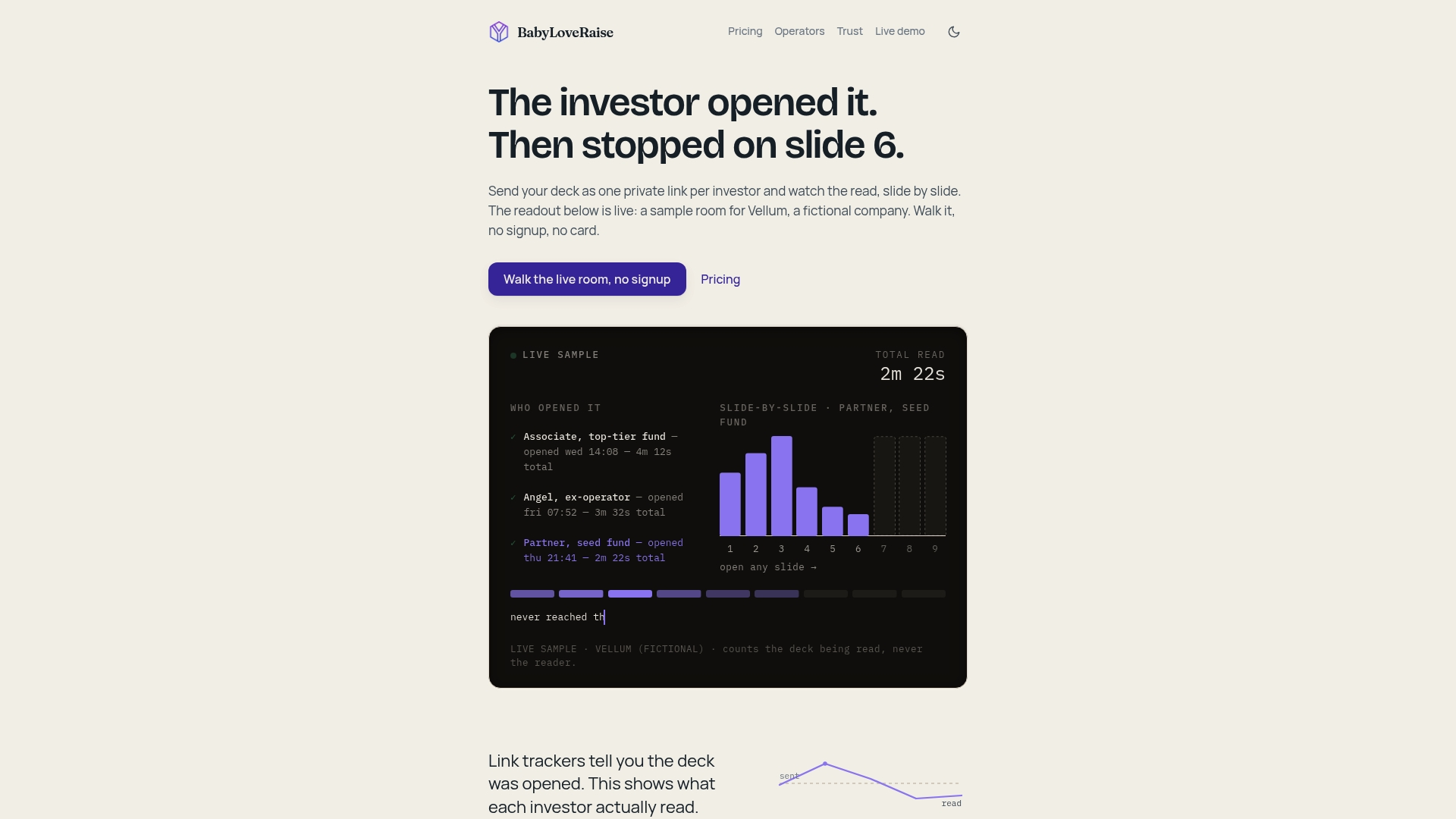
In our raise room, you are notified on first read and see per-slide engagement: who opened the deck, who reached the last slide, and which slides held attention or got skimmed. If your financial summary sits at slide 11 and every reader leaves at slide 9, the model is not your problem. Your story is. For a solo founder without a cofounder to read over their shoulder, that dwell data is a stand-in for the second opinion. See how this compares with a shared drive folder in our per-slide tracking comparison.
Step 6: Accept what no tool can promise
Anyone with screen access can photograph a screen. No sharing method makes copying impossible, so the goal is to make it costly, traceable and unlikely.
You can reduce the risk with a few habits:
- Send the least detailed version that will do the job.
- Use a link per recipient or per firm so a leak can be traced to a source.
- Watermark downloads with the recipient’s identity.
- Use the private link register for your most sensitive material.
- Review who has access on a regular schedule, and close what is no longer needed.
- Keep a record of what you sent, to whom, and when.
We also think tracking should be honest. Our tracking register reports on the document, not on the person: it tells you how a deck was read, not who the reader is as an individual.
What to do when the raise closes
The closing of a round is a security moment too. Links sent in January should not still work in December by accident. Our rooms convert to a free permanent archive when the raise closes, so you keep a record of what you shared and who saw it without paying on an ongoing basis. For how long to keep a room open before and after a raise, read why a data room works best as an evergreen tool.
For advisers running many raises
If you manage several client raises as a fractional CFO or advisory firm, repeating this routine by hand across ten founders invites mistakes. Our white-label Operator tier lets firms run firm-branded rooms across their client raises. Operator seats are listed at $399 per month per seat or $3,990 per year per seat on the operators page.
Promo
If you are raising now, the raise room gives you the sharing controls above around your pitch deck: one link, first-read notifications, per-slide engagement and watermarked downloads. It is $149 per month or $399 per quarter, priced per raise rather than per seat forever. If you want a second pair of eyes on the story before it goes out, we also offer an editorial pass. See the pricing page for the plans.
Founders comparing tools can also read our guide to secure data rooms for startups and our general guide to securely sharing documents.
Our perspective
Most advice on sharing a financial model is written for a data room built for a company sale: dozens of folders, a deal team, weeks of diligence. A seed founder has none of that. You have a deck, a model, a few dozen investors and a very short window.
We built our raise room around that reality. What a founder needs most is not another folder tree. It is knowing what happened after they sent the link: did the investor open it, did they get to the numbers, where did they stop?
That is why we price per raise and not per seat forever, and why the room turns into a free permanent archive when you close. Your record of who saw what should not disappear behind a paywall the day you finish fundraising.
Share the least that lets an investor decide, watch how it is read, and widen access for the people who earn it.
Paul
FAQ
Should I send investors my financial model as an Excel file?
Not as a first send. Share a PDF or view-only version of the headline projections first, and keep the working file for investors who request a specific analysis. If you must send an editable workbook, strip unrelated data, mark its status and record who received it.
Do I need an NDA before sharing my model?
Not always, and early-stage investors often decline to sign one before a first conversation. A more reliable protection is to limit what you show at each stage, aggregate sensitive details and use traceable, watermarked links. Ask your startup attorney if your raise has specific legal requirements.
How do I know whether an investor actually read my financials?
Use a sharing method that records engagement per page or slide, not just that a file was opened. Time spent on the financial pages tells you far more than an open notification. In our raise room, you see who opened the deck, who reached the last slide and which slides were skimmed.
Can anyone stop an investor from forwarding my model?
No tool can fully prevent it, because a screen can always be photographed. You can reduce the risk with per-recipient links, watermarked downloads, a private link for the most sensitive material and a view-only first version of the numbers.
Sources
- How to Build a Financial Model for Fundraising (Assetica)
- Build a Startup Financial Model Investors Trust (Inflection CFO)
- Virtual Data Room Security: Practical Best Practices (Glencoyne)
- How to Share a Financial Model With Investors Securely (SecureTools.live)
- Investor data room guide (City of Detroit)