
The Venture Capital Process: Every Stage, Step by Step
How the venture capital process works for founders: fund structure, first meetings, diligence, term sheet and closing, plus how to track deck reads along the way.
November 25, 2026 · 13 min read

The venture capital process is a sequence of filters. An investor reads your deck, takes a first meeting, brings you to partners, runs diligence, issues a term sheet and then closes. At every stage the deciding question is the same: does this person get another conversation? Founders who know where they stand at each stage, and who actually read their deck, follow up on facts instead of guesses. That is why we built the raise room: one link for your deck that tells you who opened it, who finished it and which slides lost them.
BabyLoveRaisebabyloveraise.comKnow Who Read Your DeckShare one raise room link to see who opened your deck, who finished it, and which slides held their attention.VisitTL;DR
- Venture capital is money from a fund, invested as equity, in companies that could grow very fast and be sold or go public years later.
- The path runs from preparation and outreach through first meetings, partner meetings, diligence, a non-binding term sheet and closing. Plan for three months or more from preparation to money.
- Investors weigh the team first, then the business model, product and market. The deck’s job is to earn the next meeting, not to explain everything.
- The hardest part of the early process is silence. Knowing whether an investor never opened your deck or read it and passed changes what you do next.
- After closing, expect a board, regular reporting and pressure toward the next milestone.
Table of Contents
- How venture capital works: the money behind the meeting
- The stages of the funding cycle
- The venture capital investment process, step by step
- How long it takes
- What investors evaluate
- The two silences in your inbox
- Run your raise from one room
- After the money arrives
- FAQ
- Sources
How venture capital works: the money behind the meeting
To read an investor’s behavior, it helps to know where their money comes from. According to the SEC’s small business guidance, a venture capital fund is a private fund that typically invests in rapidly growing companies, is structured to last at least ten years, and usually takes equity such as preferred stock that stays locked in until a liquidity event like an acquisition or IPO.
The NVCA’s 2024 Yearbook explains the structure. A firm pitches asset allocators such as pension funds, insurance companies, family offices and endowments. They become limited partners (LPs, the people who supply the capital), and the firm becomes the general partner (GP, the people who decide where it goes). Capital is called down over time, and a VC typically reserves three to four times the initial investment for follow-on financing.
Three things follow for you as a founder:
- The fund needs outsized wins. Investors back many companies hoping a few return the fund. That is why they ask about market size and upside before anything else.
- Your stake is a bet on a later sale. Returns arrive when a company goes public or is acquired, as Stripe’s overview notes.
- Selection is brutal. The NVCA Yearbook, citing a 2016 study, reports that a firm considers roughly 100 opportunities for every company it invests in, and the median firm closes about four deals a year.
Those odds are the reason the early stages are so fast to say no. Your job is to make the yes easy to reach.
The stages of the funding cycle
A Congressional Research Service overview describes the usual progression: pre-seed funded mostly by founders, family, friends and angels; seed with early VC and angels; Series A as generally the first VC-dominant round; Series B for expansion; and Series C as late-stage money. Most VCs aim to exit through an IPO, with sales to companies or funds and SPAC mergers as alternatives.
Stripe’s guide puts typical sizes on this: seed rounds from $500,000 to a few million dollars to validate an idea or build a prototype, and Series A in the range of several million once there is a working product and early adoption. The process below applies to pre-seed through Series A, where most founders meet institutional investors for the first time.
The venture capital investment process, step by step
1. Prepare the materials before you contact anyone
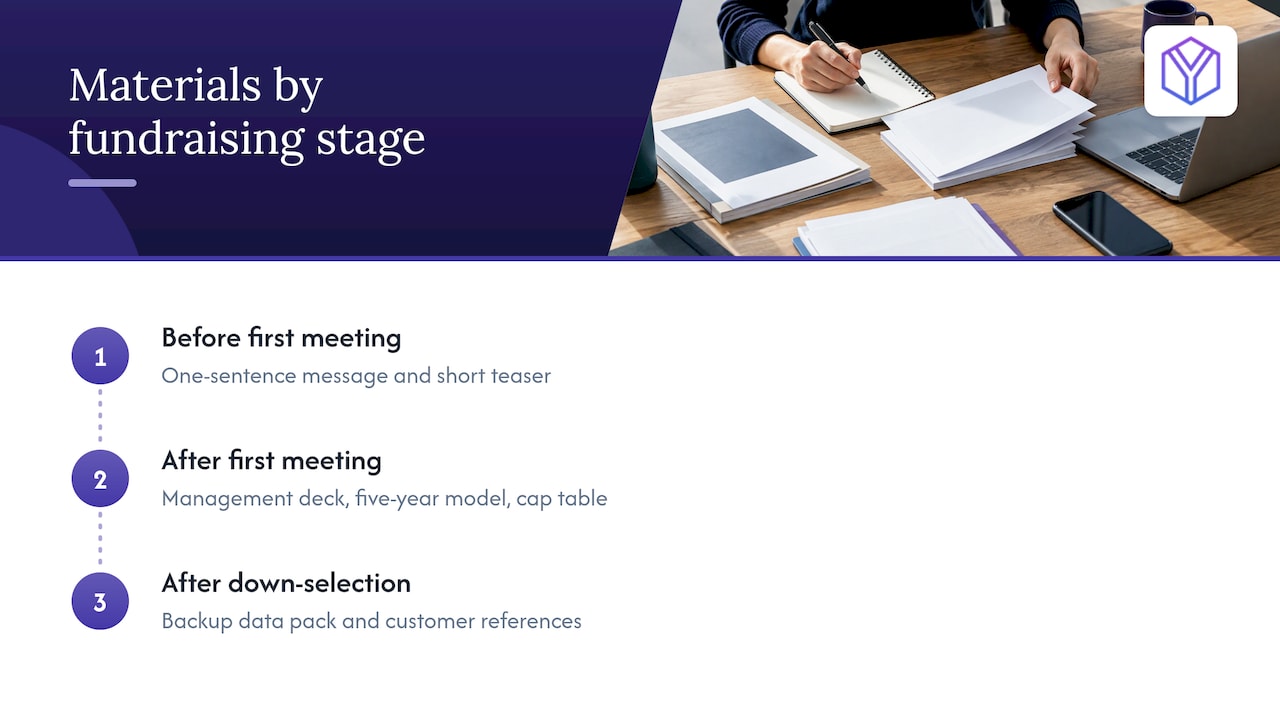
G2 Venture Partners’ fundraising playbook lays out a materials sequence. Before a first meeting, a one-sentence core message and a short teaser. After the first meeting, a longer management deck, a five-year financial model and a cap table (the table of who owns what). After investors are down-selected, a backup data pack and customer references. Budget two to three weeks for this preparation.
NYU’s entrepreneurship program advises treating the deck as a teaser, not a business plan. The single goal of the first meeting is to get the second one. Save the financial model, technical architecture and competitive analysis for later.
Where it goes wrong: a deck built to answer every question, sent as an attachment, with no idea who read it. The raise room is built for this step. You publish the deck once, send one link, and can choose between link types for a first send, a forwardable version and a private one. If you want a second pair of eyes on the story first, we offer an editorial pass, and our pitch deck strategy guide covers what the deck needs to do.
2. Build a target list and reach out
Open Core Ventures’ startup manual recommends contacting investors about three weeks before the meetings you want and scheduling all of them inside a two-week block, so term sheets arrive together. G2VP adds that firms you have talked to for months are primed when formal outreach starts, and that warm introductions beat cold ones.
So the list matters more than the email. Sort investors by stage, check size and sector fit, then track what each one does with your deck. Our guide to a 40 to 50 investor target list shows how deck engagement feeds that list: the room records which investors opened the deck and which read to the last slide.
3. The first meeting
The first meeting is short and often slide-free. The Holloway Guide describes it as a test of whether your problem and team are interesting enough for a second meeting. At seed, Open Core Ventures notes, typically only the CEO attends, while the CTO keeps building. The handbook also advises against attaching decks to emails and says sending one up to 24 hours before a meeting is fine.
That last point is where a link beats a PDF. A room link sent the day before tells you when the investor first reads it, so you walk in knowing whether they prepared.
4. Second and partner meetings
Per the Holloway Guide, the second meeting repeats the pitch to more of the team, ideally with your first contact acting as sponsor. The third is usually the partner meeting, where the formal pitch is delivered and the firm works through its open questions before deciding.
Here the deck gets forwarded internally. A forwardable link register lets you share a version meant to travel inside the firm, so the partner who never met you sees the same story the sponsor saw. Our investor meeting prep guide goes deeper on using read signals to prepare for each meeting.
5. Diligence
NYU states that institutional VC funds typically require four to six or more meetings across multiple partners over several months. Investors meet the team, review the data room, call customers and talk with portfolio companies. Follow-up meetings may bring updated decks, models, demos and references.
What gets checked depends on stage. Rubicon’s Readiness Ladder lists, at pre-seed, founder backgrounds and references, incorporation, the SAFE stack and cap table, IP assignment and 83(b) elections. At seed, customer calls, market claims and trademarks are added. Our due diligence documents guide walks through assembling these before an investor asks.
Diligence runs both ways. Wing VC’s founder docs frame the post-pitch stage as mutual selection, since you will be tied to whoever you choose for a long time. See our guide to reverse due diligence for how to vet a firm.
6. The term sheet
A term sheet is a non-binding proposal. Wing VC says it covers the investment amount, ownership stake, valuation, the securities offered, and special provisions such as board seats or veto rights. J.P. Morgan’s overview of venture capital adds terms like liquidation preference, participation rights and conversion rights, which significantly affect how value is split. The headline valuation is only one piece.
This is a point for a startup lawyer, not for guesswork. Alder VC recommends one who has closed rounds before.
7. Legal work and closing
After signing, investors’ accounting and legal teams cross-check your claims. Alder VC puts the stretch between term sheet and close at three to eight weeks depending on complexity and responsiveness; Wing VC says money typically arrives four to six weeks after the term sheet. Closing means signing the final documents, filing the restated charter and wiring funds, as Legal 500 describes.
In the United States, offerings to accredited investors under Regulation D are the most common approach for venture financings, and a Form D must be filed with the SEC after the first sale of securities. Your lawyer handles the filing and its timing.
How long it takes
G2VP says a raise takes three months or more from preparation to closing: two to three weeks of materials, three to four weeks of initial conversations, one to two weeks of term sheet negotiation and four to six weeks of post-term-sheet diligence. Open Core Ventures proposes a tighter seven-week seed schedule built on momentum, with first calls in week three and term sheets in week seven.
The lesson from both is the same. A raise is a campaign with a start and an end, not a drip of emails. Compress your meetings into a window, because competing interest is what moves investors from interested to committed.
What investors evaluate
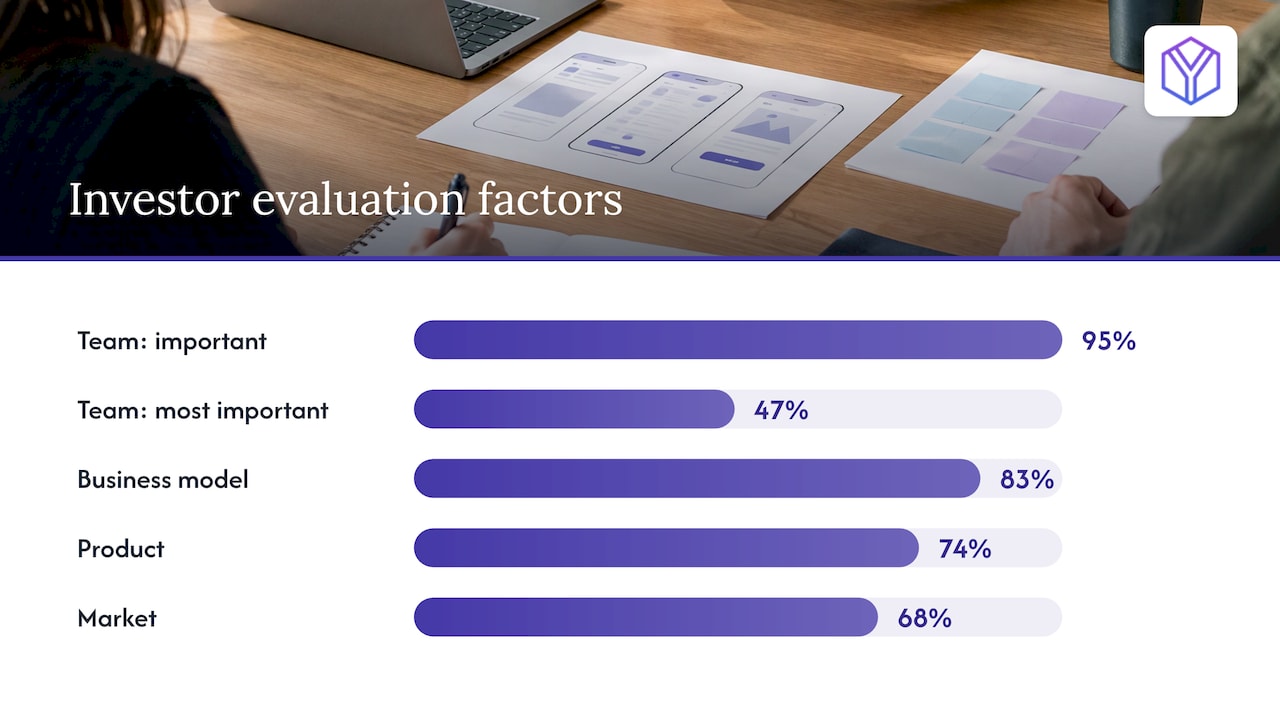
Rubicon, citing a 2020 survey of 885 institutional VCs, reports that the management team was named important by 95% of firms and most important by 47%, ahead of business model (83%), product (74%) and market (68%). Investors are first betting on you.
NYU’s Frank Rimalovski frames it as five P’s: Problem, Product, Potential, Progress and People, and says investors like to watch founders over time, ideally starting six to twelve months before a raise. Progress is what you can show in that period: customers, revenue, shipped product. Independent validation also strengthens a traction story, and third-party reviews for AI startups are one example of outside proof investors can check.
The deck’s part in this is narrow. It must make the team credible, the problem real and the market big, in a few minutes of reading. That is also why slide-level feedback is so valuable: you learn which of those claims lost the reader.
The two silences in your inbox
Most early rejections never arrive as a rejection. You send a PDF or a Drive link, and nothing comes back. That silence can mean the investor never opened it. It can also mean they read every slide and passed. The follow-up is different in each case, and an attachment cannot tell you which one you have.
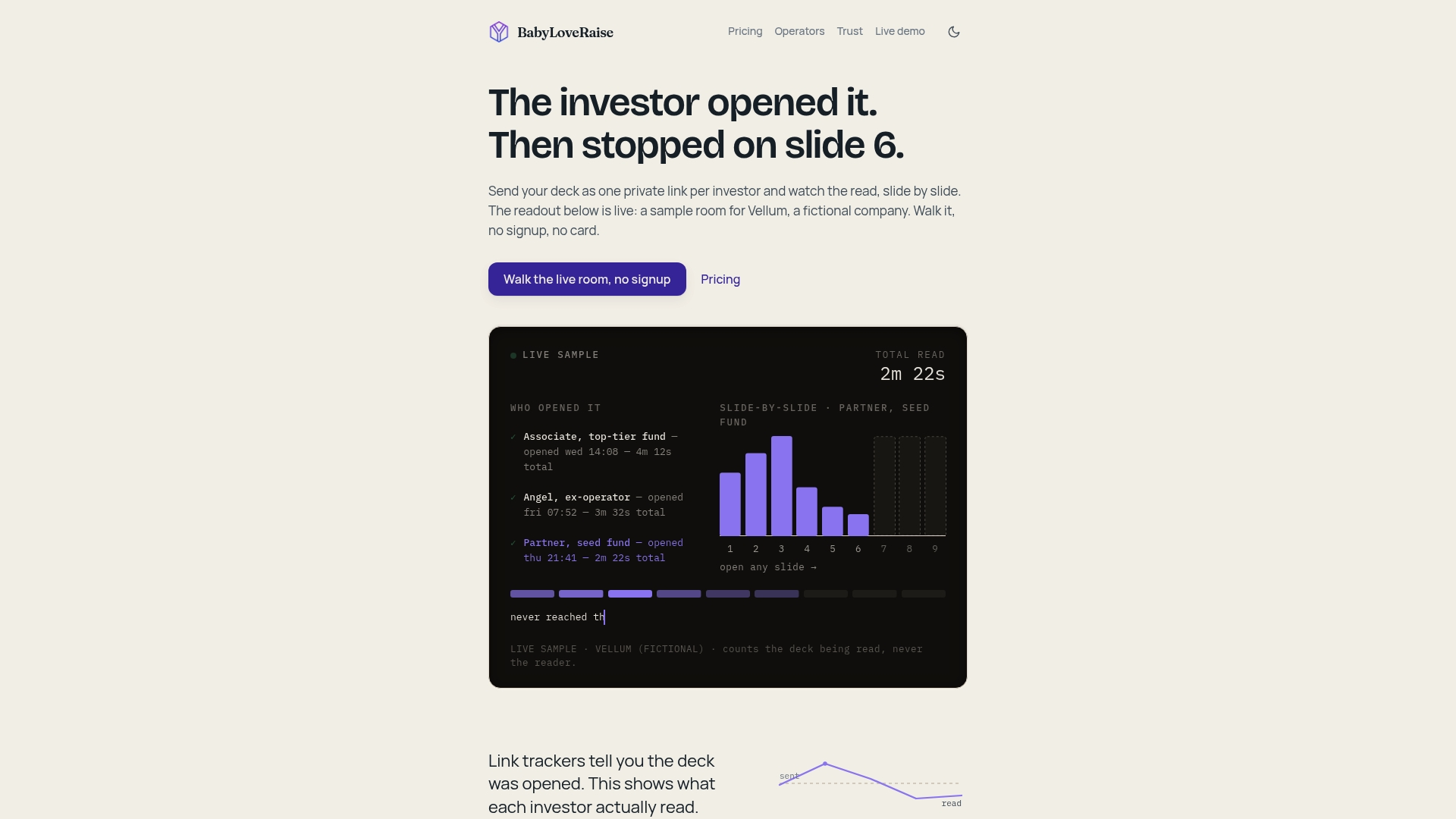
A raise room splits the silence into two states. It notifies you on first read and records engagement slide by slide: who opened the deck, who reached the last slide, which slides held attention and which were skimmed. That gives you two actions:
- Follow up with readers. An investor who read to the end is a live conversation. An investor who never opened it needs a different nudge or a different channel.
- Revise where attention died. If most readers stall on the same slide, that slide is your next edit, instead of a guess about what is wrong.
For a solo founder with no cofounder to ask, per-slide dwell time is the closest thing to a second reader. Our solo founder fundraising guide covers that case. The room reports on the document, not on the person, and when the raise closes it converts to a free permanent archive.
The raise room costs $149 per month or $399 per quarter, priced per raise rather than per seat forever. See the pricing page for details and the draft room and editorial pass options.
What we think
The venture capital process rewards founders who treat a raise as a short, managed campaign, and punishes the ones who send a deck into the dark. Investors see hundreds of companies for each one they back, so the deck gets minutes, and the follow-up gets a day or two of attention. Founders then spend weeks guessing which of those minutes worked.
We built BabyLoveRaise around that gap. A general file-sharing tool treats a fundraise like any other document. We treat it as a raise: first-read moments, per-slide attention, a list of which investors finished the deck, and pricing per raise instead of per seat forever.
Our view is that tracking should report on the document, never surveil the person. You should learn what your deck did, so you can improve it and follow up where interest is real, and you should keep the archive when the round closes. For advisory firms running many client raises, our Operator tier brings the same rooms under one firm-branded roof.
Paul
Run your raise from one room
If you are about to start outreach, the raise room gives you one link per investor type, a first-read notification and slide-level engagement for the whole campaign. Fractional CFOs and advisory firms can run firm-branded rooms across client raises with an Operator seat, listed at $399 per month per seat or $3,990 per year per seat on the operators page. Founders who want hands-on help can add an editorial pass on the deck.
Start on the pricing page and set up the room before your first email goes out.
After the money arrives
Closing is the start of a different relationship. The Equation Series describes a typical Series A board of two common seats and one investor seat, with most firms reviewing their portfolios quarterly. Information rights in the investor agreements typically cover annual and quarterly financials and an annual budget, according to M. Carter McKay.
In practice: set a monthly or quarterly update rhythm early, keep your numbers consistent with what you showed in diligence, and remember that each follow-on investment is a fresh decision for your investors. Our fundraising playbook and glossary of venture terms help with the vocabulary.
FAQ
What is the venture capital process in simple terms?
You prepare materials, reach out to investors, take meetings, go through diligence, negotiate a term sheet and close. Each stage is a filter, and most companies are screened out early. Plan for three months or more from preparation to funding.
How long does the venture capital investment process take?
G2 Venture Partners puts it at three months or more from preparation to closing. Some seed processes are run in about seven weeks when meetings are compressed into a tight window. Legal work between term sheet and close can take roughly three to eight weeks.
How many meetings does a VC need before investing?
NYU says an angel may commit after two or three conversations over a few weeks, while institutional funds typically need four to six or more meetings across multiple partners over several months.
Is a term sheet a guarantee of funding?
No. A term sheet is a non-binding proposal covering valuation, amount and governance, and the deal remains subject to legal and financial diligence. Money arrives only after the final documents are signed, so keep your lawyer involved and your other conversations warm until closing.
How do I know if investors actually read my deck?
Use a hosted link instead of an attachment. A raise room tells you when an investor first opens it and how far into the deck they got, slide by slide, so you can tell a missed email from a considered pass.
Sources
- SEC: types of early-stage investors
- NVCA 2024 Yearbook
- Congressional Research Service: venture capital operations and regulation
- Stripe: what is venture capital
- G2 Venture Partners: raising capital playbook
- NYU Entrepreneurship: from first pitch to first check
- Open Core Ventures: fundraising process
- The Holloway Guide: investor meetings
- Rubicon: the Readiness Ladder
- Wing VC: executing the raise
- J.P. Morgan: what is venture capital
- Alder VC: how the venture capital process works
- Legal 500: from first meeting to closing
- Legal 500: United States venture capital guide
- The Equation Series: how venture capital works
- M. Carter McKay: adding new investors after your seed round