
Post-Raise Investor Access: What to Share and What to Ask For
What investor access means after a pre-seed or seed round closes: what to share, how often, where to set limits, and how to keep the deck and room open.
November 17, 2026 · 13 min read

After the wire lands, “investor access” runs in two directions. Your investors get access to information about the company. You get access to their introductions, hiring help and judgment. Both work best when you set the terms in writing in the first two weeks, send one steady monthly update, and keep a single, permanent link to the deck and materials that investors read when they decided to back you.
This guide is for pre-seed and seed founders who have closed or are about to close, and for the fractional CFOs, advisors and accelerators who run those raises for others. It covers what to share, how often, where to draw lines, and how to use the access you now have.
BabyLoveRaisebabyloveraise.comKeep Your Raise Materials AccessibleBabyLoveRaise keeps your pitch deck in one room, then turns it into a permanent archive when the raise closes.VisitTL;DR
- Hold a short relationship call with each investor in the first week or two after close, and agree on cadence, how they can help and what keeps them engaged.
- Send a brief monthly update to every investor, with numbers first and a specific ask in each one. Save longer calls for quarterly moments with lead investors.
- Keep the deck and raise materials in one permanent place so investors can always find what they backed. Our raise room converts to a free permanent archive when the raise closes.
- Write down decision authority: what you decide alone, what needs board input, and what protective provisions in your documents require.
- Ask each investor for one specific thing at a time, and track who delivers.
Table of Contents
- What investor access means once the round closes
- The first two weeks: agree the terms
- Information access: the monthly update
- Material access: one permanent home for the deck
- Decision access: where investors get a say and where they do not
- Help access: asking for what investors can deliver
- For advisors, accelerators and studios
- Run the raise and the aftermath in one room
- FAQ
- Sources
What investor access means once the round closes
During the raise, access is simple: investors want your attention, and you control the deck. After close the relationship changes. The people who wired money now hold a stake, and most of them hold it passively. They have a portfolio, limited time and, if they are institutional, a duty to the investors in their own fund.
Harlem Capital, a seed-stage fund, puts that last point plainly: venture investors owe their limited partners an understanding of what is happening in portfolio companies, so surprises or silence do more damage than bad news. That is the practical core of investor access. Investors rarely need frequent contact. They need predictable contact, and they need no unpleasant surprises.
Tamar Ventures suggests a useful reframe: treat a new investor like a new hire. Set expectations, explain how you make decisions, and show them where they can add value. An investor activated early tends to become a champion. One left dormant tends to lose interest.
So post-raise access has four parts:
- Information access: what investors see, and when.
- Material access: where the deck, data and past updates live.
- Decision access: what investors have a say in, and what they do not.
- Help access: what you can draw from them.
The rest of this article takes them in that order, after the first two weeks.
The first two weeks: agree the terms
The moment after close is when expectations are cheapest to set. Tamar Ventures advises scheduling a call with each investor within the first week or two. The call is not about metrics. Its job is to agree on communication cadence, where the investor can be most useful (introductions, hiring, customer conversations, strategic advice), and what that investor needs in order to stay engaged.
A workable agenda for a 30-minute call:
- Cadence: monthly written update on a fixed day, plus a note when something significant happens.
- Channel: email for updates, a faster channel for urgent matters.
- Help: the two or three areas where you most need this investor, and the areas where you do not.
- Their needs: what they want to see in order to feel informed, and whether their fund reports to its own investors on a schedule.
Harlem Capital’s second post on the first 90 days adds the work behind the calls: define KPIs with investors, map runway and burn to the outcomes you want, ask for benchmarks, triage core needs and secure early wins. Those KPIs become the numbers at the top of every update.
If you have several small checks from angels and one lead, you do not need twelve identical calls. Hold a full call with the lead and anyone who is writing a large check or is clearly willing to help, and send the rest a short written welcome that states the cadence.
Information access: the monthly update
The update is the main channel. Yonder recommends monthly updates at pre-seed and seed, considering quarterly only after Series A. It suggests opening with a short summary and numbers, then highlights, lowlights, what is next, help needed and thanks to anyone who helped.
Length matters as much as content. TechCrunch’s guidance for seed and Series A updates is about 250 to 750 words, and it stresses that a consistent cadence is what builds trust. An update that takes two minutes to read gets read.
A structure that fits the evidence:
| Section | What goes in it |
|---|---|
| Headline | One sentence: the state of the company this month |
| Numbers | 5 to 8 metrics with the prior month, such as revenue, growth, churn, burn |
| Cash | Cash on hand, monthly burn, months of runway |
| Wins | Two or three specific, dated results |
| Lowlights | What did not work, named honestly |
| Asks | Specific requests, ideally with a name and a deadline |
| Thanks | Credit investors who helped last month |
Putting cash and runway in every update, even in a bad month, is the habit that protects you most. It tells investors you are not hiding a problem, and it gives them time to help before a problem becomes a crisis.
Tiered touchpoints
Not every investor needs the same contact. One practical way to split it, drawing on the pattern in Obapr’s investor relations guide, is three touchpoint types: a monthly written update to everyone, a quarterly 60 to 90 minute call with lead investors and advisors (materials sent 48 hours ahead), and ad hoc check-ins for major decisions, urgent problems or specific asks.
| Who | Monthly update | Call | Ad hoc |
|---|---|---|---|
| Lead investor | Yes | Quarterly, or monthly if agreed | Major decisions, urgent news |
| Other institutional investors | Yes | Quarterly if invited | Big wins, big problems |
| Angels | Yes | On request | When you need their expertise |
| Observer or advisor | Yes | Quarterly | As agreed |
Harlem Capital describes a similar seed-stage split: monthly meetings with lead investors, monthly emails to core investors and quarterly emails to all investors. Pick the version your lead investor expects and write it down.
Material access: one permanent home for the deck
Most founders spend the raise sending a PDF or a file-share link, then close the round and forget that those links exist. Months later an investor wants to re-read the deck before introducing you to a Series A fund, or a partner at their firm wants to see what was pitched. The link has expired, been switched off, or sits behind a plan you stopped paying for.
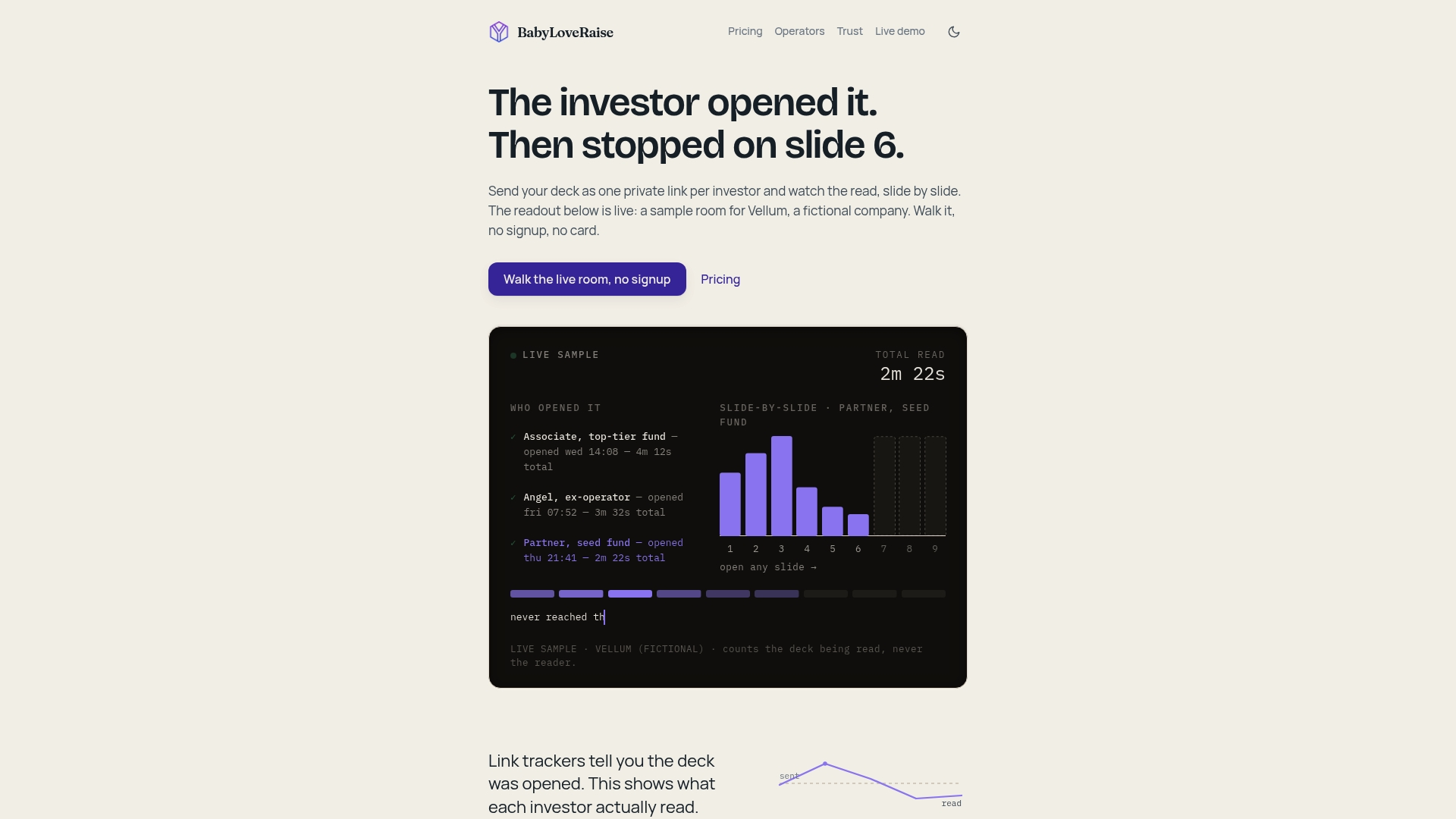
This is where the room you used during the raise matters. With BabyLoveRaise, you send one room link rather than a file, and the room notifies you on first read and records per-slide engagement. When the raise closes, the room converts to a free permanent archive instead of a paywall. Investors keep a stable place to find the deck they backed, and you do not have to rebuild it.
Two practical habits follow:
- Put the archive link in your welcome note and in the footer of every update. Investors then never have to search their inbox for the original deck.
- Choose the link type for the audience. Our share links come in three registers: first send, forwardable and private. After close, the forwardable register suits the investor who wants to pass your story to a colleague or a prospective co-investor, and the private register suits sensitive material meant for one person. Downloads can carry a measured watermark when you want to know a copy’s origin.
Our tracking reports on the document, not the person: which slides held attention and which were skimmed. That information is useful after close too. If you are circulating an update and want to know whether investors read to the last slide, our investor update template with engagement tracking shows a 15-minute way to build one, and our guide to investor update analytics explains what to track and how to read it.
Decision access: where investors get a say and where they do not
Information rights are not decision rights. Many first-time founders blur the two, and the result is either investors who micromanage or founders who discover too late that an action needed approval.
Two layers are worth separating.
Operating decisions are yours. Obapr’s guidance is to state decision authority before investors commit: seek board input on strategic matters such as major pivots, large hires and capital allocation, move quickly on day-to-day execution, and report results afterward. Saying so in the first call makes it a shared norm instead of a negotiation later.
Contractual decisions are set by your documents. The U.S. Securities and Exchange Commission’s Office of the Advocate for Small Business Capital Formation notes that at later stages investors may expect operational oversight, including board seats and greater involvement in strategy, and suggests founders consider whether an investor offers services beyond capital. At pre-seed and seed, that oversight usually comes through the agreements you signed rather than a seat at the table.
Two terms to know:
- A board observer attends meetings and receives materials but has no vote. Angel Investors Network notes that most angel rounds do not justify formal board seats until Series A and that stockholder agreements often grant observer rights instead.
- Protective provisions give a class of investors approval rights over named actions. 51percent’s founder control guide lists examples such as creating senior stock, amending preferred rights, a sale of the company, or debt above a negotiated threshold.
Keep a one-page list of every action that needs investor consent under your documents, and review it before any major move. Your lawyer is the right person to confirm what your own agreements say. Then the monthly update can flag upcoming consent items early, so approvals never arrive as a surprise.
Shared operating priorities help here too. Once everyone agrees what the next two quarters are for, most consent requests become routine. This startup growth playbook is a useful companion when you are turning post-raise goals into an operating plan you can show investors.
Help access: asking for what investors can deliver
Investor access is also an asset you have bought. Spend it deliberately.
Tamar Ventures lists the areas where investors tend to be most useful: introductions, hiring, customer conversations and strategic advice. The common mistake is the generic ask, such as “let me know if you know any engineers”. Specific asks get answered because they are easy to act on.
A better habit:
- Learn which investor is strongest at what. A lead may be a good sounding board on strategy while an operator angel can help you hire a first sales lead.
- Include a small number of precise asks in each update, with a name, company or role and a date.
- Ask each investor for one thing at a time.
- Note who delivered. Go back to those investors more often.
An ask in an update is easier to answer than an ask in a call, because the investor can forward it on. If your update is a room link, you can see which investors opened it and which slides they spent time on. Our guide to investor follow-up strategy shows how to follow up with the people who actually read.
Looking ahead to the next round
Post-raise access has a second job: it is the early stage of your Series A. Work-Bench advises working with your lead seed investor to vet a tiered list of Series A firms, pick a short list of favorites, and schedule first meetings two to three months after close, building toward a quarterly cadence ahead of a raise 12 to 18 months out.
The same discipline you used for the seed round applies: a target list with stages. Our guides on building a 40 to 50 investor target list and on investor pipeline stages carry over directly. Your seed investors’ introductions are the warmest path to that list, which is another reason to keep them well informed.
For advisors, accelerators and studios

If you run several raises, you hold the same problem multiple times: each founder needs a post-close routine, a cadence, and a permanent home for their materials. Standardize the first-two-weeks call agenda, the update format and the consent-item list across your cohort. Founders then close with a ready-made investor relations habit, and you can see across the portfolio who is communicating consistently.
Our advisor-led fundraising workflow describes how advisory firms prioritize investors by deck reads during the raise. The same rooms carry into the post-raise period.
Our view
We built BabyLoveRaise around a simple observation: a fundraise produces two silences that look identical. One is the investor who never opened the deck. The other is the investor who read everything and passed. Treating them the same wastes your follow-up and hides what to fix in the deck.
After the round closes, a third silence appears. It is the investor who wrote the check and now hears nothing. It looks harmless, and it is the one that quietly costs you the introduction you need in twelve months.
That is why we think the raise should leave something behind. The room that carried your deck during the raise should become a permanent, free archive, so that what investors backed is always one link away. It should report on the document, never surveil the person, so the relationship stays one of trust.
Pay for the raise, not for a seat forever. Keep the habit of reading engagement, because it tells you where attention goes. Then spend your energy on the part only you can do: telling your investors the truth, regularly, and asking them for one specific thing.
Paul
Run the raise and the aftermath in one room
If you are still raising, or about to, the raise room is our core plan: $149 per month or $399 per quarter. You send one link, you are notified on first read, and you see per-slide engagement and which investors reached the last slide. When the raise closes, the room becomes a free permanent archive.
Founders who want hands-on help can add our editorial pass. Advisory firms and fractional CFOs running several raises can look at the Operator seat at $399 per month per seat or $3,990 per year per seat. See the plans on our pricing page.
FAQ
How often should I update investors after a seed round?
Monthly is the common recommendation at pre-seed and seed. Yonder suggests moving to quarterly only after Series A, and TechCrunch emphasizes that a consistent cadence builds trust. Keep each update short and put the numbers first. If you have a lead investor, add a quarterly call.
What should I include in an investor update?
Start with a one-sentence headline and a small metrics table, then cash and runway, wins, honest lowlights and specific asks. Aim for roughly 250 to 750 words. Add a line thanking investors who helped, which encourages more help.
Do my investors get a board seat or observer role?
That depends on your documents. Many angel and seed rounds grant no formal seat, and some give an observer who attends and receives materials without voting. Check your stockholder or investor rights agreement, and ask your lawyer to confirm which actions need investor approval.
How do I keep investors able to find my deck after the round closes?
Give them one permanent link and repeat it in your welcome note and every update. Our raise room converts to a free permanent archive when the raise closes, so the link you shared during the raise keeps working.
When should I start talking to Series A investors?
Work-Bench suggests building a tiered list with your lead seed investor and scheduling first meetings two to three months after the seed closes, then moving to a quarterly cadence ahead of a raise 12 to 18 months out.
Sources
- Tamar Ventures: After the Wire
- Harlem Capital: First 90 Days After Your Seed Round, Part 1
- Harlem Capital: First 90 Days After Your Seed Round, Part 2
- Yonder: Startup Investor Update Template
- TechCrunch: How to write your monthly investor update
- Obapr: Startup Investor Relations Guide
- SEC Office of the Advocate for Small Business Capital Formation: What comes next after early-stage capital
- Angel Investors Network: Stockholders Agreement for Angel Investors
- 51percent: Founder Control After Seed
- Work-Bench: How to Handle VC Inbound After Raising a Seed Round
- Startup growth playbook