
Teaser vs Full Deck: What to Send and When
A teaser deck opens the conversation and a full deck advances it. See what goes in each, how long they run, when to send them and how to track reads.
November 10, 2026 · 12 min read

A teaser deck is a short, self-explanatory pitch whose only job is to earn a first conversation. A full deck is the longer, complete story you share once an investor has shown interest. Send the teaser to open a relationship. Send the full deck to move one forward.
Most founders get this wrong in one direction: they send the full deck to a stranger. The investor has no context, no reason to read 15 slides, and no way to ask a question. This guide covers what each document contains, how long each should run, when to send which, and how to keep both under your control after you hit send.
BabyLoveRaisebabyloveraise.comSee How Investors Read Your DeckShare your teaser and full deck through a raise room that shows who opened, finished, and where attention dropped.Explore the raise roomTL;DR
- A teaser is a few slides (some guides allow up to 10) that makes an investor curious enough to take a screening call. A full deck is the complete story, built to be read alone.
- The teaser leaves out detailed financials, deep competitive analysis and anything proprietary, because it will be forwarded.
- Send the teaser for cold outreach and warm intros. Send the full deck after a positive first conversation or when an investor asks for more.
- Share both through a tracked link so you know who opened, who finished and which slides lost attention.
Table of Contents
- The difference at a glance
- What belongs in a teaser deck
- What belongs in the full deck instead
- A third version: the deck you present live
- When to send which
- Keeping the teaser safe to forward
- Our perspective
- Reading the signals after you send
- Set up your raise room
- FAQ
- Sources
The difference at a glance
The two documents are not a long version and a short version of the same thing. They have different readers, different calls to action and different risks.
| Teaser deck | Full deck | |
|---|---|---|
| Job | Get a first meeting or screening call | Let an investor form a preliminary view of the deal |
| Typical reader | Someone who has never heard of you | Someone who has already engaged |
| Length | A few slides, up to about 10 at the outer edge | Roughly 10 to 20 slides, plus an optional appendix |
| Detail | Headline claims and one or two proof points | Market, model, traction, financials, ask |
| Ends with | An invitation to talk | Enough information to decide on a next step |
| Safe to forward? | Yes, by design | Share deliberately, to named people |
As TechCrunch’s Haje Jan Kamps puts it, the teaser’s purpose is to get a quick “no” from investors who aren’t really interested, which saves both sides time. A quick “no” is a feature. It leaves your calendar for the people who might say yes.
What belongs in a teaser deck
The teaser is a “look at me” document. According to the same TechCrunch guide, it is usually 3 to 4 slides, works like a one-pager, and is typically used by startups at the earliest stages. Because nobody is narrating it, it can carry more words per slide than a deck you present live.
A strong teaser covers:
- One-line description. What the company does, in a sentence a stranger can repeat.
- Problem and solution. Often a single slide.
- Traction. One or two numbers that prove something is happening: revenue, waitlist, pilots, growth rate.
- Team. The credibility signal, such as prior exits, domain experience or a notable employer.
- Market size. One credible figure, not a three-slide TAM exercise.
- The ask. Roughly how much you are raising.
Penn State’s Propel Business resource describes a teaser in similar terms: a summary of key company details, an elevator pitch, the opportunity, and the main aspects of market, products, customers, founder team, financial prospects and the investment opportunity.
The last slide should invite a call. Do not close with a wall of numbers. If the investor finishes the teaser wanting one specific thing, a conversation, you have built it correctly.
How long is too long?
Guides disagree on the exact count, and that is fine. TechCrunch’s July 2022 piece says 3 to 4 slides. Another TechCrunch guide by Andrew Gershfeld recommends a maximum of 10 slides for a teaser. The useful rule sits underneath both: if an investor cannot take it in during a short skim on a phone, it has stopped being a teaser.

The same Gershfeld article says a teaser should be self-explanatory and not need a narrator. Test yours by sending it to someone outside your industry and asking them to explain your company back to you in two sentences.
What belongs in the full deck instead
The full deck, sometimes called the email deck or investor deck, is built to be read without you in the room. It tells the whole story and answers the questions a thoughtful investor would otherwise bring to the first meeting.
It typically adds:
- Product detail. Screens, workflow, how a customer actually uses it.
- Business model and unit economics. How you make money and what each customer is worth.
- Go-to-market. How you will find and win customers, with what channels and what costs.
- Competitive landscape. Where you sit relative to the alternatives, described fairly.
- Financials and projections. Labeled clearly as projections, with the assumptions stated.
- Use of funds. What this round buys and what milestone it reaches.
- Appendix. Material that supports a claim without cluttering the main story.
Why hold these back from the teaser? Projections invite questions a slide cannot answer. A full competitor table invites an argument about one row. Use of funds only matters to someone already considering writing a check. Keeping these for the second stage is not secrecy for its own sake. It puts each detail where a conversation can handle it.
If you are deciding what the complete version should contain, our guide on what should be included in a pitch deck goes slide by slide. For the difference between a deck and a longer written document, see pitch deck vs. investment memo.
A third version: the deck you present live
There is a third document that causes confusion. Business Insider’s reporting on multiple deck versions recommends three: one to send before a meeting, one to present in person, and one to send in a follow-up. The main difference is how much detail each slide holds.
The same piece reports that WayUp cofounder Liz Wessel advises keeping the meeting deck light on text, because investors who are busy reading the screen are not listening to you. The email decks are the opposite: they have to make sense with no narrator.
That gives you a simple map:
- Teaser: read alone, short, public-safe.
- Presentation deck: spoken to, visual, minimal text.
- Full deck: read alone, complete, shared after the meeting or on request.
Three versions means version control matters. Our pitch deck version control guide covers how to keep them straight so a stale number does not reach the wrong investor.
When to send which
The sequence follows the relationship. Business Insider’s reporting on venture capitalist Mark Suster describes the advance email deck as a “teaser deck” that answers who you are, what you do, why you and the product are unique, and why the market is big. The meeting deck then covers vision, financial plans and how much you are raising.
Send the teaser when:
- You are emailing an investor who does not know you.
- A friend or fellow founder offers a warm introduction and the investor will want something to glance at first.
- You are passing material to an associate or scout who will forward it internally.
- You are responding on a platform or form that asks for a short summary.
Send the full deck when:
- A first call went well and the investor asks for more.
- The investor requests the deck directly after the teaser.
- An accelerator application asks for the complete story.
- A partner needs something to circulate before a partner meeting.
The typical cadence is a teaser, then a screening call, then the full deck, then further calls, and only later the heavier diligence materials. Do not skip steps to look generous. Handing a stranger everything at once tends to read as eagerness, and it removes the curiosity that makes someone reply.
A good cover email matters as much as the attachment. We wrote six teaser email templates for investors that you can adapt, each built around a link you can track.
Keeping the teaser safe to forward
A teaser will travel. TechCrunch’s Gershfeld says its role is far more public than a complete presentation: it should be something anyone can safely pass along through third parties. That is the design test. Before you send it, ask what happens if a competitor reads it. If the answer is “something bad,” the slide belongs in the full deck.
Practical habits:
- Show outcomes, not mechanics. “Cut onboarding from 14 days to 3” is a teaser line. The exact workflow behind it is not.
- Keep the model out. No spreadsheet, no customer names you do not have permission to share, no technical architecture.
- Label it. Calling the document a teaser or abbreviated deck tells the reader more will follow.
- Design it to be skimmed. Strong layout and clear imagery help a stranger grasp the point fast. These visual storytelling tips apply directly to a short deck that has to land without you.
- Control the full deck’s access. Share it with named people, and decide whether downloads are allowed. Our walkthrough on pitch deck access control for investors covers the setup.
If your full deck includes projections or a statement about the offering, talk to a securities attorney about the disclaimer language before it goes out. Rules on how startups may offer securities are specific to your situation and your state, and a lawyer who knows your round should write that language, not a template.
Our perspective
Founders usually treat the teaser-versus-full-deck question as a design question. We think it is a visibility question.
When you email a PDF, you learn nothing. An investor who never opened it and an investor who read every slide and passed look exactly the same: silence. That makes the two-stage approach hard to run, because you cannot tell when someone is ready for the next stage.
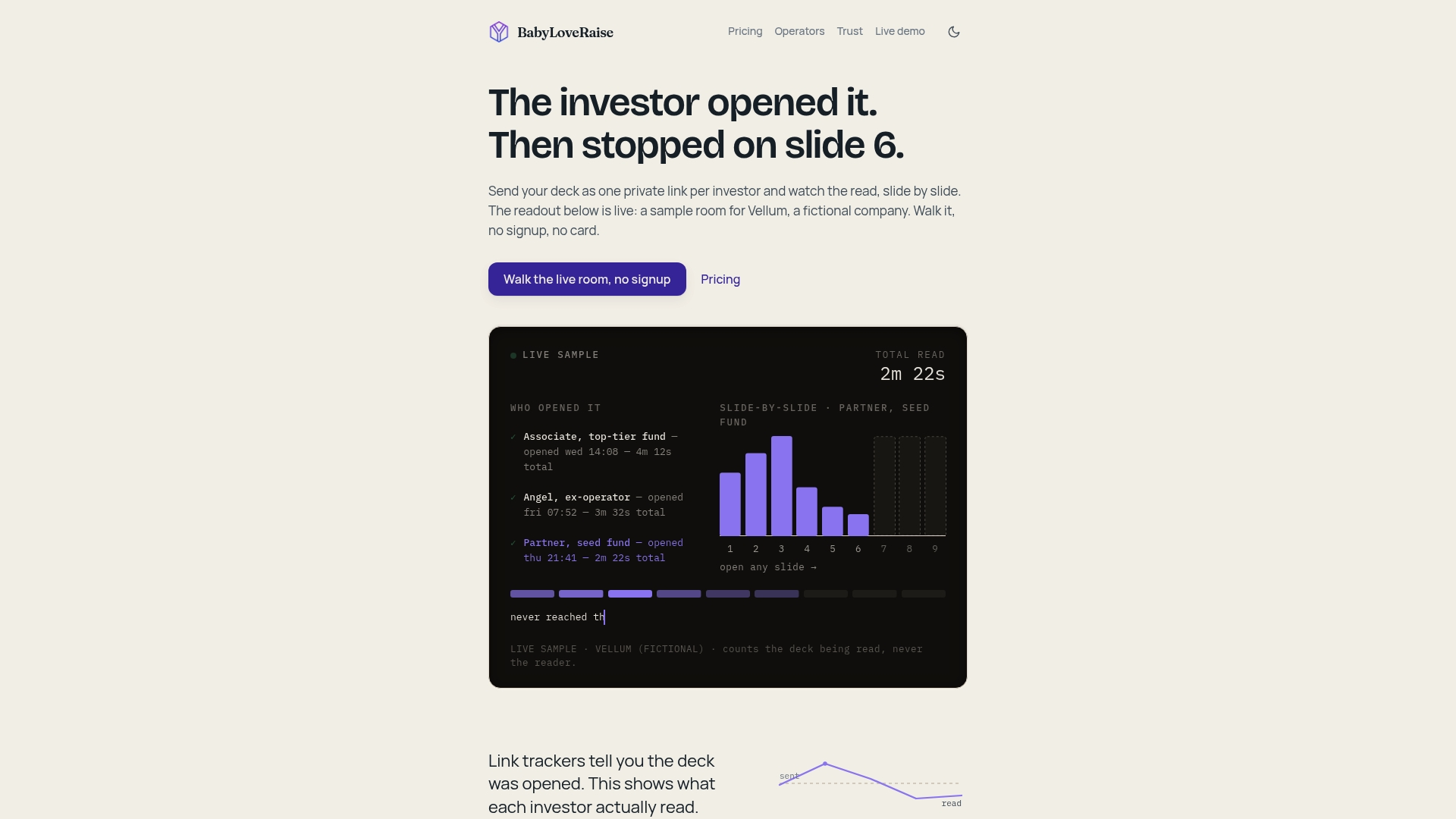
This is why we built BabyLoveRaise around the raise itself. You send one room link. You are notified on the first read. Per-slide engagement shows who finished the deck and which slides were skimmed. A teaser that gets opened twice by an associate and forwarded is a different signal from a full deck that gets abandoned on the financials slide, and each calls for a different follow-up.
Share links come in three registers: first send, forwardable, and private. That maps well onto the teaser, the deck you expect to travel, and the version meant for one person only. When the raise closes, the room becomes a free permanent archive.
Our advice: keep the teaser short, keep the full deck complete, and let the reading behavior tell you which one to send next.
Paul
Reading the signals after you send
Two-stage fundraising only works if you can tell when to move from stage one to stage two. Tracking gives you that.
Here is how the signals usually map to action:
- Opened, read to the end, no reply. Follow up once, reference something specific, and offer a short call.
- Opened, dropped off early. The opening slides may not be doing their job. Revise the first three slides before the next batch of sends.
- Never opened. Try a different subject line or send time, or ask your introducer to nudge.
- Opened by several people. The deck is being forwarded internally. Consider whether to send the full deck to the person who first engaged.
Per-slide dwell time is the closest thing a solo founder has to a cofounder’s read. If most readers stall on the market slide, that is a revision target. Our guide to pitch deck analytics goes deeper on reading these patterns, and the investor target list guide shows how to turn engagement into a ranked list of who to call. If you want to rehearse for the conversations that follow, see investor meeting prep.
Tracking should report on the document, not surveil the person. Treat it as a way to time your follow-up well, and never as a reason to pressure someone who has not replied.
Set up your raise room
If you are about to send your first teaser, set up the room before the first email goes out. The raise room is $149 per month or $399 per quarter. It gives you one link per deck, a first-read notification, per-slide engagement and the three share-link registers described above. When your raise ends, the room becomes a free permanent archive.
If you want a second pair of eyes on your teaser before it goes out, we also offer an editorial pass. See current pricing and plans. Advisors and fractional CFOs running several raises at once can look at the Operator seat, which supports firm-branded rooms across client raises. Our pitch deck strategy guide and pitch deck examples are good companions while you draft.
FAQ
Is a teaser deck the same as a one-pager?
They do the same job but in different formats. A teaser is a few slides, while a one-pager is a single page. Some founders send the one-pager first and the teaser deck second, and both exist to get a conversation rather than an investment.
Do I need a teaser if I already have a full deck?
If you are reaching out to investors who do not know you, yes. A shorter document asks less of a stranger’s attention, and it is safe to forward. You can build it from your existing deck by keeping the problem, solution, one traction proof, the team and the ask, and removing the rest.
Should I ask investors to sign an NDA before sending the full deck?
Founders are often advised not to, because most investors will not sign one at this stage and asking can slow the conversation. Instead, keep the most sensitive details out of both decks and share the full deck through a link you control. If your deck contains material that needs legal protection, ask a startup attorney what is appropriate for your situation.
Can I send the full deck if an investor asks for it right away?
Yes. If an investor asks, send it. An investor who requests more information has moved to the next stage on their own. Share it through a tracked link so you can see whether they read it and follow up at the right moment.
Sources
- You may need more than one pitch deck, TechCrunch
- How to make a teaser trailer for your startup pitch, TechCrunch
- Raising Venture Capital: Have Multiple Versions of Your Pitch Deck, Business Insider
- Startup Funding Documents, Propel Business, Penn State
- Visual storytelling tips